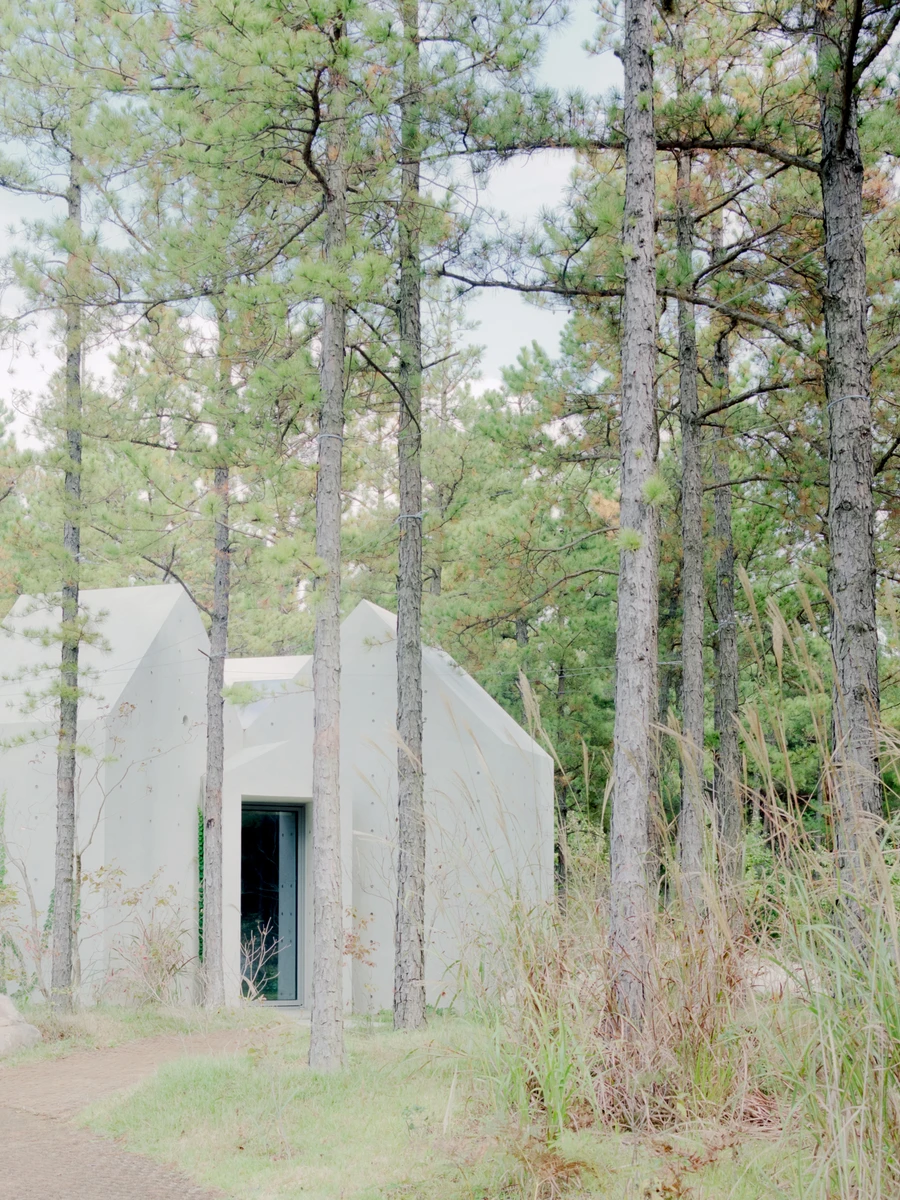
In Sayuwon — a private park in Daegu, South Korea, open to the public since 2020 — Andrea Liverani designs two small buildings for the most ordinary human need, and makes them carry the weight of an architectural meditation on the sacred and the profane.
Sayuwon is an unusual place. Since 2013, the park's founder Yoo Jaesung has invited selected architects, artists, landscapers, and designers to contribute works that enter into dialogue with the natural landscape. The site opened to the public in 2020, and what visitors find is a contemplative environment where architecture and art are distributed across a terrain of trees, water, and cultivated ground — each building existing in relation to the others and to the land, rather than asserting itself independently.
The brief for Liverani was spare: two small toilet buildings, using concrete and brick as the primary materials, fully functional but also symbolic, evocative. The client asked for buildings that would not merely serve a utility but would embody something. Liverani's response was to organise the pair around a duality — Sacred and Profane — that he positions not as opposition but as dialogue. These are, in his framework, two modes of human existence that coexist within everyday life, and the two structures enact this coexistence spatially.
The Sacred building is a black-brick monolith — a perfect 4.8 by 4.8 metre cube that radiates what the architect describes as "austerity and spirituality." Its essential geometry invites contemplation. Inside, ascetic spaces in exposed concrete play with varying ceiling heights from two to four metres, generating sensations of compression and upward thrust. Small square windows placed near the ceiling filter a subdued, focused light — the kind of light that makes a room feel like it is held, not merely enclosed. The Profane building counterpoints this rigour with a more open, humanly scaled spatial experience: warmer in material, oriented toward the park and the natural world, acknowledging its service function without concealing it.
Photographed by Simone Bossi, whose own visual sensibility tends toward the contemplative and the precisely framed, the buildings gain an additional layer of restraint. In the images, the pine forest presses close. The light falls at angles that make the geometry exact. These are very small buildings doing large conceptual work — and in a park whose entire premise is that architecture and landscape might think together, Liverani's pair of toilets arrives as exactly the right kind of contribution: serious, modest, quietly extraordinary.