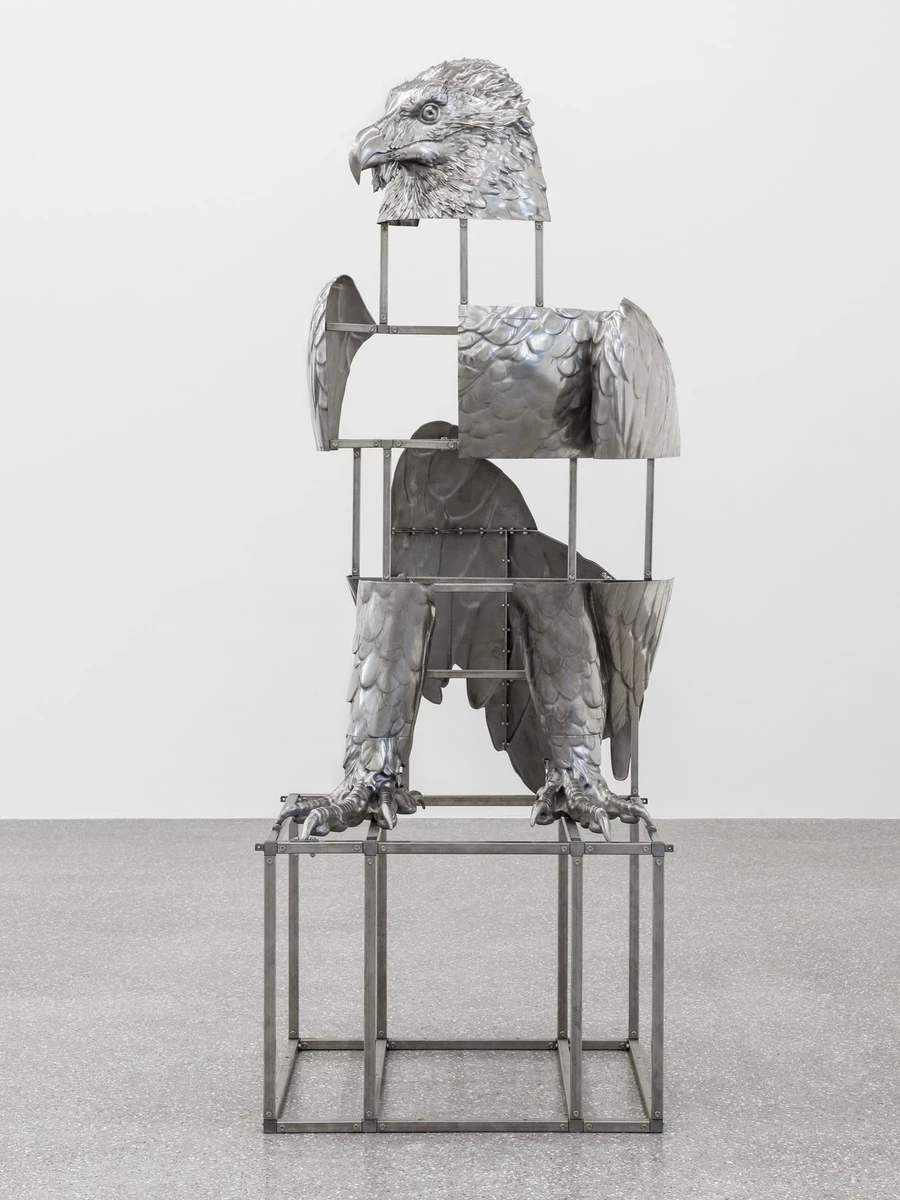
In Klaus, a village in Austria's Vorarlberg, Oliver Laric fills Galerie Brugger with sectioned aluminum animals whose steel supports carry what the bodies leave out.
At the center of the main hall, an eagle in cast aluminum stands on a welded steel cube, taken apart like a model kit. Head, wing shells, tail and talons hold their positions in midair, each section pinned to a thin armature that bridges the missing body. The polish mirrors the grid of tube lights overhead, and the gaps are modeled as precisely as the feathers. Around it the rooms stay cold and exact: white walls, gray terrazzo, aluminum-framed doors opening onto a forecourt.
The exhibition text reaches for Kant's parerga, the borders, draperies and colonnades that "belong to the work while being subsidiary to it", and for Derrida's reply that the line between artwork and accessory never holds. Laric takes the argument literally. Roman copyists added struts and tree trunks to keep marble versions of bronze originals upright; here the support is promoted to subject. A ram's hindquarters dissolve into bent-wire grid, another body resolves into perforated mesh, and a human figure clings beneath a ram's belly in a pose lifted from Odysseus escaping the Cyclops.
Trees run through the show as the test case for what cannot be invented. The text borrows a recollection from the making of Paths of Glory, in which every copied rock carries an inherent logic "you're not aware of until you see a fake rock. Every detail looks right, but something's wrong." Laric answers by copying with conviction. Twin trunks are worked into aluminum panels, silver bark against a gray ground, breaking into pixelated fragments at the base. The same image jumps scale onto the gallery's metal-clad upper floor, where a bare crown spreads across the facade and turns the building itself into one more version.
On the floor, a stack of offset prints repeats six line-drawn sheep, a flock standing in for the multitude. "Common land, common rights, common people, common sense," runs the Peter Linebaugh line quoted by the show, and Laric has long worked on that side of the ledger, scanning historical sculptures and posting the files online for anyone to download, rework or sell. The stack waits on the terrazzo like inventory, attribution loosened, reproduction assumed.
What binds the exhibition is its refusal to decide where the work ends. The armature is not packaging for the eagle; it is half the animal. The building makes the same claim at full scale. At dusk the cladding warms with the last light, and beside it a living tree stands in white blossom, the original keeping its appointment next to the copy.