Thisispaper Community
Join today.
Enter your email address to receive the latest news on emerging art, design, lifestyle and tech from Thisispaper, delivered straight to your inbox.
Oops! Something went wrong while submitting the form.
Instant access to new channels
The top stories curated daily
Weekly roundups of what's important
Original features and deep dives
Exclusive community features
No items found.
47°24’35’’N / 9°44’20’’E by Davide Allieri
Alexander Zaxarov
Apr 22, 2026

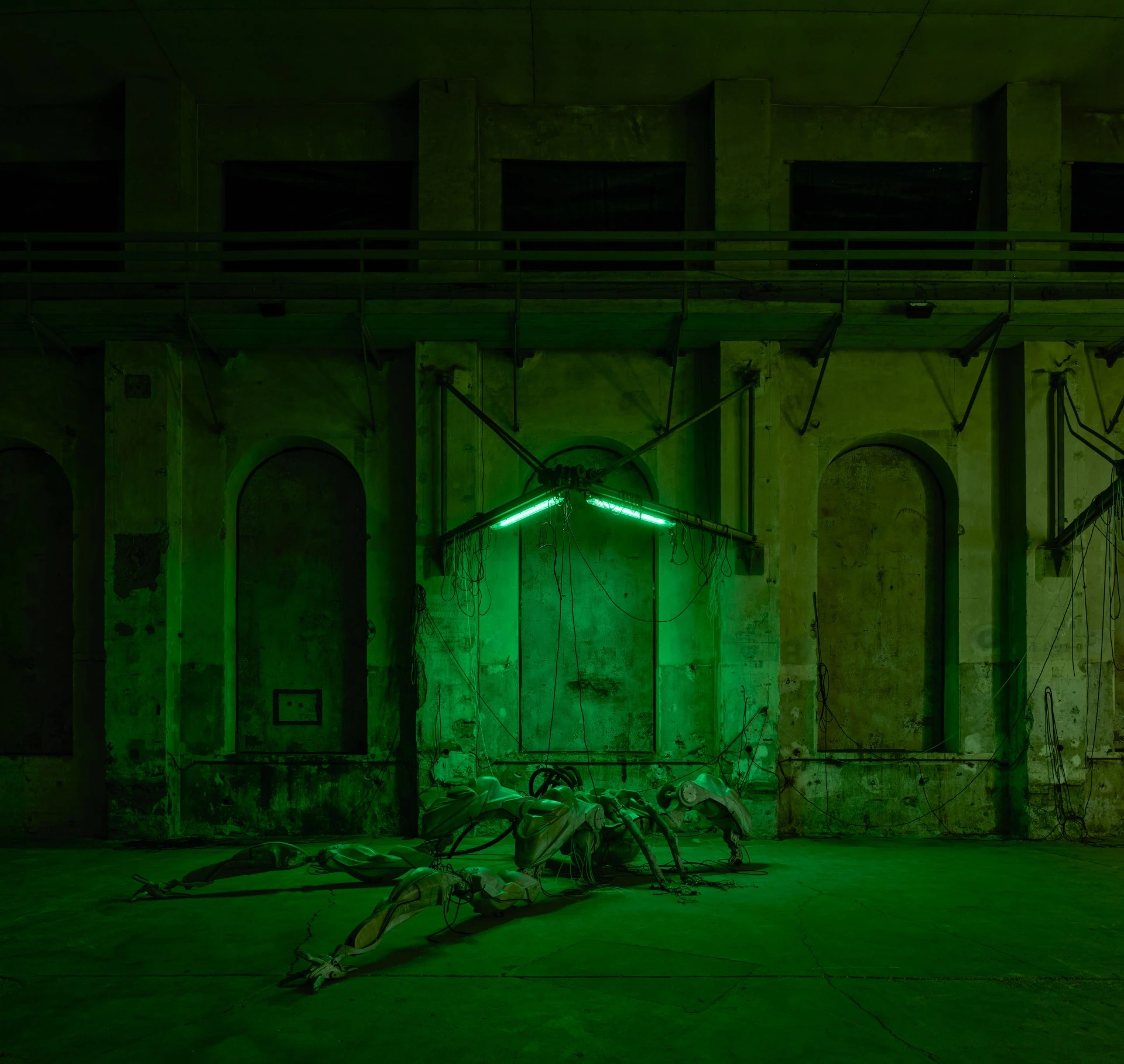
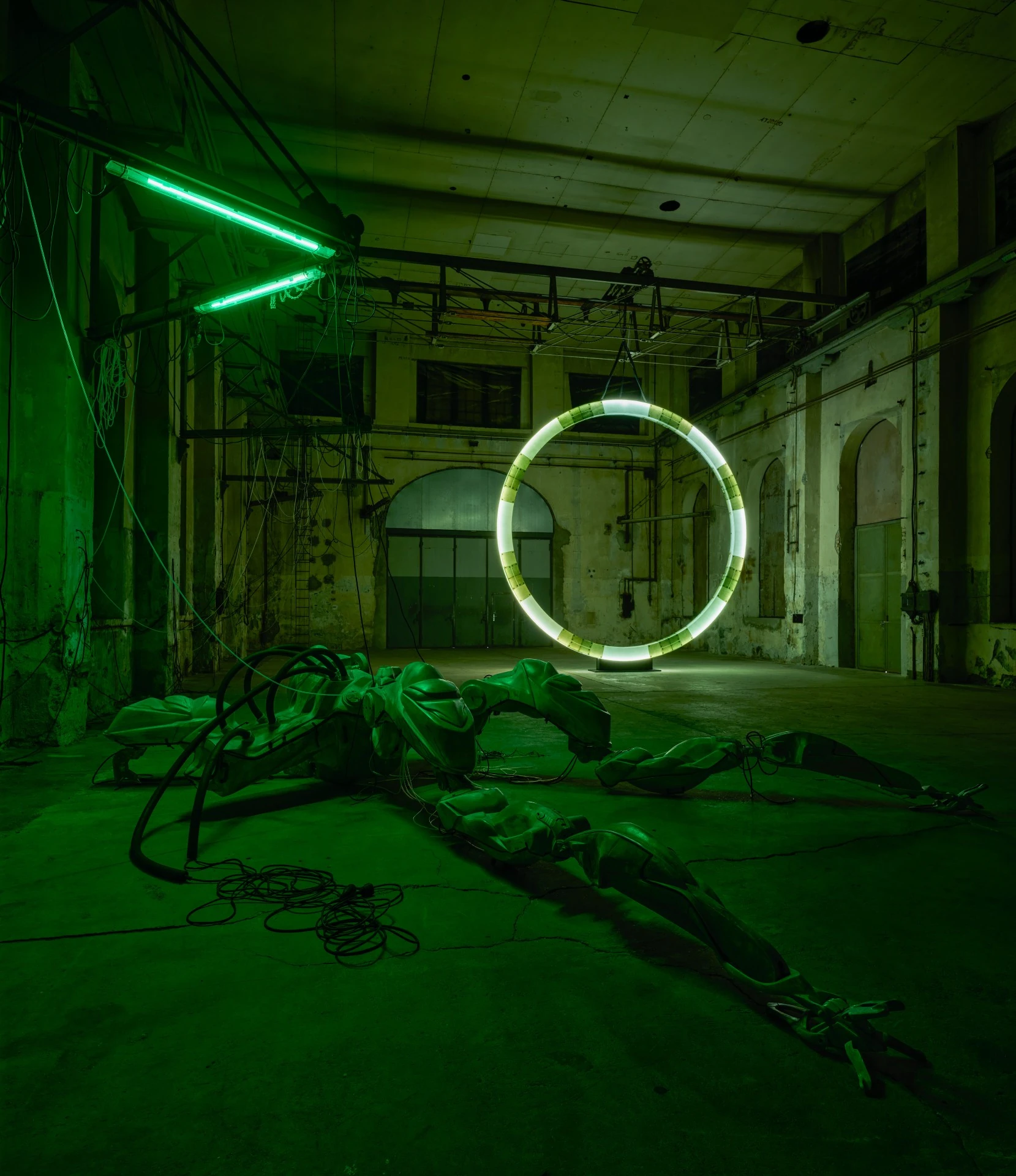
Inside a former metalworks hall in Dornbirn in Austria, Davide Allieri stages 47°24’35’’N / 9°44’20’’E, a portal of segmented light and a collapsed mech in a room soaked in acidic green.

The title gives coordinates. Follow them, and they land at Kunstraum Dornbirn, a former metal foundry in the Austrian Vorarlberg whose arched double doors, peeling render, and suspended mezzanine still carry the memory of heavy industry. Inside, Davide Allieri has drawn a black-out curtain across the daylight and replaced it with one temperature of light: a saturated, almost chlorophyllic green that turns walls, floor, and air into a single emulsion. From the municipal garden outside, one step crosses from spring into an afterwards.

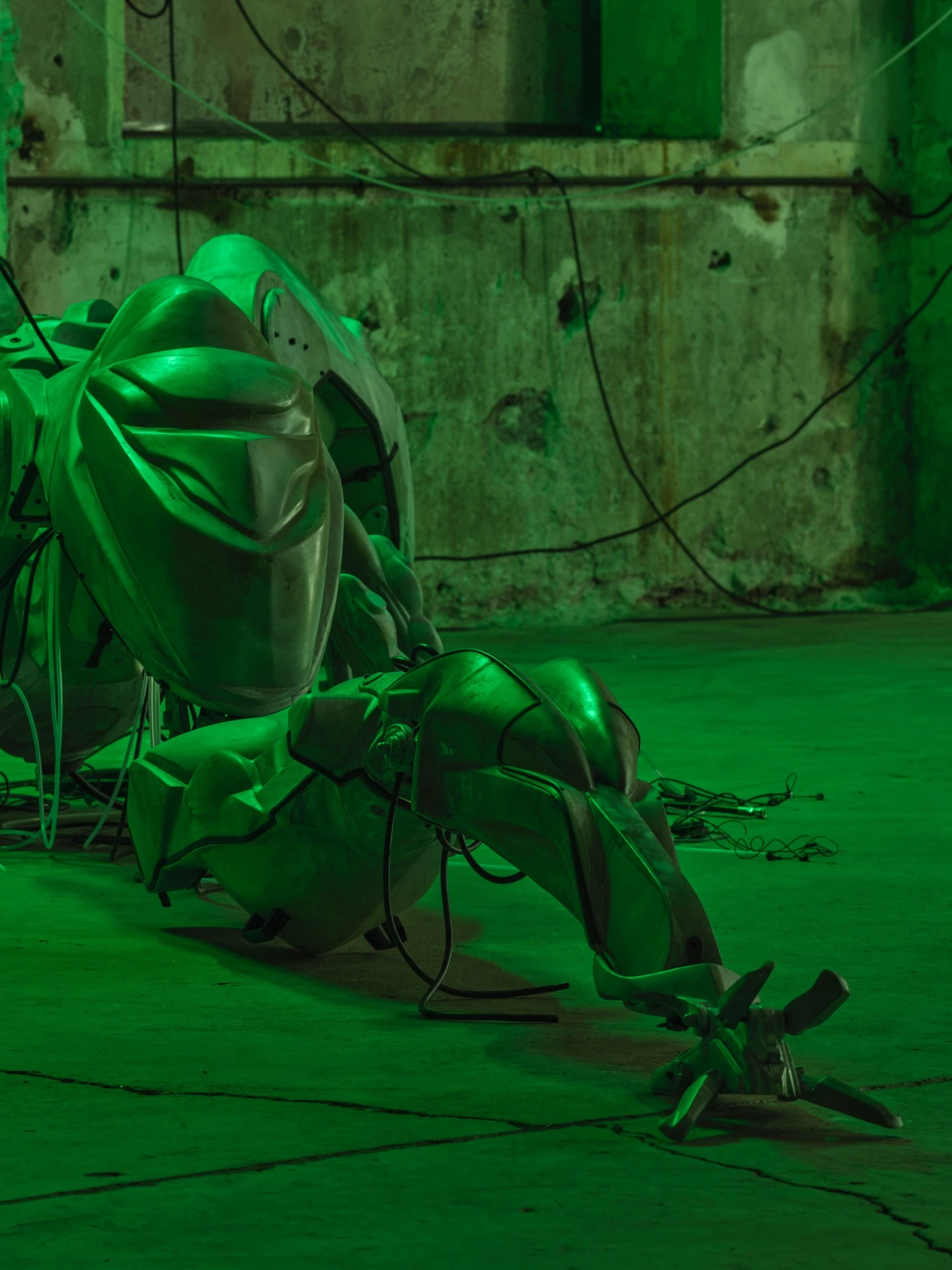
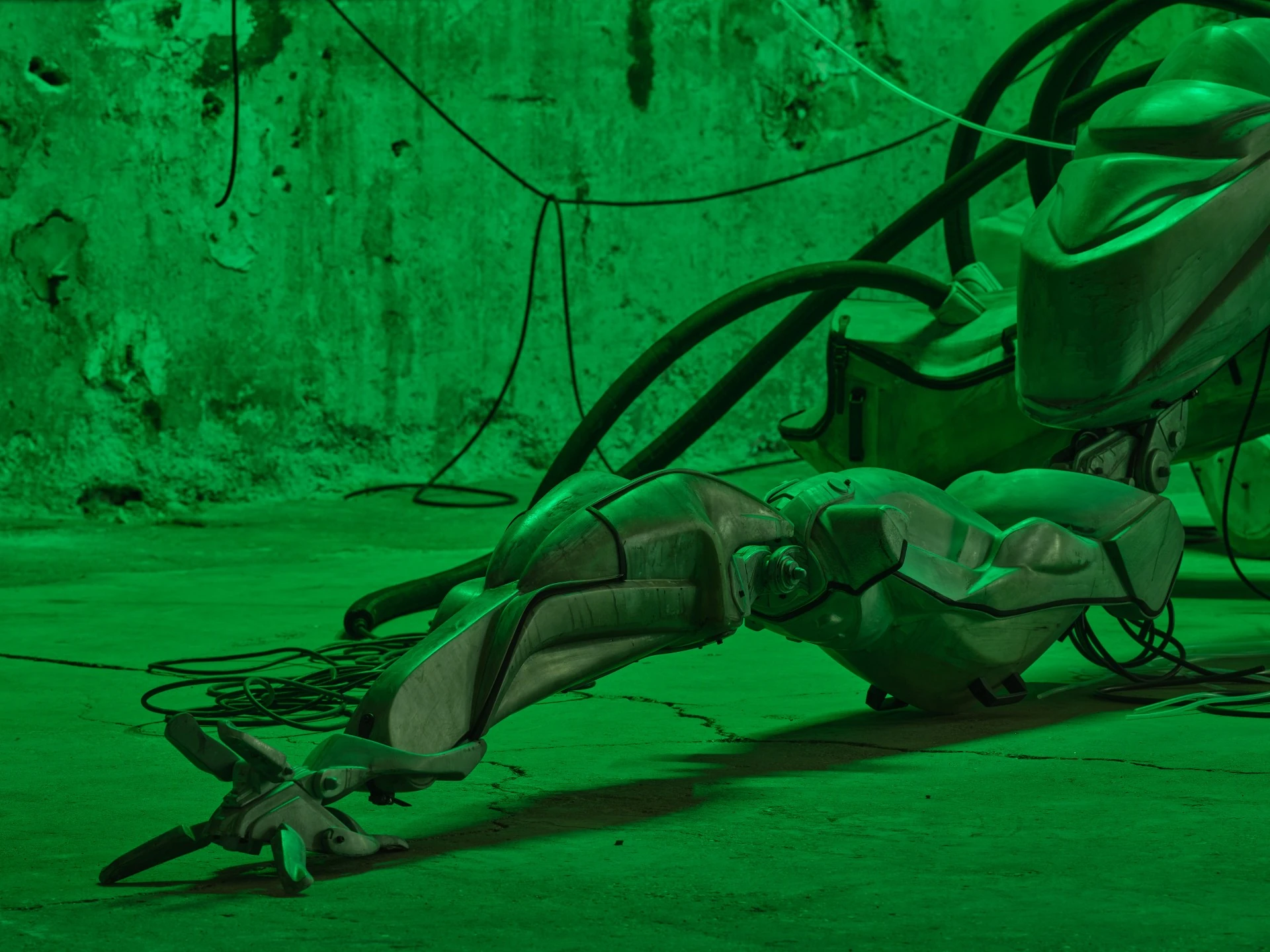
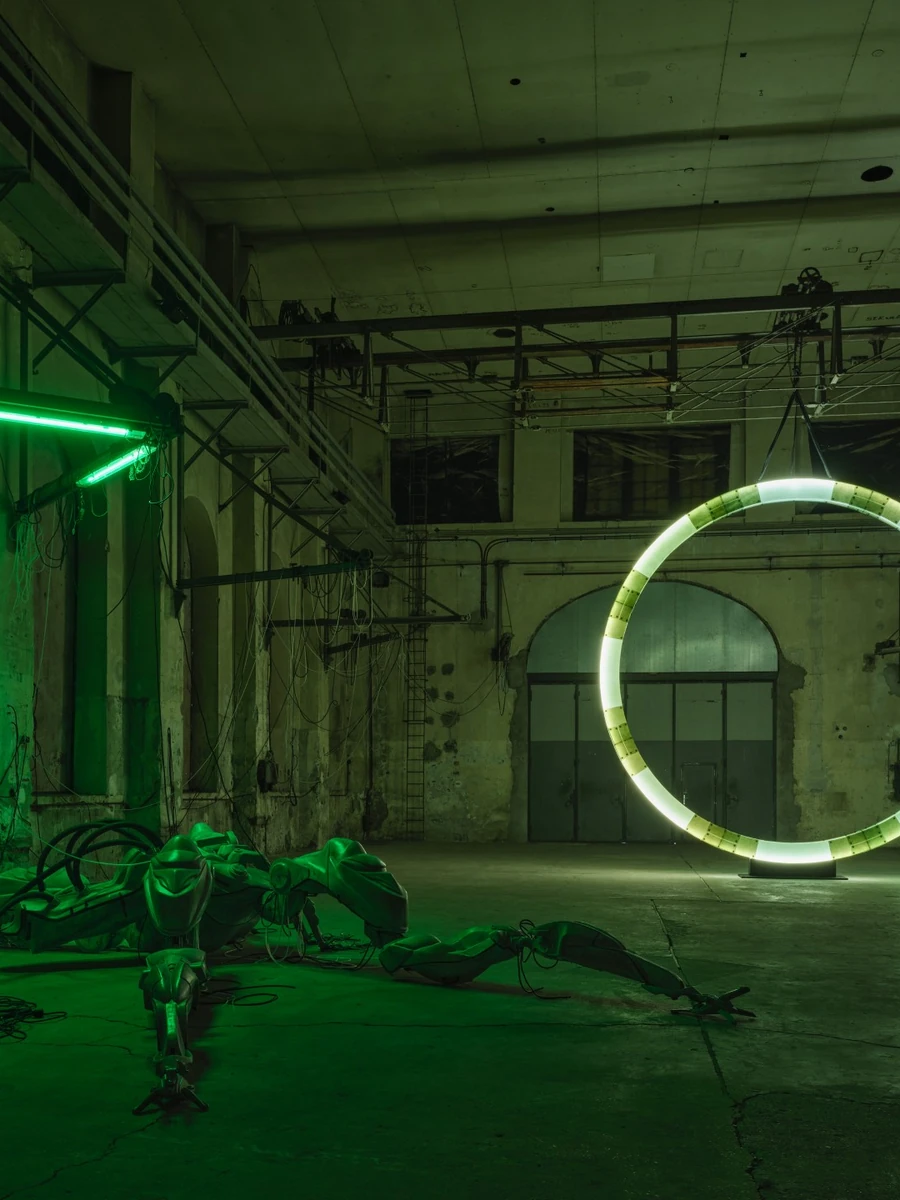
The room is arranged around two objects. A luminous ring, roughly three metres across, hangs at head height from the overhead rigging. Its circumference alternates frosted white tubes with translucent olive-yellow segments, producing the even pulse of a portal sign or a docking gate for something that has not yet arrived. Opposite it, splayed across the painted concrete floor, is a fibreglass creature: part mech, part insect, part carapace from a motorcycle that has not been invented yet. It does not stand. It lies on its side in articulated plates, claw-footed, cockpit cracked open, a limb extended as if reaching for a switch that is not there.

Allieri builds his sculptures as shells. Fibreglass, the artist's chosen material, lets him thin surface to the edge of dematerialisation while keeping form intact. "A solid sculpture remains an object," he has said. "An empty one contains space." The creature is hollow. So is the promise it gestures toward. Cables run everywhere and terminate nowhere, power assumed but not activated. A low-frequency drone by Francesco Peccolo settles over the floor, interrupted by metallic resonances and fragmented impulses, the way a distant machine might call across an empty valley.

What Allieri is building here is less a dystopia than a simulacrum. No catastrophe, no romantic ruin. What remains is the present after the grand narratives of modern progress stopped binding. Marc Augé's non-place, shifted into a speculative register: precisely located at 47°24’35’’N / 9°44’20’’E, yet cut loose from any clear before or after. Time stretches laterally. Orientation dissolves. The body that might have piloted the mech, opened the portal, or pulled the cable taut is absent, and only reimagined in the act of looking.

Formally, the works oscillate between machine, organism and fragment of the hall's own fabric. Allieri sources the grammar of human-operated drones and contemporary car body parts, then composes them through what he calls spatial collage into autonomous creatures that point back at a missing human. The ring could be passage, relic, or religious sign; the mech could be guardian, victim, or abandoned prototype. The exhibition deliberately withholds the answer. What it confronts the visitor with is a harder question: what does the future mean when it has lost its direction, and the memory of its own promise.
Interested in Showcasing Your Work?

If you would like to feature your works on Thisispaper, please visit our Submission page and sign up to Thisispaper+ to submit your work. Once your submission is approved, your work will be showcased to our global audience of 2 million art, architecture, and design professionals and enthusiasts.
No items found.
We love less
but there is more.
Become a Thisispaper+ member today to unlock full access to our magazine, advanced tools, and support our work.
Get two months FREE
with annual subscription
We love less
but there is more.
Become a Thisispaper+ member today to unlock full access to our magazine, advanced tools, and support our work.
Get two months FREE
with annual subscription
No items found.
Alexander Zaxarov
Apr 22, 2026

Inside a former metalworks hall in Dornbirn in Austria, Davide Allieri stages 47°24’35’’N / 9°44’20’’E, a portal of segmented light and a collapsed mech in a room soaked in acidic green.

The title gives coordinates. Follow them, and they land at Kunstraum Dornbirn, a former metal foundry in the Austrian Vorarlberg whose arched double doors, peeling render, and suspended mezzanine still carry the memory of heavy industry. Inside, Davide Allieri has drawn a black-out curtain across the daylight and replaced it with one temperature of light: a saturated, almost chlorophyllic green that turns walls, floor, and air into a single emulsion. From the municipal garden outside, one step crosses from spring into an afterwards.

The room is arranged around two objects. A luminous ring, roughly three metres across, hangs at head height from the overhead rigging. Its circumference alternates frosted white tubes with translucent olive-yellow segments, producing the even pulse of a portal sign or a docking gate for something that has not yet arrived. Opposite it, splayed across the painted concrete floor, is a fibreglass creature: part mech, part insect, part carapace from a motorcycle that has not been invented yet. It does not stand. It lies on its side in articulated plates, claw-footed, cockpit cracked open, a limb extended as if reaching for a switch that is not there.

Allieri builds his sculptures as shells. Fibreglass, the artist's chosen material, lets him thin surface to the edge of dematerialisation while keeping form intact. "A solid sculpture remains an object," he has said. "An empty one contains space." The creature is hollow. So is the promise it gestures toward. Cables run everywhere and terminate nowhere, power assumed but not activated. A low-frequency drone by Francesco Peccolo settles over the floor, interrupted by metallic resonances and fragmented impulses, the way a distant machine might call across an empty valley.

What Allieri is building here is less a dystopia than a simulacrum. No catastrophe, no romantic ruin. What remains is the present after the grand narratives of modern progress stopped binding. Marc Augé's non-place, shifted into a speculative register: precisely located at 47°24’35’’N / 9°44’20’’E, yet cut loose from any clear before or after. Time stretches laterally. Orientation dissolves. The body that might have piloted the mech, opened the portal, or pulled the cable taut is absent, and only reimagined in the act of looking.

Formally, the works oscillate between machine, organism and fragment of the hall's own fabric. Allieri sources the grammar of human-operated drones and contemporary car body parts, then composes them through what he calls spatial collage into autonomous creatures that point back at a missing human. The ring could be passage, relic, or religious sign; the mech could be guardian, victim, or abandoned prototype. The exhibition deliberately withholds the answer. What it confronts the visitor with is a harder question: what does the future mean when it has lost its direction, and the memory of its own promise.

Interested in Showcasing Your Work?

If you would like to feature your works on Thisispaper, please visit our Submission page and subscribe to Thisispaper+. Once your submission is approved, your work will be showcased to our global audience of 2 million art, architecture, and design professionals and enthusiasts.
No items found.

Join Thisispaper+
Unlock access to 2500 stories, curated guides + editions, and share your work with a global network of architects, artists, writers and designers who are shaping the future.
Get two months FREE
with annual subscription
Travel Guides
Immerse yourself in timeless destinations, hidden gems, and creative spaces—curated by humans, not algorithms.
Explore All Guides +
Submission Module
Submit your project and gain the chance to showcase your work to our worldwide audience of over 2M architects, designers, artists, and curious minds.
Learn More+
Curated Editions
Dive deeper into carefully curated editions, designed to feed your curiosity and foster exploration.
Off-the-Grid
Jutaku
Sacral Journey
minimum
The New Chair
Explore All Editions +
Atlas
A new and interactive way to explore the most inspiring places around the world.
Interactive map
Linked to articles
300+ curated locations
Google + Apple directions
Smart filters
Subscribe to Explore+
Become a Thisispaper+ member today to unlock full access to our magazine, submit your project and support our work.
Join Thisispaper+Join Thisispaper+
€ 9 EUR
/month
Cancel anytime
Get two months FREE
with annual subscription