Thisispaper Community
Join today.
Enter your email address to receive the latest news on emerging art, design, lifestyle and tech from Thisispaper, delivered straight to your inbox.
Oops! Something went wrong while submitting the form.
Instant access to new channels
The top stories curated daily
Weekly roundups of what's important
Original features and deep dives
Exclusive community features
Alexander Zaxarov
Jun 2, 2026

At the Fondation Beyeler in Riehen/Basel, Pierre Huyghe stages a survey-as-organism where films, ants, aquariums and neural networks share one shifting respiratory field.

Mouna Mekouar and Anne Stenne assemble new commissions and earlier works into what Huyghe calls a soulscape, an inner world shaped by multiple temporalities, voices and subjectivities. Sixteen pieces, made between 2011 and 2026, are wired into one another so that boundaries between reality and fiction, the human and the non-human refuse to settle. Nothing here unfolds the same way twice.

The first rooms read as preparation. In Umwelt (2011), ants form paths across a gallery wall, indifferent to the human standing in front of them. A second carpet, extracted from the Museum Ludwig in Cologne, records the wear of past footfall. Both feed into Light Dust (2026), a printed carpet of coloured pigment and cast artificial light spread across the whole show. Next door, Timekeeper (2026) cores through the walls of previous Beyeler exhibitions, releasing paint layers that visitors carry forward on their shoes.

Liminals (2025), commissioned by LAS Art Foundation and Hartwig Art Foundation, anchors the central film room. Built from photogrammetric body and landscape scans, motion capture and a real-time game engine, the fifty-minute work follows a hollow, faceless figure that shifts between states as it tries to exist outside time. The wall text frames it: "This liminal condition unfolds as an ongoing dance of matter, where multiple possibilities coexist simultaneously and each moment remains unstable." The character is less a protagonist than a probability.

Apnea (2026) installs an artificial breathing organ underwater, its silicone membrane oscillating at a human rhythm before slipping into held breath. Air, sound and low vibration travel through holes drilled in the walls, desynchronising across rooms. Cambrian Explosion 19 (2013) submerges live horseshoe crabs, anemones and a buoyant volcanic rock that defies gravity, organisms whose behaviour predates the museum by half a billion years.

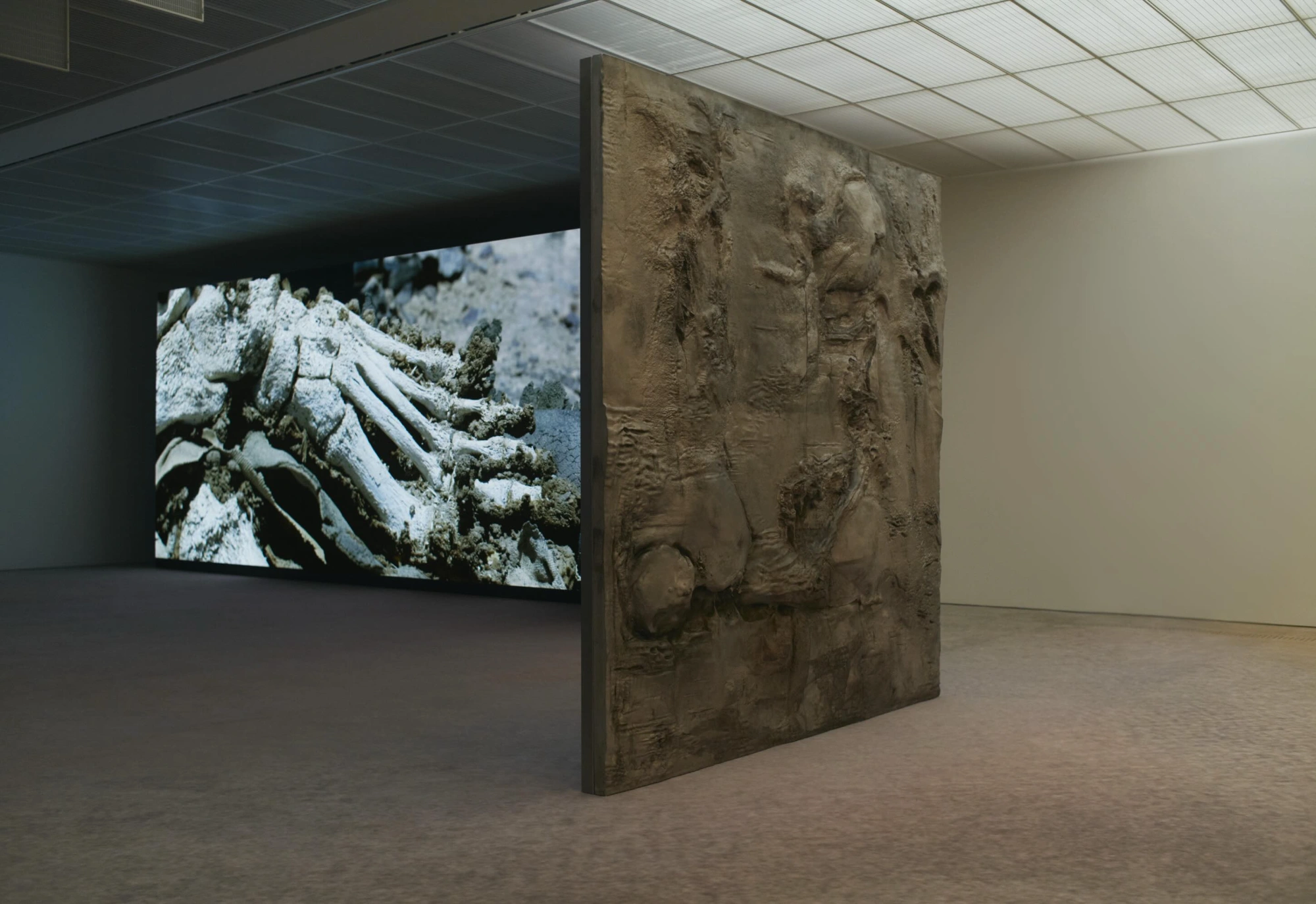
Older films sharpen the stakes. Human Mask (2014), set inside the nuclear exclusion zone around Fukushima, opens with a drone view of an abandoned city before settling on a monkey wearing a human mask, repeating learned gestures inside an empty restaurant, then pausing without purpose. Camata (2024), shown beside an aluminium bas-relief titled Adversary, films robots performing an obscure ritual around an unburied skeleton in the Atacama Desert; the cut is re-edited in real time by sensors in the room.

Idiom (2024-ongoing) closes the show. A golden LED mask, worn by a silent carrier, captures signals beyond human perception and vocalises them through a neural network as a self-generating language. Alchimia, a worm-like soft-robotic form at a doorway, breathes in counterpoint: it hums when fed air and convulses when starved. Across eight rooms, Huyghe builds an environment that learns, breathes and forgets, less an exhibition than a held condition the visitor briefly enters and disturbs.

Interested in Showcasing Your Work?

If you would like to feature your works on Thisispaper, please visit our Submission page and sign up to Thisispaper+ to submit your work. Once your submission is approved, your work will be showcased to our global audience of 2 million art, architecture, and design professionals and enthusiasts.
No items found.
We love less
but there is more.
Become a Thisispaper+ member today to unlock full access to our magazine, advanced tools, and support our work.
Get two months FREE
with annual subscription
We love less
but there is more.
Become a Thisispaper+ member today to unlock full access to our magazine, advanced tools, and support our work.
Get two months FREE
with annual subscription
No items found.
Alexander Zaxarov
Jun 2, 2026

At the Fondation Beyeler in Riehen/Basel, Pierre Huyghe stages a survey-as-organism where films, ants, aquariums and neural networks share one shifting respiratory field.

Mouna Mekouar and Anne Stenne assemble new commissions and earlier works into what Huyghe calls a soulscape, an inner world shaped by multiple temporalities, voices and subjectivities. Sixteen pieces, made between 2011 and 2026, are wired into one another so that boundaries between reality and fiction, the human and the non-human refuse to settle. Nothing here unfolds the same way twice.

The first rooms read as preparation. In Umwelt (2011), ants form paths across a gallery wall, indifferent to the human standing in front of them. A second carpet, extracted from the Museum Ludwig in Cologne, records the wear of past footfall. Both feed into Light Dust (2026), a printed carpet of coloured pigment and cast artificial light spread across the whole show. Next door, Timekeeper (2026) cores through the walls of previous Beyeler exhibitions, releasing paint layers that visitors carry forward on their shoes.

Liminals (2025), commissioned by LAS Art Foundation and Hartwig Art Foundation, anchors the central film room. Built from photogrammetric body and landscape scans, motion capture and a real-time game engine, the fifty-minute work follows a hollow, faceless figure that shifts between states as it tries to exist outside time. The wall text frames it: "This liminal condition unfolds as an ongoing dance of matter, where multiple possibilities coexist simultaneously and each moment remains unstable." The character is less a protagonist than a probability.

Apnea (2026) installs an artificial breathing organ underwater, its silicone membrane oscillating at a human rhythm before slipping into held breath. Air, sound and low vibration travel through holes drilled in the walls, desynchronising across rooms. Cambrian Explosion 19 (2013) submerges live horseshoe crabs, anemones and a buoyant volcanic rock that defies gravity, organisms whose behaviour predates the museum by half a billion years.

Older films sharpen the stakes. Human Mask (2014), set inside the nuclear exclusion zone around Fukushima, opens with a drone view of an abandoned city before settling on a monkey wearing a human mask, repeating learned gestures inside an empty restaurant, then pausing without purpose. Camata (2024), shown beside an aluminium bas-relief titled Adversary, films robots performing an obscure ritual around an unburied skeleton in the Atacama Desert; the cut is re-edited in real time by sensors in the room.

Idiom (2024-ongoing) closes the show. A golden LED mask, worn by a silent carrier, captures signals beyond human perception and vocalises them through a neural network as a self-generating language. Alchimia, a worm-like soft-robotic form at a doorway, breathes in counterpoint: it hums when fed air and convulses when starved. Across eight rooms, Huyghe builds an environment that learns, breathes and forgets, less an exhibition than a held condition the visitor briefly enters and disturbs.

Interested in Showcasing Your Work?

If you would like to feature your works on Thisispaper, please visit our Submission page and subscribe to Thisispaper+. Once your submission is approved, your work will be showcased to our global audience of 2 million art, architecture, and design professionals and enthusiasts.
Thisispaper+
Basel Guide
15+ Locations
Web Access
Link to Maps
Architecture in Basel — Christ & Gantenbein's brick volumes at the Kunstmuseum, Herzog & de Meuron's hometown experiments, Buchner Bründler's residential interiors, and a civic culture funded by pharmaceutical capital and held together by the Rhine. The Swiss border city where art-fair urgency meets quiet precision.
Explore
Basel Guide

Join Thisispaper+
Unlock access to 2500 stories, curated guides + editions, and share your work with a global network of architects, artists, writers and designers who are shaping the future.
Get two months FREE
with annual subscription
Travel Guides
Immerse yourself in timeless destinations, hidden gems, and creative spaces—curated by humans, not algorithms.
Explore All Guides +
Submission Module
Submit your project and gain the chance to showcase your work to our worldwide audience of over 2M architects, designers, artists, and curious minds.
Learn More+
Curated Editions
Dive deeper into carefully curated editions, designed to feed your curiosity and foster exploration.
Off-the-Grid
Jutaku
Sacral Journey
minimum
The New Chair
Explore All Editions +
Atlas
A new and interactive way to explore the most inspiring places around the world.
Interactive map
Linked to articles
300+ curated locations
Google + Apple directions
Smart filters
Subscribe to Explore+
Become a Thisispaper+ member today to unlock full access to our magazine, submit your project and support our work.
Join Thisispaper+Join Thisispaper+
€ 9 EUR
/month
Cancel anytime
Get two months FREE
with annual subscription