Thisispaper Community
Join today.
Enter your email address to receive the latest news on emerging art, design, lifestyle and tech from Thisispaper, delivered straight to your inbox.
Oops! Something went wrong while submitting the form.
Instant access to new channels
The top stories curated daily
Weekly roundups of what's important
Original features and deep dives
Exclusive community features
Thisispaper+ Member

Transformation of a Mayen by LVPH Architectes

Dates:
✧ Collect Post
Alpine Houses
under the patronage of
Weekend Retreat
under the patronage of
Set in Stone
under the patronage of
Transformation of a Mayen by LVPH Architectes
Alexander Zaxarov
May 6, 2026

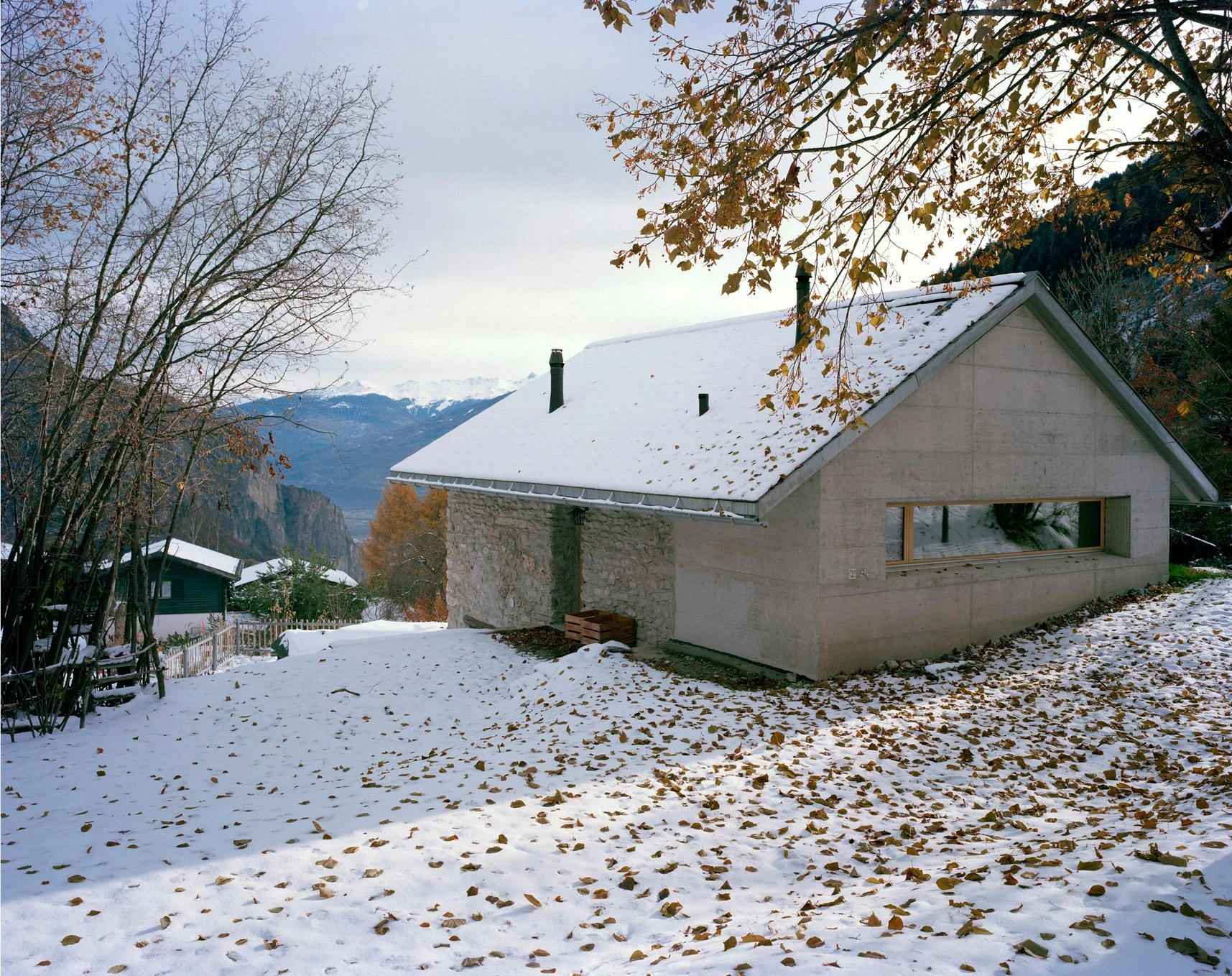
In the village of Chamoson, Canton of Valais, LVPH Architectes transforms a shepherd's mayen, inserting a spruce-plywood interior and a wide panoramic window into the rough stone shell against the Alpine skyline.

A mayen is not a farmhouse. It is a seasonal hut, built from the stone of the mountain it sits on, used for summer grazing and abandoned for winter. In Chamoson, at a bend on a snow-covered road in the Valais Alps, LVPH Architectes found one in need of transformation and used it to ask a particular question: how much can you change a vernacular building without replacing it?

The exterior answer is visible immediately. The rough dry-stone masonry is intact, the snow-shedding pitch unchanged. What has changed is a single aperture: a wide horizontal window opening cut into the gable wall at living-room height, framed in pale timber, proportioned like a widescreen view. Through it, the sitting room captures the village rooftops and the ridgeline of the alpine limestone above. The window is not modest, but it reads as a single considered cut rather than a redesign of the face.

Inside, the original stone is gone from the visible surfaces. The intervention is a spruce plywood envelope: walls, ceiling, shelving, bedroom partition all in the same pale knotted timber. Where the mayen offered rough masonry, the new interior offers a consistent, smooth, low-sheen wood surface that collects diffuse light from the horizontal window and from a smaller opening above. The junction between stone shell and timber insert is clean: one world stops, the other begins.

The kitchen retains some vernacular layering: a floral-painted traditional hutch cabinet survives beside new plywood joinery. It reads neither as heritage curation nor as irony but simply as retention of what was usable. A concrete terrace wall at the rear anchors the house to a garden with the mountain face behind it, the transition between old stone and board-formed concrete forming the only material conversation on the exterior.

LVPH Architectes, based in Lausanne, works consistently across domestic renovation and new construction in the Swiss landscape. The Chamoson mayen is one of their smaller projects and one of their clearest: the argument is made with a few decisions, and the photographs by Joël Tettamanti are allowed to carry the weight of the Valais winter around it.

Interested in Showcasing Your Work?

If you would like to feature your works on Thisispaper, please visit our Submission page and sign up to Thisispaper+ to submit your work. Once your submission is approved, your work will be showcased to our global audience of 2 million art, architecture, and design professionals and enthusiasts.
No items found.
We love less
but there is more.
Become a Thisispaper+ member today to unlock full access to our magazine, advanced tools, and support our work.
Get two months FREE
with annual subscription
We love less
but there is more.
Become a Thisispaper+ member today to unlock full access to our magazine, advanced tools, and support our work.
Get two months FREE
with annual subscription
No items found.
Alexander Zaxarov
May 6, 2026

In the village of Chamoson, Canton of Valais, LVPH Architectes transforms a shepherd's mayen, inserting a spruce-plywood interior and a wide panoramic window into the rough stone shell against the Alpine skyline.

A mayen is not a farmhouse. It is a seasonal hut, built from the stone of the mountain it sits on, used for summer grazing and abandoned for winter. In Chamoson, at a bend on a snow-covered road in the Valais Alps, LVPH Architectes found one in need of transformation and used it to ask a particular question: how much can you change a vernacular building without replacing it?

The exterior answer is visible immediately. The rough dry-stone masonry is intact, the snow-shedding pitch unchanged. What has changed is a single aperture: a wide horizontal window opening cut into the gable wall at living-room height, framed in pale timber, proportioned like a widescreen view. Through it, the sitting room captures the village rooftops and the ridgeline of the alpine limestone above. The window is not modest, but it reads as a single considered cut rather than a redesign of the face.

Inside, the original stone is gone from the visible surfaces. The intervention is a spruce plywood envelope: walls, ceiling, shelving, bedroom partition all in the same pale knotted timber. Where the mayen offered rough masonry, the new interior offers a consistent, smooth, low-sheen wood surface that collects diffuse light from the horizontal window and from a smaller opening above. The junction between stone shell and timber insert is clean: one world stops, the other begins.

The kitchen retains some vernacular layering: a floral-painted traditional hutch cabinet survives beside new plywood joinery. It reads neither as heritage curation nor as irony but simply as retention of what was usable. A concrete terrace wall at the rear anchors the house to a garden with the mountain face behind it, the transition between old stone and board-formed concrete forming the only material conversation on the exterior.

LVPH Architectes, based in Lausanne, works consistently across domestic renovation and new construction in the Swiss landscape. The Chamoson mayen is one of their smaller projects and one of their clearest: the argument is made with a few decisions, and the photographs by Joël Tettamanti are allowed to carry the weight of the Valais winter around it.

Interested in Showcasing Your Work?

If you would like to feature your works on Thisispaper, please visit our Submission page and subscribe to Thisispaper+. Once your submission is approved, your work will be showcased to our global audience of 2 million art, architecture, and design professionals and enthusiasts.
Thisispaper+
Alpine Houses
40+ Projects
Web Access
Link to Maps
Architecture for a vertical condition. The slope is the brief, the climate is the second skin, and larch, stone, and shingle do most of the talking. Houses pressed into hillsides, cabins held above snowfall, conversions that keep the barn's geometry and lose its programme. Orientation negotiates with terrain and weather more than view. A growing collection.
Explore
Alpine Houses

Join Thisispaper+
Unlock access to 2500 stories, curated guides + editions, and share your work with a global network of architects, artists, writers and designers who are shaping the future.
Get two months FREE
with annual subscription
Travel Guides
Immerse yourself in timeless destinations, hidden gems, and creative spaces—curated by humans, not algorithms.
Explore All Guides +
Submission Module
Submit your project and gain the chance to showcase your work to our worldwide audience of over 2M architects, designers, artists, and curious minds.
Learn More+
Curated Editions
Dive deeper into carefully curated editions, designed to feed your curiosity and foster exploration.
Off-the-Grid
Jutaku
Sacral Journey
minimum
The New Chair
Explore All Editions +
Atlas
A new and interactive way to explore the most inspiring places around the world.
Interactive map
Linked to articles
300+ curated locations
Google + Apple directions
Smart filters
Subscribe to Explore+
Become a Thisispaper+ member today to unlock full access to our magazine, submit your project and support our work.
Join Thisispaper+Join Thisispaper+
€ 9 EUR
/month
Cancel anytime
Get two months FREE
with annual subscription