Thisispaper Community
Join today.
Enter your email address to receive the latest news on emerging art, design, lifestyle and tech from Thisispaper, delivered straight to your inbox.
Oops! Something went wrong while submitting the form.
Instant access to new channels
The top stories curated daily
Weekly roundups of what's important
Original features and deep dives
Exclusive community features
Hitoshi Arato
May 19, 2026

In London Fields, Paraforma converts a flat into Studio Four, where an inhabitable bleached-oak wall holds kitchen, storage, and services, dissolving the boundary between communal and private life.

The apartment refuses enclosure as an organising principle. Instead of walls dividing rooms, London-based studio Paraforma structures Studio Four around degrees of openness: thresholds that filter rather than separate, materials that shift register from one zone to the next, light that reads differently on each side of a surface.

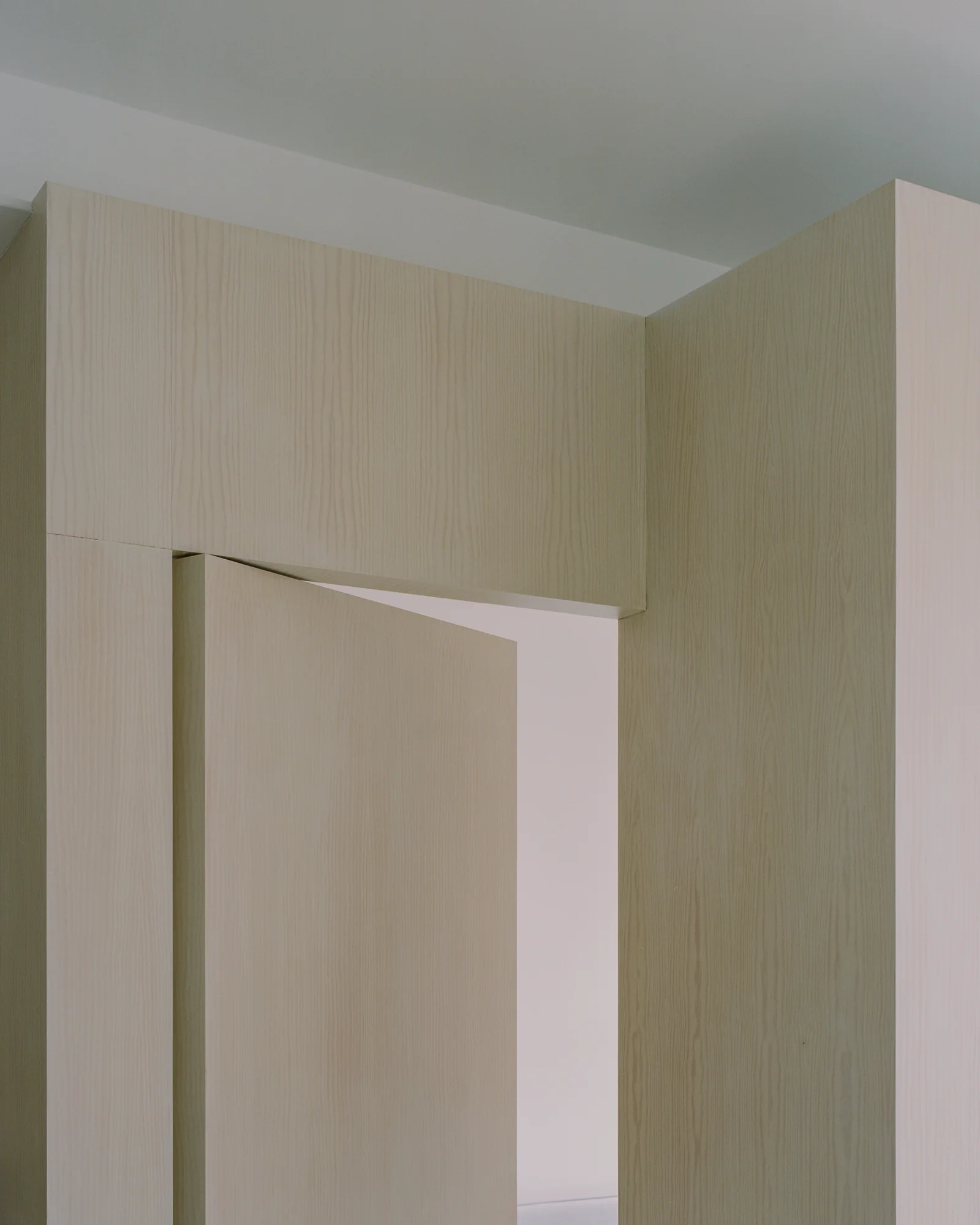
At the centre of the plan sits an inhabitable timber wall, clad floor to ceiling in bleached white oak veneer that runs continuous across storage panels, door leaves, and services housing. The wood grain reads clearly across every face, the joints almost invisible, so the wall functions less as furniture than as spatial infrastructure, an object that happens to contain a kitchen on one face and storage on the other while also being the apartment's primary spatial gesture.

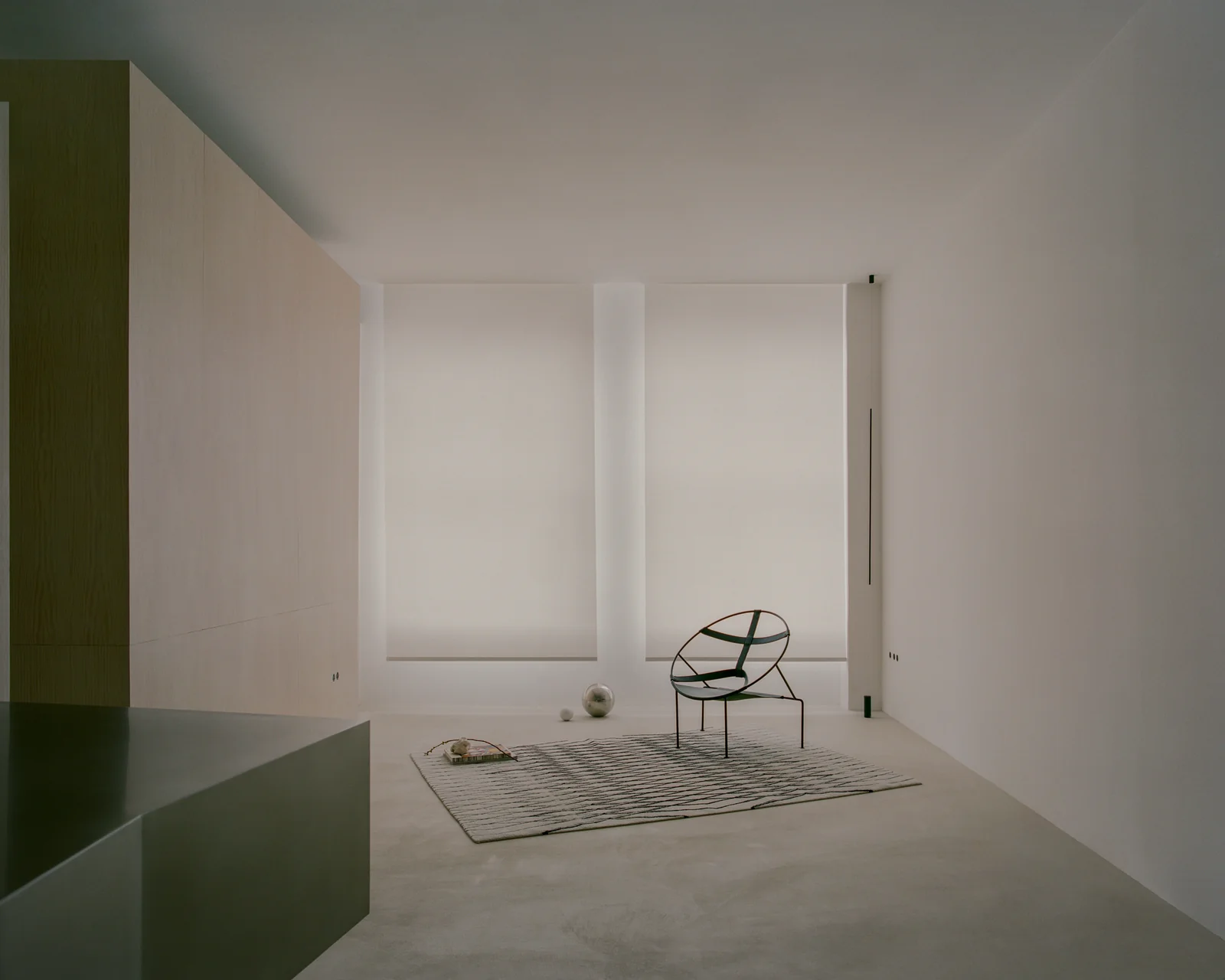
The kitchen island, developed in collaboration with Mingardo, arrives as a solid stainless steel prism that has been cut, shifted, and carved. Defined through subtraction, it sits somewhere between a piece of furniture and a small piece of construction: surfaces at different heights, the steel brushed to a matte finish that absorbs rather than reflects the pale oak and white resin surrounding it.

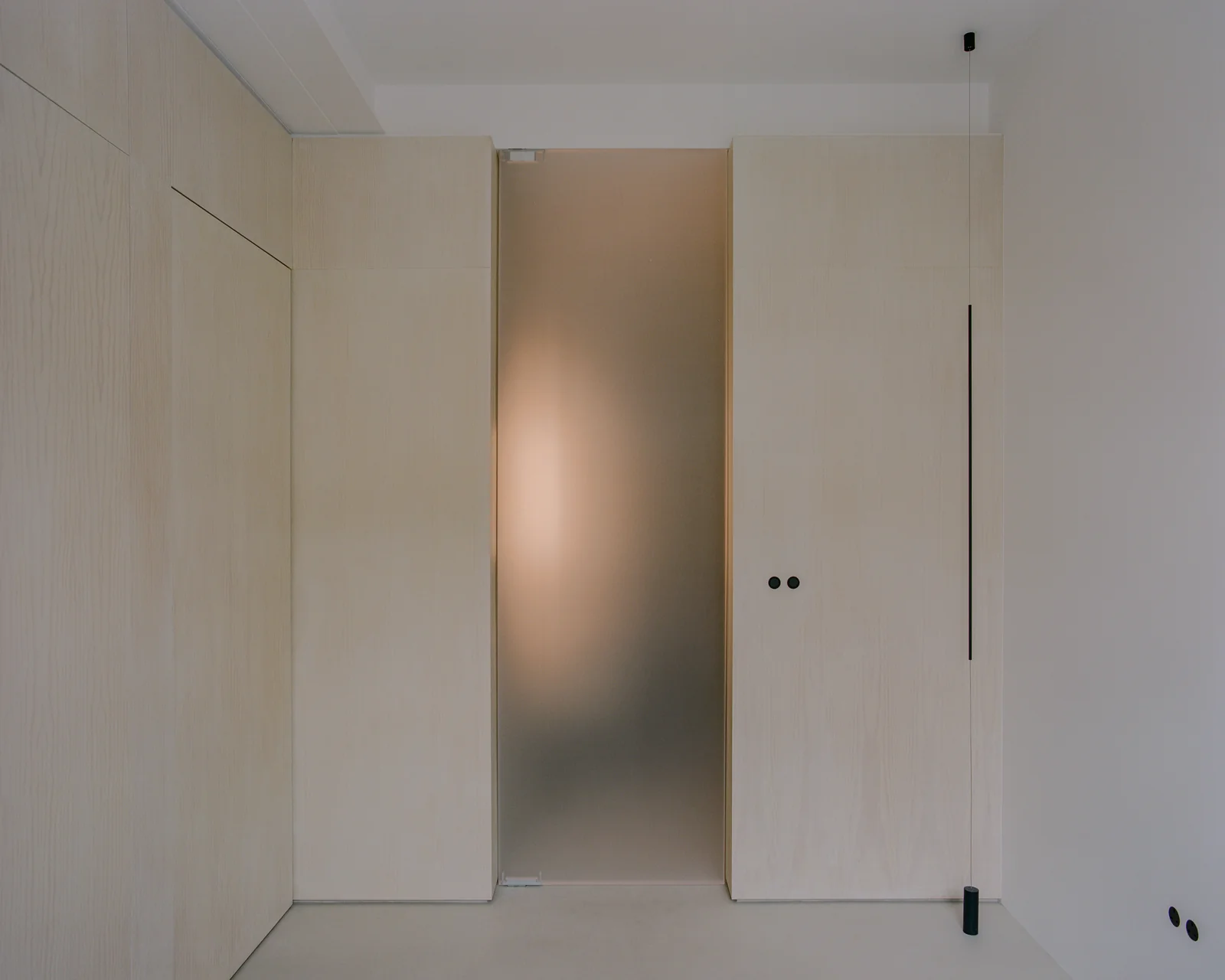
A three-metre-high door in translucent resin mediates between bedroom and bathroom. It operates less as a partition than as a membrane: in the photographs it appears lit from within, the amber cast of the bathroom bleeding through the resin panel and softening as it reaches the sleeping zone. Neither opaque nor transparent, it marks a transition in programme without announcing it.

The floor throughout is polished white resin, reading as a continuous plane that amplifies the low-contrast palette of the bleached oak and off-white walls. Black pin hardware at each door leaf provides the only punctuation. In the bedroom, a steel-framed industrial window opens onto London brick, the one moment where the building's Victorian context enters the composition without being aestheticised.

Paraforma's wager is that space can be organised through material shifts and perceptual gradients rather than through room boundaries. Studio Four holds together as an argument about domestic life: that intimacy and collectivity do not require separate containers, only careful filtration between them.

Interested in Showcasing Your Work?

If you would like to feature your works on Thisispaper, please visit our Submission page and sign up to Thisispaper+ to submit your work. Once your submission is approved, your work will be showcased to our global audience of 2 million art, architecture, and design professionals and enthusiasts.
No items found.
We love less
but there is more.
Become a Thisispaper+ member today to unlock full access to our magazine, advanced tools, and support our work.
Get two months FREE
with annual subscription
We love less
but there is more.
Become a Thisispaper+ member today to unlock full access to our magazine, advanced tools, and support our work.
Get two months FREE
with annual subscription
No items found.
Hitoshi Arato
May 19, 2026

In London Fields, Paraforma converts a flat into Studio Four, where an inhabitable bleached-oak wall holds kitchen, storage, and services, dissolving the boundary between communal and private life.

The apartment refuses enclosure as an organising principle. Instead of walls dividing rooms, London-based studio Paraforma structures Studio Four around degrees of openness: thresholds that filter rather than separate, materials that shift register from one zone to the next, light that reads differently on each side of a surface.

At the centre of the plan sits an inhabitable timber wall, clad floor to ceiling in bleached white oak veneer that runs continuous across storage panels, door leaves, and services housing. The wood grain reads clearly across every face, the joints almost invisible, so the wall functions less as furniture than as spatial infrastructure, an object that happens to contain a kitchen on one face and storage on the other while also being the apartment's primary spatial gesture.

The kitchen island, developed in collaboration with Mingardo, arrives as a solid stainless steel prism that has been cut, shifted, and carved. Defined through subtraction, it sits somewhere between a piece of furniture and a small piece of construction: surfaces at different heights, the steel brushed to a matte finish that absorbs rather than reflects the pale oak and white resin surrounding it.

A three-metre-high door in translucent resin mediates between bedroom and bathroom. It operates less as a partition than as a membrane: in the photographs it appears lit from within, the amber cast of the bathroom bleeding through the resin panel and softening as it reaches the sleeping zone. Neither opaque nor transparent, it marks a transition in programme without announcing it.

The floor throughout is polished white resin, reading as a continuous plane that amplifies the low-contrast palette of the bleached oak and off-white walls. Black pin hardware at each door leaf provides the only punctuation. In the bedroom, a steel-framed industrial window opens onto London brick, the one moment where the building's Victorian context enters the composition without being aestheticised.

Paraforma's wager is that space can be organised through material shifts and perceptual gradients rather than through room boundaries. Studio Four holds together as an argument about domestic life: that intimacy and collectivity do not require separate containers, only careful filtration between them.

Interested in Showcasing Your Work?

If you would like to feature your works on Thisispaper, please visit our Submission page and subscribe to Thisispaper+. Once your submission is approved, your work will be showcased to our global audience of 2 million art, architecture, and design professionals and enthusiasts.
No items found.

Join Thisispaper+
Unlock access to 2500 stories, curated guides + editions, and share your work with a global network of architects, artists, writers and designers who are shaping the future.
Get two months FREE
with annual subscription
Travel Guides
Immerse yourself in timeless destinations, hidden gems, and creative spaces—curated by humans, not algorithms.
Explore All Guides +
Submission Module
Submit your project and gain the chance to showcase your work to our worldwide audience of over 2M architects, designers, artists, and curious minds.
Learn More+
Curated Editions
Dive deeper into carefully curated editions, designed to feed your curiosity and foster exploration.
Off-the-Grid
Jutaku
Sacral Journey
minimum
The New Chair
Explore All Editions +
Atlas
A new and interactive way to explore the most inspiring places around the world.
Interactive map
Linked to articles
300+ curated locations
Google + Apple directions
Smart filters
Subscribe to Explore+
Become a Thisispaper+ member today to unlock full access to our magazine, submit your project and support our work.
Join Thisispaper+Join Thisispaper+
€ 9 EUR
/month
Cancel anytime
Get two months FREE
with annual subscription