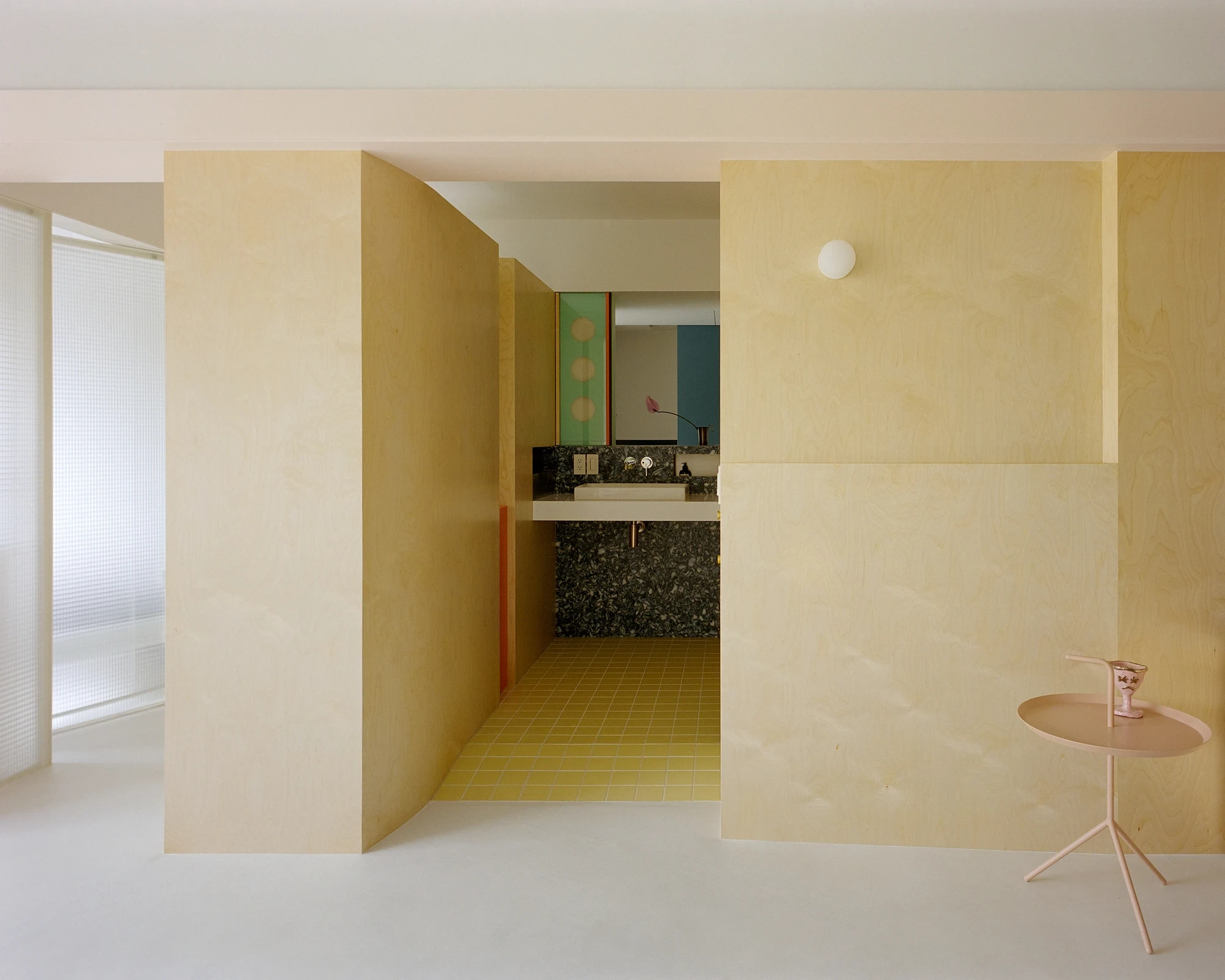
In a 40-year-old Taipei public housing complex, OUJ reorganises a 72-square-metre apartment around a birch plywood central block — a home designed in three phases for elderly parents and their daughters, where the architecture anticipates care before it is needed.
The apartment in the Taiwan Contemporary Culture Lab district occupies a dual-facade position: the south faces quiet greenery, the north a major commercial boulevard. The existing three-bedroom layout amplified the narrow proportions; iron window grilles and fixed AC units blocked light and ventilation. OUJ began with removal — the grilles and partitions stripped, a birch plywood central block inserted as the new spatial anchor from which all the rooms take their orientation.
The block's distinguishing feature is a bespoke 'light box' — a composition of fluted and frosted glass that refracts and diffuses daylight throughout the residence. The kitchen, dining area, daybed zone, and bedrooms are arranged in sequence around this core, establishing a fluid circular circulation that keeps the narrow plan open and continuous. An open washbasin at the block's surface enhances visual continuity; light, air, and sound flow freely through the apartment, bridging the shifting conditions of north and south.
At the window-side, a daybed reinterprets the Japanese noryo-yuka — a cooling platform associated with relaxation and social gathering. Constructed from solid wood planks, cylindrical supports, and stainless-steel triangular beams, it functions as a communal threshold: a place where family members spontaneously converge, oriented toward the greenery of the south.
The three-phase spatial plan reflects the project's core ambition. During a transitional period, the daybed area serves as a temporary bedroom for the daughter. Once the household stabilises, the storage room becomes a caregiver's room. Both the master bedroom and the daybed space are dimensioned to accommodate a hospital bed with minimal future adjustment. The architecture provides for care without declaring it — the flexibility is latent, embedded in proportion and plan rather than announced.
All paints and adhesives are low-VOC; 70% of construction materials are certified green products; decorative panels incorporate recycled plastic. The layout is fully wheelchair-accessible. For a nation transitioning into a super-aged society, L'appartement Hu demonstrates how compact public housing can be reorganised to support cross-generational life — the spatial answer to a demographic question that most housing stock has not yet begun to ask.