An hour north of Melbourne in the Macedon Ranges, Pepper & Well renews the ensuite of Lumeah, a Paul Couch house built from raw concrete, compressed straw Stramit and Mintaro slate.
Lumeah, originally known as the Harley House, sits low in a paddock outside Macedon, on the country of the Wurundjeri Woi Wurrung people of the Kulin Nation. Precast concrete walls carry concrete beams and a vaulted roof lined in compressed straw Stramit board; the east-west plan opens north through custom timber and steel sliding doors, an angled tensile steel mesh tuning sun across the seasons. Couch apprenticed under Robin Boyd until Boyd's death in 1971. Lumeah is among the most intact houses left of his work, built on the conviction that concrete, steel and panel products belong in their raw state with fixings showing.
The ensuite was the exception. Decades of incremental fixes had left the room damp, mouldy and adrift from the language of the house. Pepper & Well began not with finishes but with diagrams, distilling Couch's plan to its parti: walls, beams, thresholds, planes. The brief was to renew without imitating, to add a sentence in the same language rather than translate the room into another.
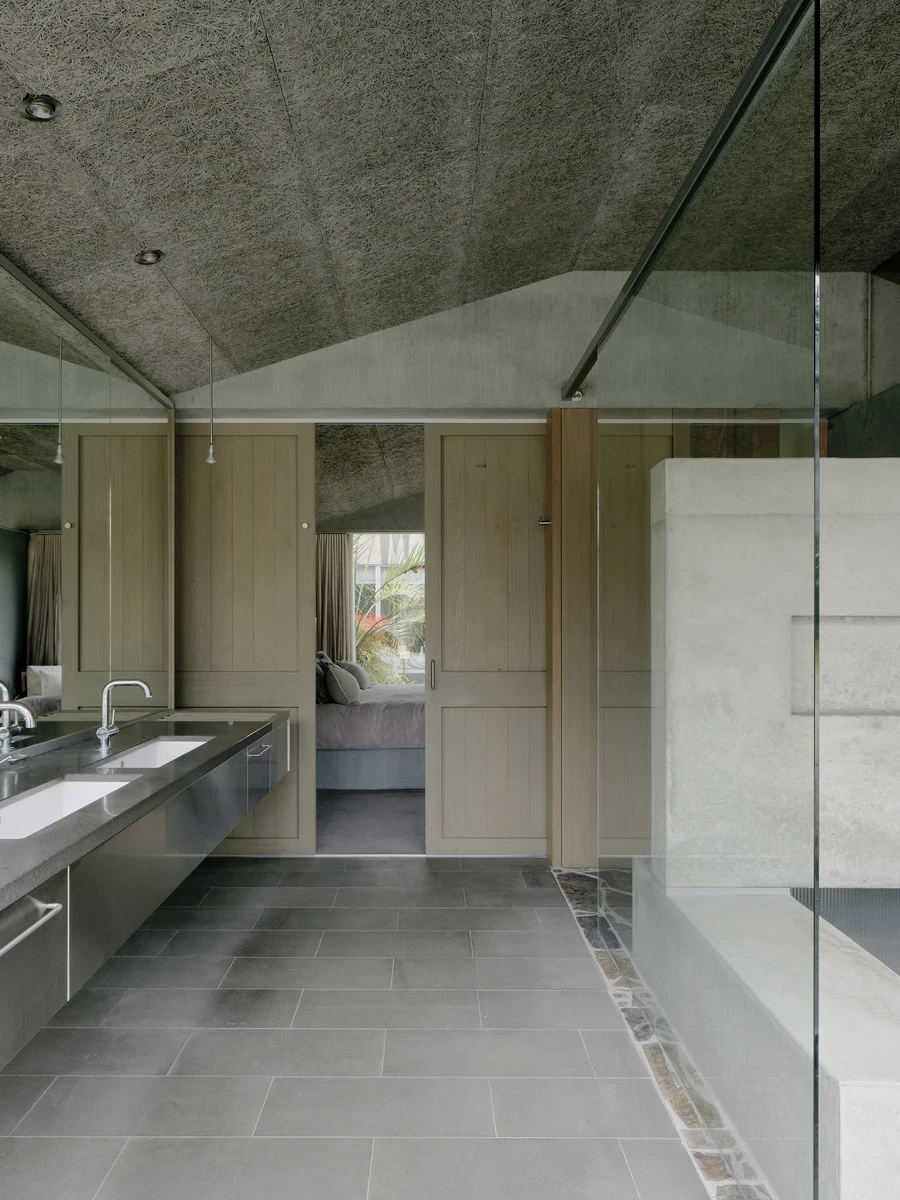
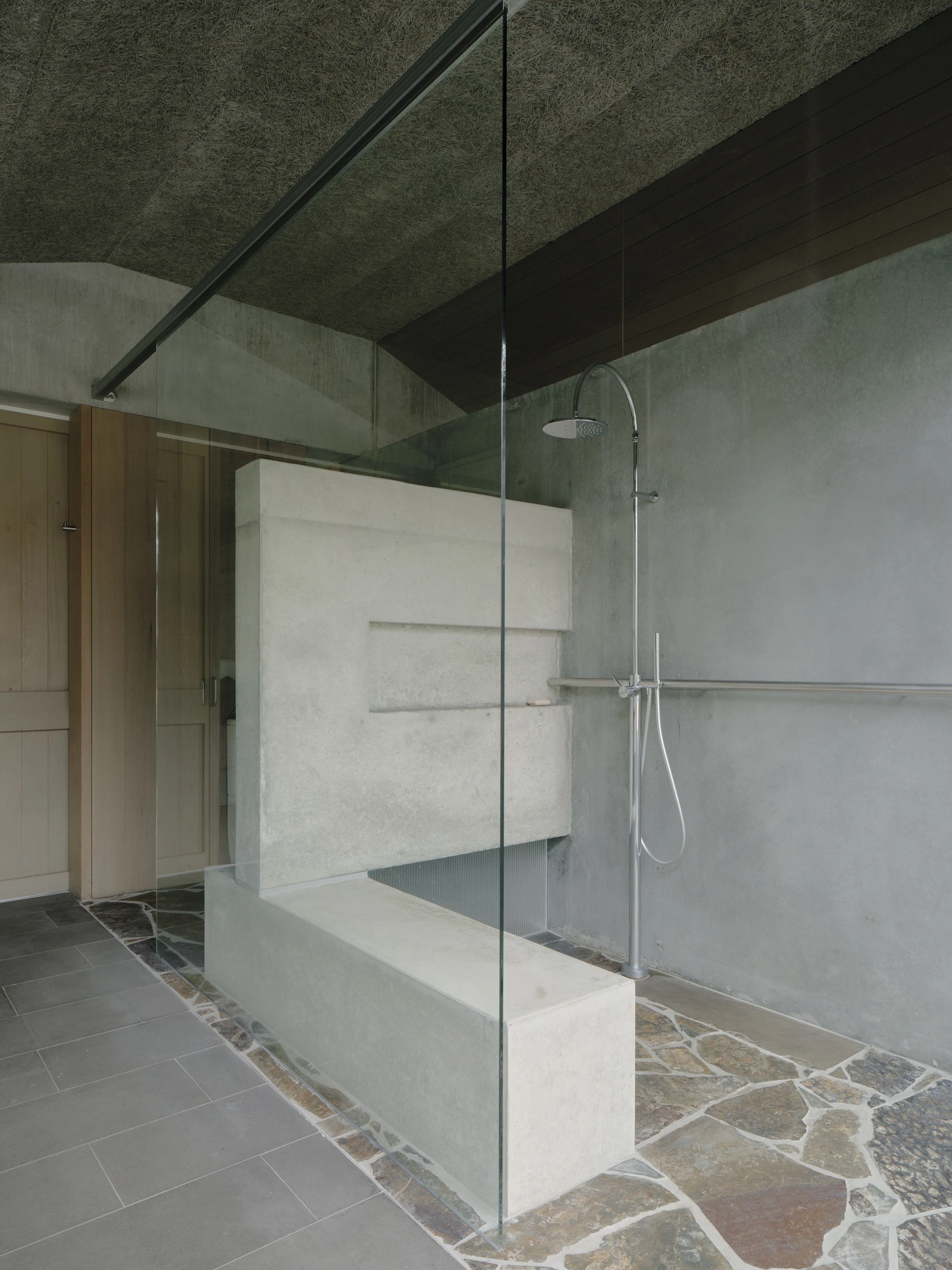
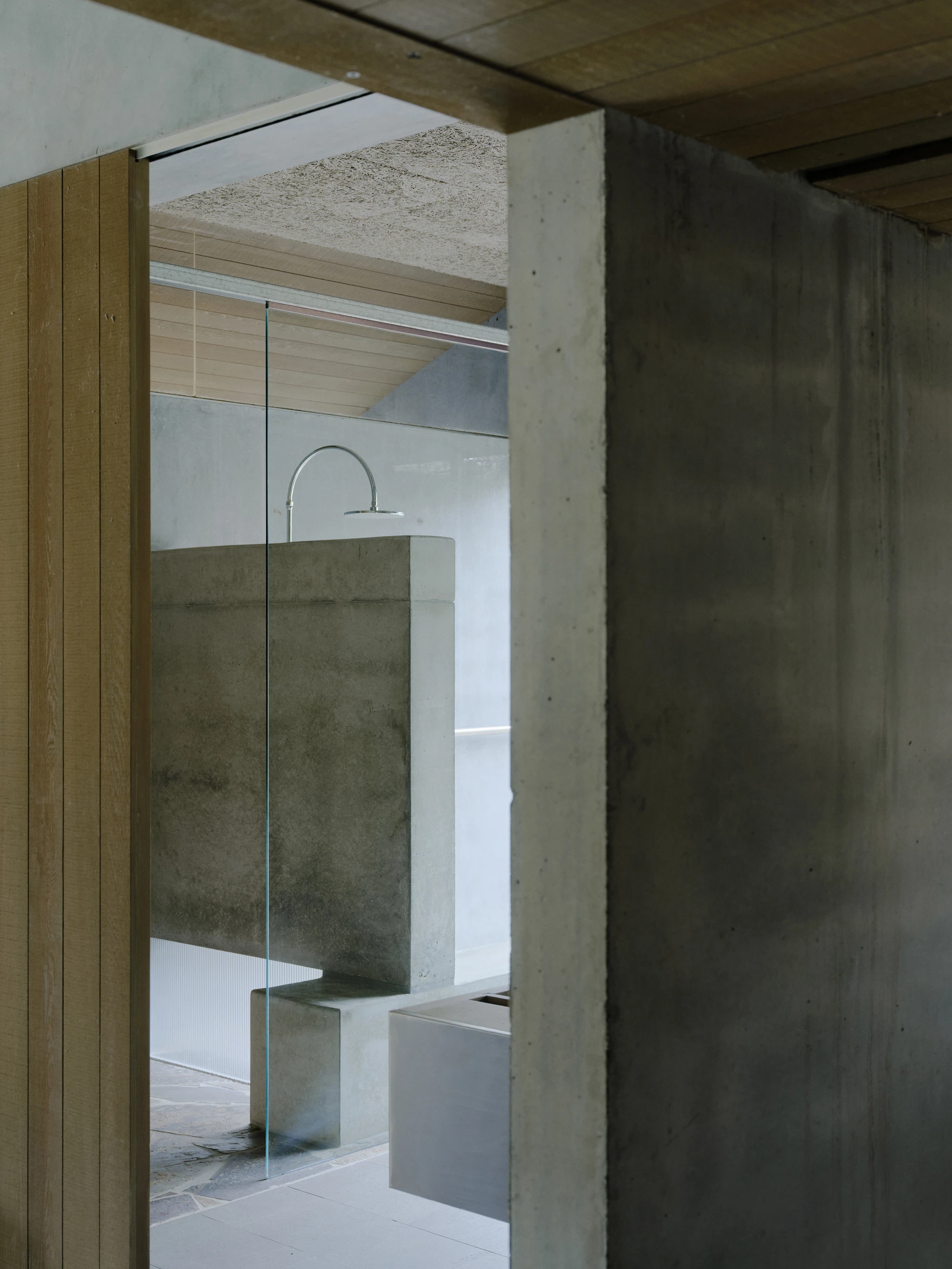
The first move was a subtraction. A retrofitted pane of glass that had sealed off a concrete wall was removed, letting the original off-form surface carry across the threshold as Couch had drawn it. Then came the addition: a new in situ concrete partition floating between shower and toilet, set onto a perpendicular concrete bench that doubles as a seat for ageing in place. Recessed niches echo the beam line above. From the bedroom doorway, the partition reads less as a wall than as a piece of furniture cast from the same family of forms as the house.
Underfoot, the calculation is more pointed. The original bluestone tile floor stays where Couch laid it, alongside the stainless steel vanity and its integrated timber towel-drying battens. Rather than match the bluestone, Pepper & Well introduced Mintaro Brown Back slate from South Australia, the same rare stone Couch used in his own bathroom at Toolern Vale, set in crazy paving against the rectangular grid of the existing tile. The seam is left exact and unapologetic. The slate is a quotation Couch himself would have recognised.
Above all of it, the compressed-straw Stramit ceiling continues uninterrupted, softening the concrete and telling the truth about how the house is built. Stainless steel fittings, the original brushed vanity, a thin steel grab rail doubling as towel rod, sit against board-formed concrete walls. There is no decorative gesture anywhere. What the room offers is rhythm: bluestone to slate to concrete to glass, beam to mesh to sky.
What Pepper & Well have done at Lumeah is small in the way that all the most useful work on existing buildings is small. A wall comes out, a wall goes in, a floor learns a new dialect from a quarry Couch trusted. The result restores integrity to one of the few compromised rooms in a house that has otherwise survived intact, and quietly extends the legacy of Paul Couch, a figure Australia is still in the process of fully recognising.