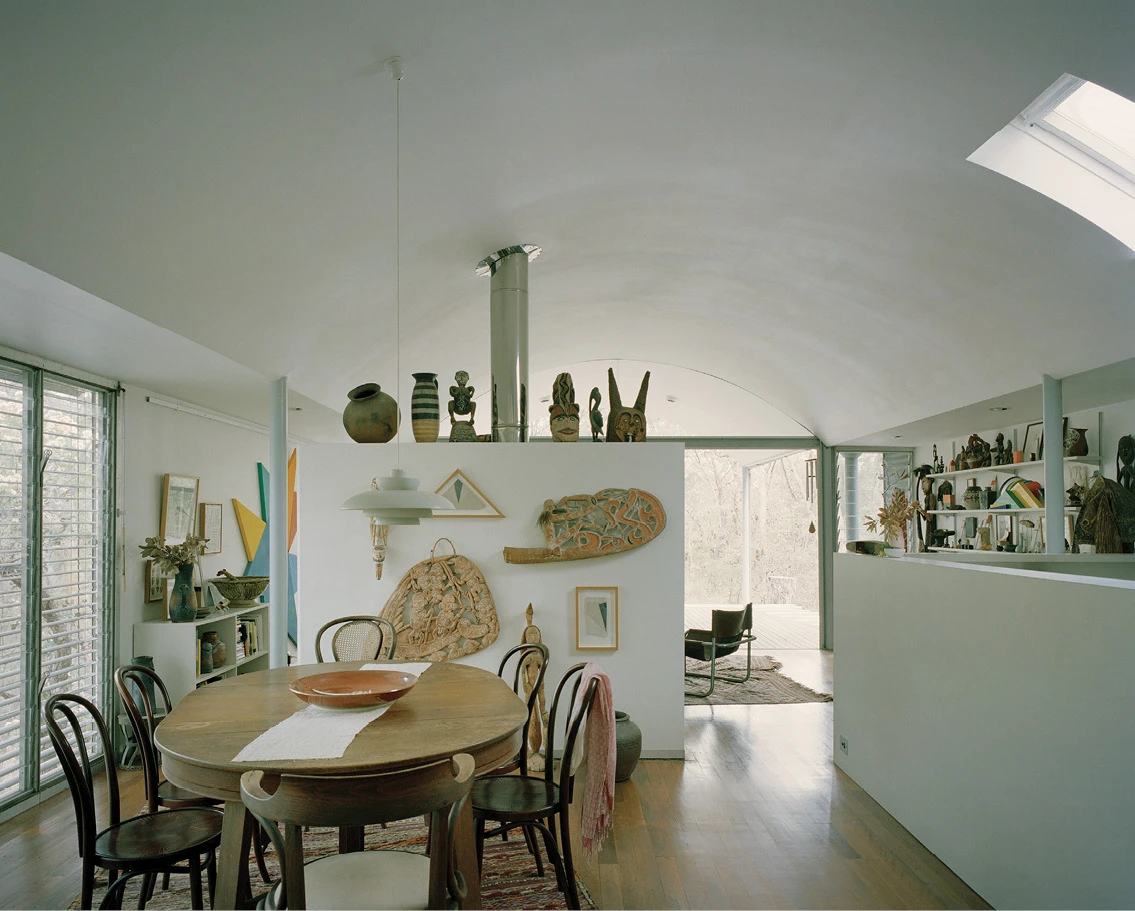
Sequestered away on a bushland site on the north-western outskirts of Sydney, Australia, where sprawling suburbia meets once-prime pastoral land, the Ball-Eastaway House was completed by Glenn Murcutt in 1983 and won the Wilkinson Award the following year.
It was designed for artist Lynne Eastaway and the pioneering Australian abstract painter Sydney Ball—a home built to hold both their lives and their work.
When Murcutt first visited the 10-hectare Glenorie site, he walked its dry sclerophyll forest for hours, observing pink angophoras and yellow bloodwoods, banksia and geebung, noting the size of the largest leaf down to the smallest. He studied the topographic contours and the lichen-clad sandstone ledges that corralled rainwater into rivulets and a nearby creek. He selected the building site quickly—a broad, gently sloping ledge of sandstone. "The rock shelf was the most suitable building site as it was already clear of trees, so we didn’t have to remove any, and the rock itself provides a safety zone against fire," Glenn explains. "The house is very much about fire and water."
A simple orthogonal structure clad in corrugated steel is cantilevered into the bush with a curved roof and glazed at either end. Two bedrooms, living and dining areas open to the bush, a kitchen and bathroom skylit from above, and hardwood floors throughout. The whole structure is elevated on slender steel columns drilled into the bedrock, allowing rainwater to continue flowing across the site unimpeded. Off the gravel driveway, a raised timber boardwalk leads to double glass doors, where entry brings you face to face with a signature Sydney Ball painting, several metres wide. "That’s called ‘prospect,’" Glenn explains of the framed landscape views. "But you also need ‘refuge.’"
For refuge, he designed one of the home’s two verandahs—a contemplative space enclosed on three sides under the curved roof, open only to the bush. "It’s designed as a meditation space," says Glenn. "When the awards jury visited, the chair told me it was the most serene space he’d ever been in." The second verandah, connected to the dining and living rooms, is social—projecting into the bush under the curved roof overhang.
Following Sydney Ball’s death in 2017, Lynne Eastaway commissioned Downie North for a gentle restoration. Catherine Downie and Daniel North reached out to Glenn, who granted them access to the Murcutt Archive. "His work, his method of practice and his way of seeing this country has enormously influenced our own practice," says Catherine. Their interventions—replacing worn timbers, repairing aluminium shutters, renewing plumbing—are nearly undetectable. For Glenn, revisiting the house after 40 years is pure delight: "It holds up very well! It’s a tough little house, but it’s also gentle."
Lynne has arranged for most of the acreage to be preserved in perpetuity as habitat sanctuary. The house that was built to touch the earth lightly will now be held by the earth in return.