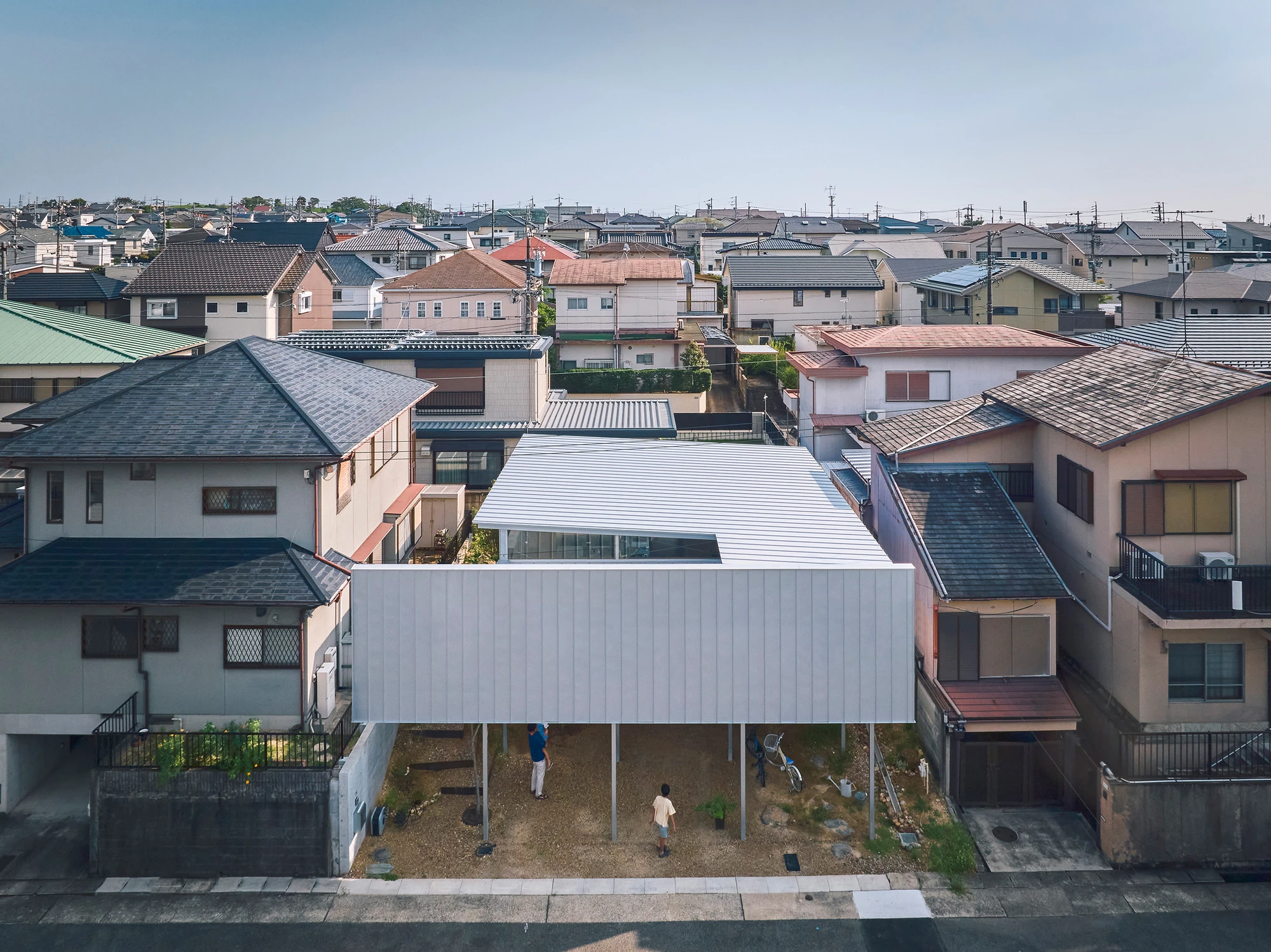
In an upscale residential district of Nagoya in Japan, Ikehara Architect & Associates lifts House in Shinokaze off a sloped plot on steel columns, opening a piloti garden beneath the single living volume.
House in Shinokaze sits on a sloped plot in an upscale residential district of Nagoya, where the land dropped roughly two meters across its own width. After demolition cleared the site, upper and lower platforms read as one continuous incline. Rather than terrace it flat or bury the difference, Ikehara Architect & Associates and the client made the slope the premise: if the openness of the ground could be kept, only a small amount of enclosed living space would be needed.
So the house floats. A single steel-framed volume, built to the maximum permitted footprint, lifts off grade on slender posts clad in ribbed silver metal. The space it opens underneath becomes a piloti lower garden, technically a garden but left without a fixed job. Where most houses fence off outdoor zones reserved for some imagined future, this one treats its undercroft as everyday slack, absorbing the small overflows of daily life. At first only the entry path and parking were fixed. Bicycles go anywhere, a hammock hangs between the posts, and the gravel and packed earth take whatever the week asks of them.
Inside, wooden columns on a 2,730mm grid carry the load and order the plan. A collar beam splits the section in two. Below it sits the living area, almost free of partitions but fitted with three full-height sliding doors that let rooms appear and dissolve. Lauan plywood lines the walls, oak boards run underfoot, and a stainless steel counter anchors the kitchen at the center. High-side windows at the collar beam wrap the room in daylight and frame the rooftops of the surrounding district.
Above the collar beam runs the second exterior space. The electrical and mechanical systems that a conventional home tucks out of sight are here left fully exposed, galvanized ducts, conduit and bracing wires treated as their own open-air zone serving the house. Nothing is concealed, and nothing pretends to be finished.
The result is one compact room that keeps expanding and contracting in conversation with the two vertical voids above and below it. Neither the lower garden nor the upper services are decorated into something they are not; both stay raw, usable and provisional. What Ikehara Architect & Associates offers is less a finished object than a frame for living, a dwelling that expects to keep changing as the people inside it do.