Thisispaper Community
Join today.
Enter your email address to receive the latest news on emerging art, design, lifestyle and tech from Thisispaper, delivered straight to your inbox.
Oops! Something went wrong while submitting the form.
Instant access to new channels
The top stories curated daily
Weekly roundups of what's important
Original features and deep dives
Exclusive community features
No items found.
Detached House by mA Style Architects
Alexander Zaxarov
May 5, 2026

In Shimada City in Japan, mA Style Architects completes a detached house whose cedar-clad exterior reads as a closed volume while the interior organises around a top-lit courtyard threaded with a living tree.

From the road, the house presents as a long cedar-clad gable with no windows. The surface is tongue-and-groove vertical boarding, honey-toned and uniformly tight, broken only by a concrete plinth and a service unit near the street edge. The roof ridge runs clean to both ends. Nothing in the exterior discloses what is happening inside, and that opacity is the argument.

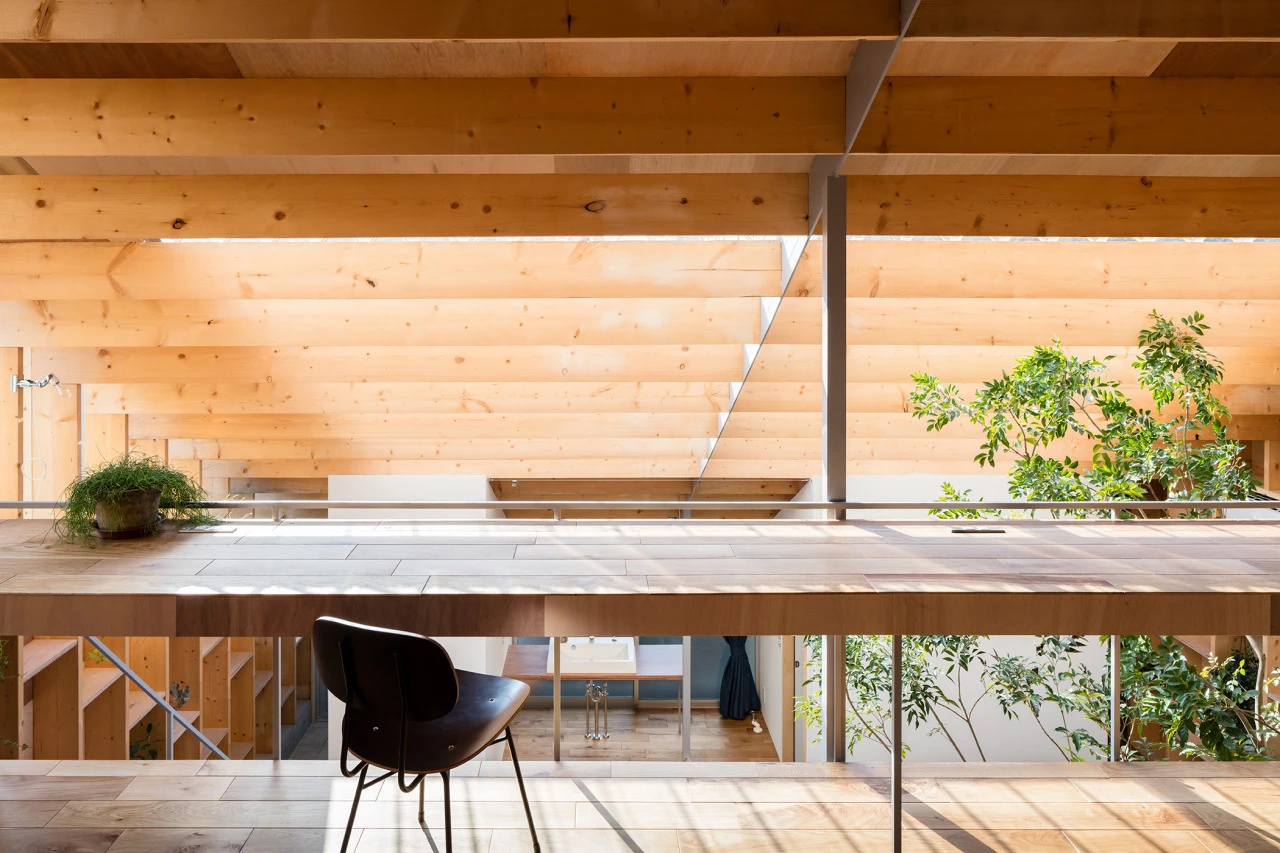
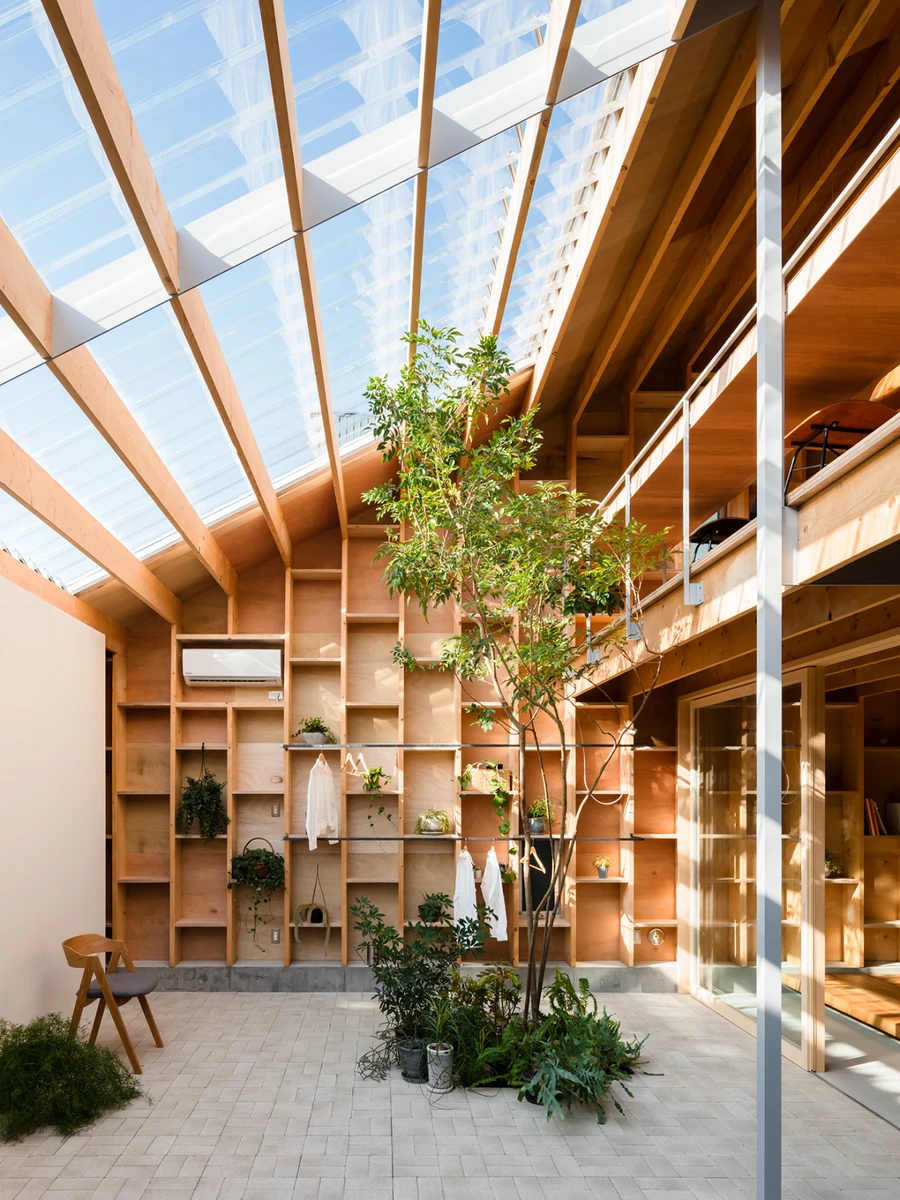
Inside, the house opens to a courtyard running the full length of the plan, roofed with a glass ridge skylight that follows the pitch of the gable. The structural logic is plain and exposed: a grid of cedar beams and posts supports both the shelving units and the glazed roof, so the elements that hold the house up are also the walls of every room. The cedar grid divides without partitioning, which means the interior reads as a single continuous volume even when it performs as a series of distinct spaces.

The light falls from above and from the courtyard, not from any exterior wall. In the section views, the ridge glazing fills the apex of the gable entirely, making the ceiling the most active surface in the house. Cedar beam flanges cast shadow grids across the polished concrete floor of the courtyard. A tree grows up through that floor, its canopy reaching the middle of the glazed zone; the metal stair rises alongside it, their silhouettes overlapping. The integration feels less like a design decision than like an outcome of the structural system being taken seriously all the way through.

The long desk that runs under the south-facing shelving works because of the diffuse overhead light. Plants are placed on the shelf modules with attention, and the whole thing has the quality of a workshop that happens to be a home: tools and books accessible, no surface finished in a way that makes it feel precious. The kitchen, visible through the courtyard, shares the same material language, stainless steel countertop against cedar frame, concrete against glass.

mA Style have described the house as a study in enclosure and privacy without darkness. The project makes good on that intention by refusing to make privacy a function of thick walls or opaque surfaces. The courtyard is the room. Everything else is partitioning within it.

Interested in Showcasing Your Work?

If you would like to feature your works on Thisispaper, please visit our Submission page and sign up to Thisispaper+ to submit your work. Once your submission is approved, your work will be showcased to our global audience of 2 million art, architecture, and design professionals and enthusiasts.
No items found.
We love less
but there is more.
Become a Thisispaper+ member today to unlock full access to our magazine, advanced tools, and support our work.
Get two months FREE
with annual subscription
We love less
but there is more.
Become a Thisispaper+ member today to unlock full access to our magazine, advanced tools, and support our work.
Get two months FREE
with annual subscription
No items found.
Alexander Zaxarov
May 5, 2026

In Shimada City in Japan, mA Style Architects completes a detached house whose cedar-clad exterior reads as a closed volume while the interior organises around a top-lit courtyard threaded with a living tree.

From the road, the house presents as a long cedar-clad gable with no windows. The surface is tongue-and-groove vertical boarding, honey-toned and uniformly tight, broken only by a concrete plinth and a service unit near the street edge. The roof ridge runs clean to both ends. Nothing in the exterior discloses what is happening inside, and that opacity is the argument.

Inside, the house opens to a courtyard running the full length of the plan, roofed with a glass ridge skylight that follows the pitch of the gable. The structural logic is plain and exposed: a grid of cedar beams and posts supports both the shelving units and the glazed roof, so the elements that hold the house up are also the walls of every room. The cedar grid divides without partitioning, which means the interior reads as a single continuous volume even when it performs as a series of distinct spaces.

The light falls from above and from the courtyard, not from any exterior wall. In the section views, the ridge glazing fills the apex of the gable entirely, making the ceiling the most active surface in the house. Cedar beam flanges cast shadow grids across the polished concrete floor of the courtyard. A tree grows up through that floor, its canopy reaching the middle of the glazed zone; the metal stair rises alongside it, their silhouettes overlapping. The integration feels less like a design decision than like an outcome of the structural system being taken seriously all the way through.

The long desk that runs under the south-facing shelving works because of the diffuse overhead light. Plants are placed on the shelf modules with attention, and the whole thing has the quality of a workshop that happens to be a home: tools and books accessible, no surface finished in a way that makes it feel precious. The kitchen, visible through the courtyard, shares the same material language, stainless steel countertop against cedar frame, concrete against glass.

mA Style have described the house as a study in enclosure and privacy without darkness. The project makes good on that intention by refusing to make privacy a function of thick walls or opaque surfaces. The courtyard is the room. Everything else is partitioning within it.

Interested in Showcasing Your Work?

If you would like to feature your works on Thisispaper, please visit our Submission page and subscribe to Thisispaper+. Once your submission is approved, your work will be showcased to our global audience of 2 million art, architecture, and design professionals and enthusiasts.
No items found.

Join Thisispaper+
Unlock access to 2500 stories, curated guides + editions, and share your work with a global network of architects, artists, writers and designers who are shaping the future.
Get two months FREE
with annual subscription
Travel Guides
Immerse yourself in timeless destinations, hidden gems, and creative spaces—curated by humans, not algorithms.
Explore All Guides +
Submission Module
Submit your project and gain the chance to showcase your work to our worldwide audience of over 2M architects, designers, artists, and curious minds.
Learn More+
Curated Editions
Dive deeper into carefully curated editions, designed to feed your curiosity and foster exploration.
Off-the-Grid
Jutaku
Sacral Journey
minimum
The New Chair
Explore All Editions +
Atlas
A new and interactive way to explore the most inspiring places around the world.
Interactive map
Linked to articles
300+ curated locations
Google + Apple directions
Smart filters
Subscribe to Explore+
Become a Thisispaper+ member today to unlock full access to our magazine, submit your project and support our work.
Join Thisispaper+Join Thisispaper+
€ 9 EUR
/month
Cancel anytime
Get two months FREE
with annual subscription