WOOYOUNGMI’s new flagship in Seoul’s Itaewon district, designed by Stocker Lee Architects reads less like a store and more like a discreet urban monolith, its presence defined by the site’s idiosyncrasies rather than any overt gesture of branding.
The volume bends with the curvature of the street, absorbing the slope with an almost geological patience. This subtle distortion of form, inherited directly from the plot, lends the building a quiet inevitability, as though it had crystallized out of the neighbourhood’s preexisting geometries rather than being inserted into them.
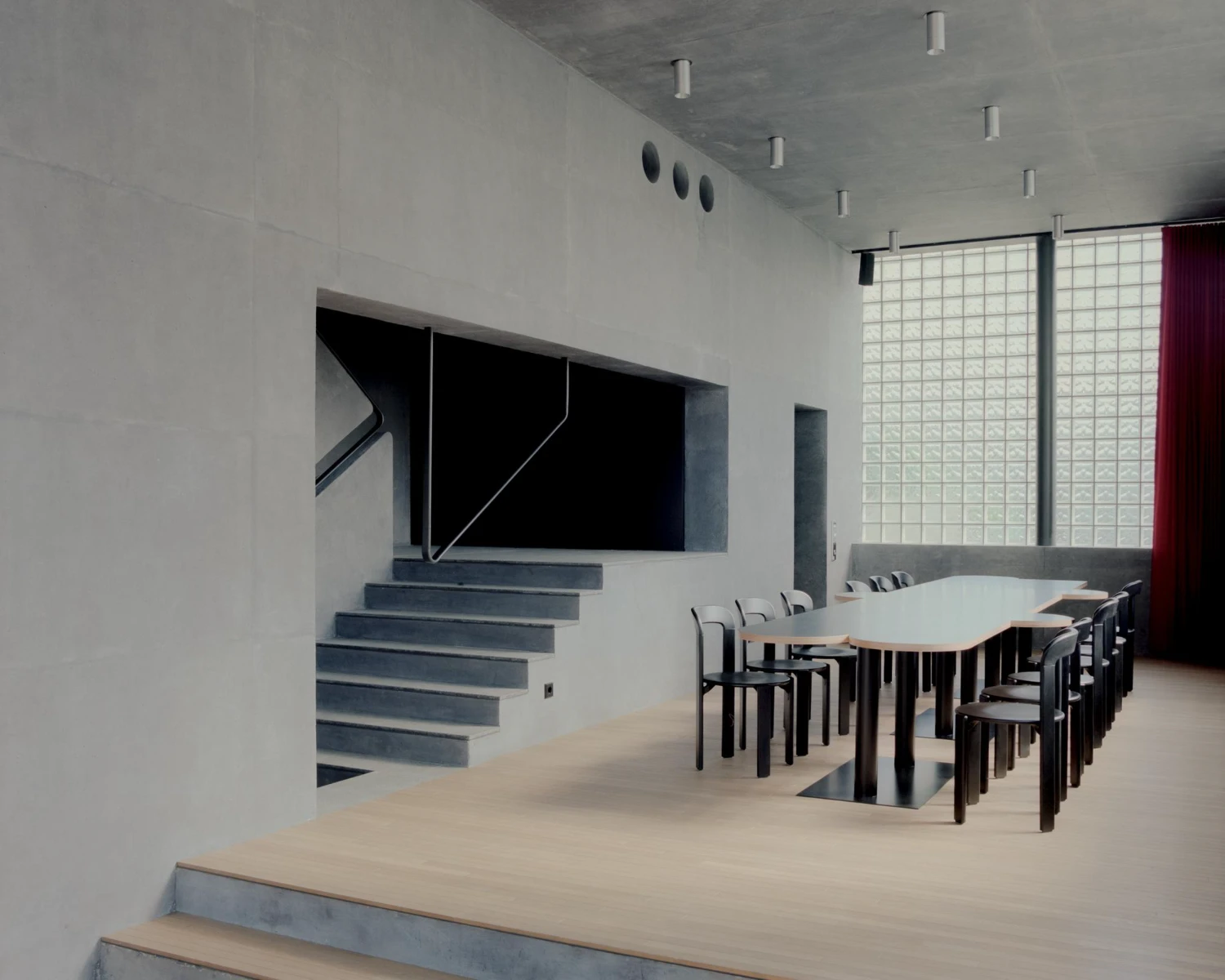
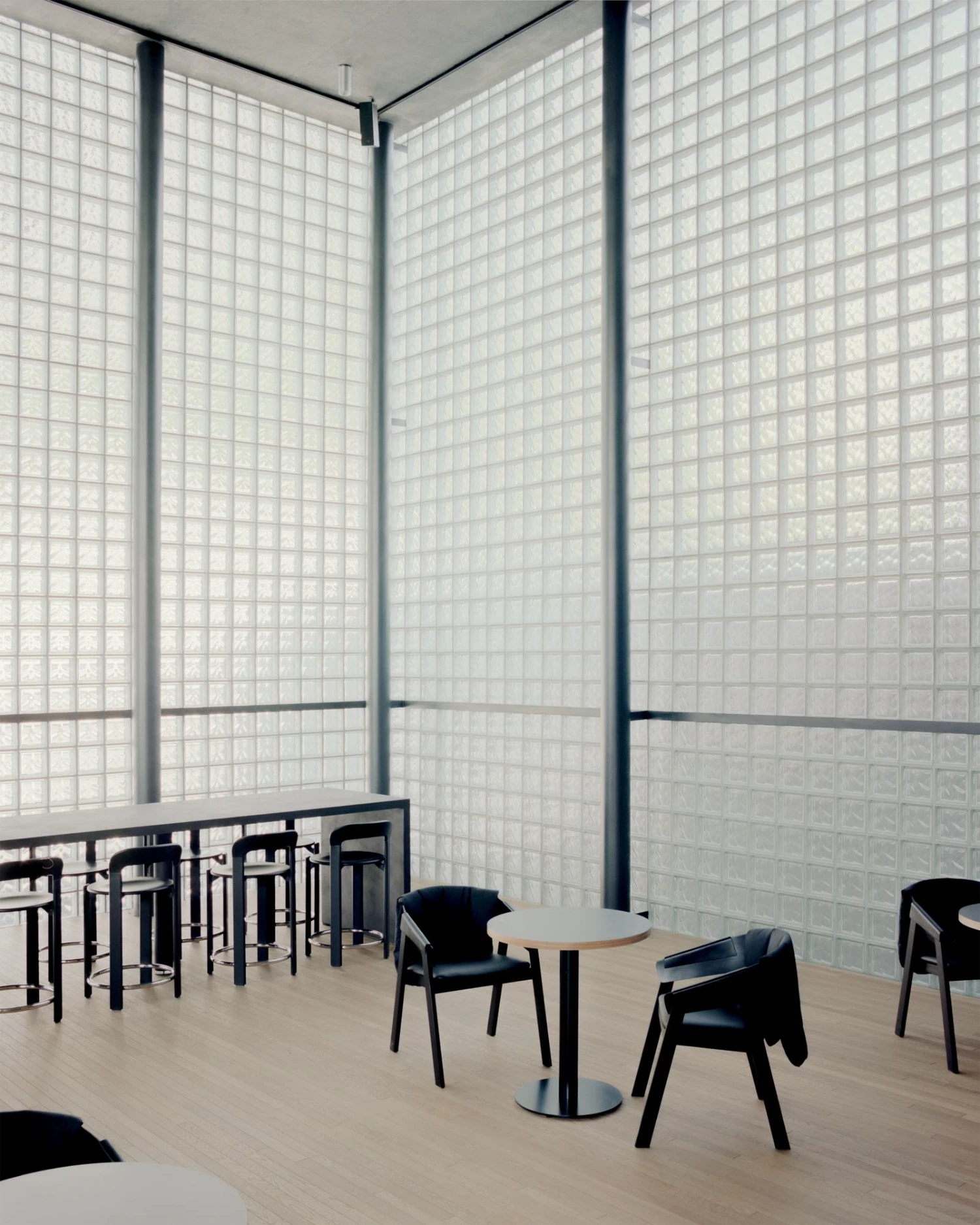
What emerges is a duality of surfaces: the lower mass, a softly variegated concrete shell, and the upper register, a luminous skin of glass blocks. The concrete, cast in OSB formwork and finished with a mineral glaze, carries a textile-like grain—an architectural analogue to the brand’s own attention to material tactility. Its patina catches and holds light with remarkable restraint. Above, the glass block façade operates like a vast lantern. In daytime it diffuses the city into a soft atmospheric wash; at night it reverses direction, releasing a muted glow that seems less about display and more about registering human presence.
Inside, a calibrated sequence of mezzanine levels negotiates the slope, creating a spatial rhythm that shifts subtly between compression and openness. The vertical core becomes not simply circulation but the hinge of the building’s internal choreography, binding the spaces into a continuous promenade. The effect is quietly cinematic: garments appear and disappear across varying heights and proportions, never staged, always encountered.
Materially, the palette is ascetic—concrete, glass, steel, stone, wood—each selected for structural clarity rather than aesthetic flourish. Yet this economy generates its own richness. The architecture withdraws just enough to let the clothing assert itself, but not so far as to become neutral. Instead, it frames an atmosphere where light, texture and proportion become active collaborators in shaping the store’s identity.
In a district often defined by noise and visual excess, the WOOYOUNGMI flagship stands apart by refusing spectacle. Its success lies in how deftly it transforms constraint into ambience, turning an awkwardly curved site into a spatial experience that feels both anchored and strangely weightless.