Time of Action 025 by Chaeyoung Lee unfolds with a quiet insistence on slowness, as though the works were formed not in a studio but in the accumulated duration of a lived day.
Chaeyoung Lee treats matter less as material and more as a witness—an interlocutor in a dialogue conducted through repetition, abrasion, and a deliberate surrender to chemical change. The carved black reliefs, with their stacked geometries, feel like tectonic plates that have learned to breathe. Their surfaces, rippled by the asa chisel, record a choreography of gestures: each incision a unit of time, each unit a decision to remain present.
What’s striking is how Lee displaces the usual hierarchy between form and process. The ebonized surfaces, especially on the rectangular compositions, don’t read as finishes but as strata—an archive of reactions between tannin, iron, and intention. The choice of beech, a pale wood that demands an almost excessive commitment to reach full darkness, becomes an aesthetic stance. Black here is not a color but a sedimented duration, the outcome of persistence. Even the uniformity of tone is deceptive; subtle shifts remain, revealing how matter negotiates with manipulation rather than submitting to it.
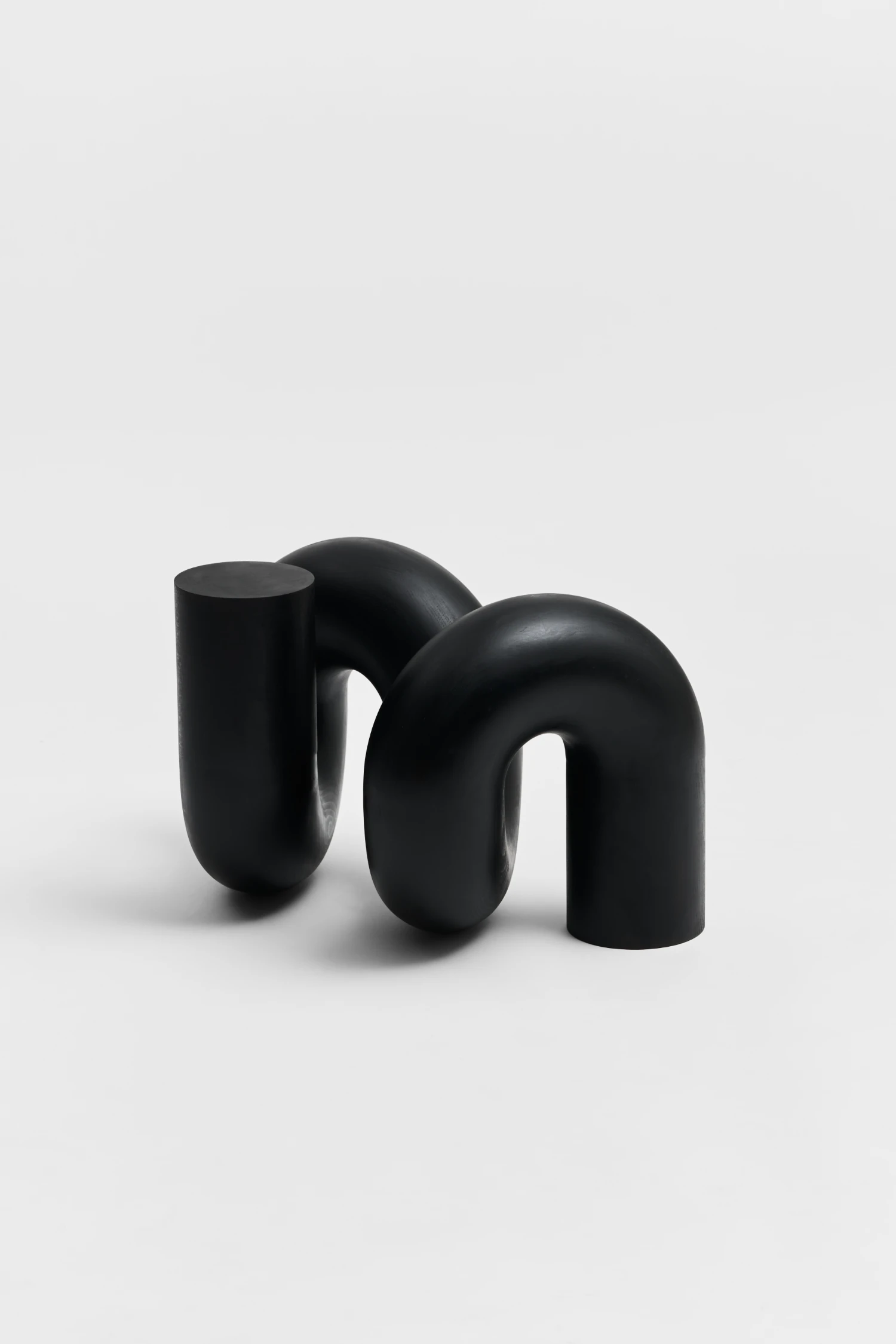
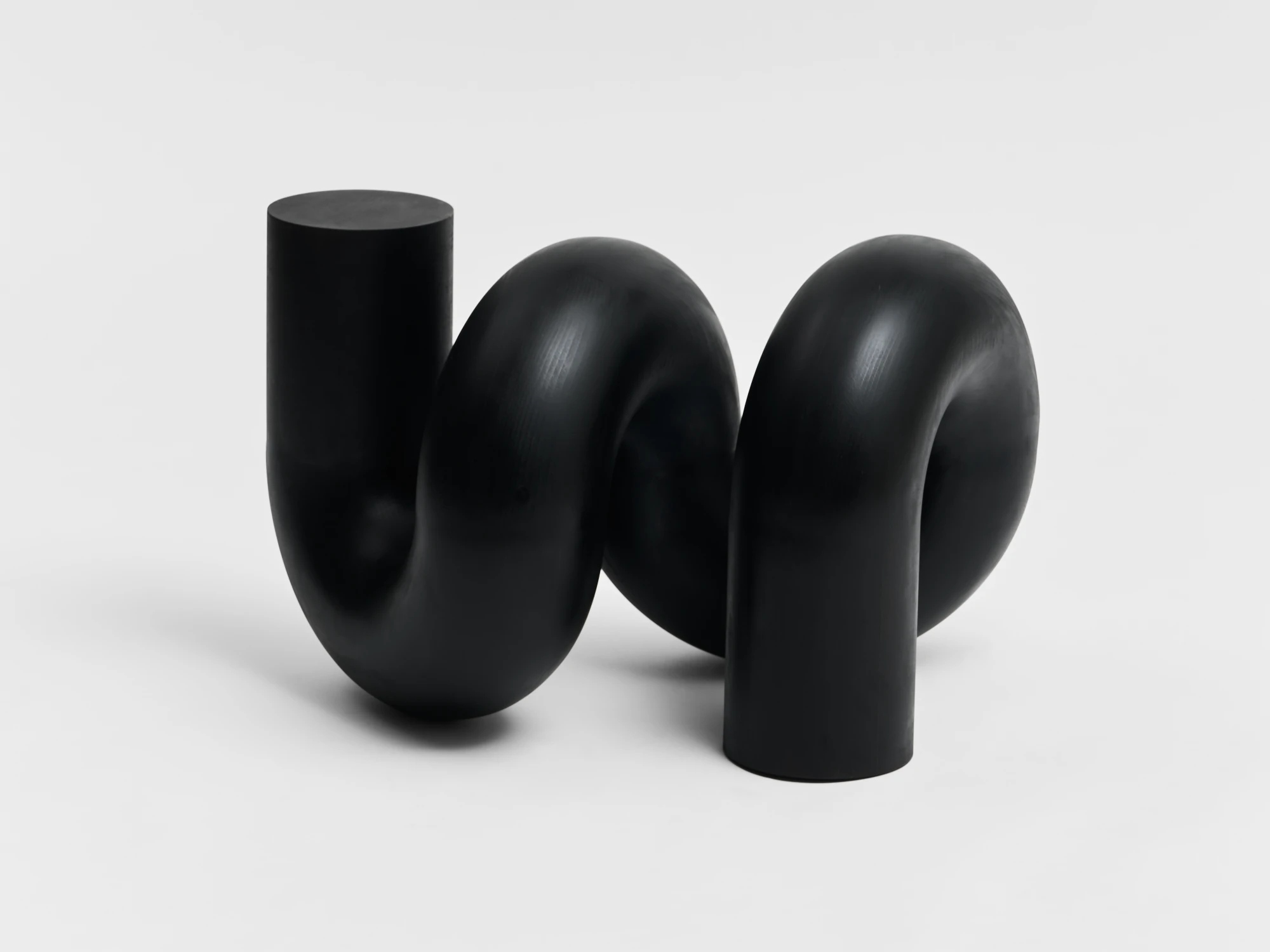
Alongside the carved panels, the tubular sculptures introduce a counterpoint: fluidity within constraint. These matte-black forms—looped, knotted, leaning—feel like punctuation marks escaping the linearity of language. Their curves suggest motion interrupted, a gesture paused midair. Where the reliefs capture time through accumulation, the tubular pieces do so through suspension; they behave like time folded back onto itself. Their spareness heightens their presence, inviting viewers to consider how a single bend might hold the residue of a dozen micro-decisions.
The long, tapering piece that leans against the wall behaves almost like a metronome of intention. Its subtle arc feels less sculpted than coaxed into being, its shadow serving as a second line drawn by duration. It is a reminder that time is not only measurable but also spatial—that shape itself can occur through the slow negotiation between gravity, material, and touch.
Taken together, Time of Action 025 feels like a proposition for an alternative productivity, one in which meaning accrues not through possession but through attention. These works don’t present objects so much as evidence: of labor, of presence, of staying with a form until it reveals a state both transformed and strangely faithful to its beginnings. In their quiet insistence, they ask us to return to the here and now, to recognize that value lies not in the finished artifact but in the intervals that make it possible.