


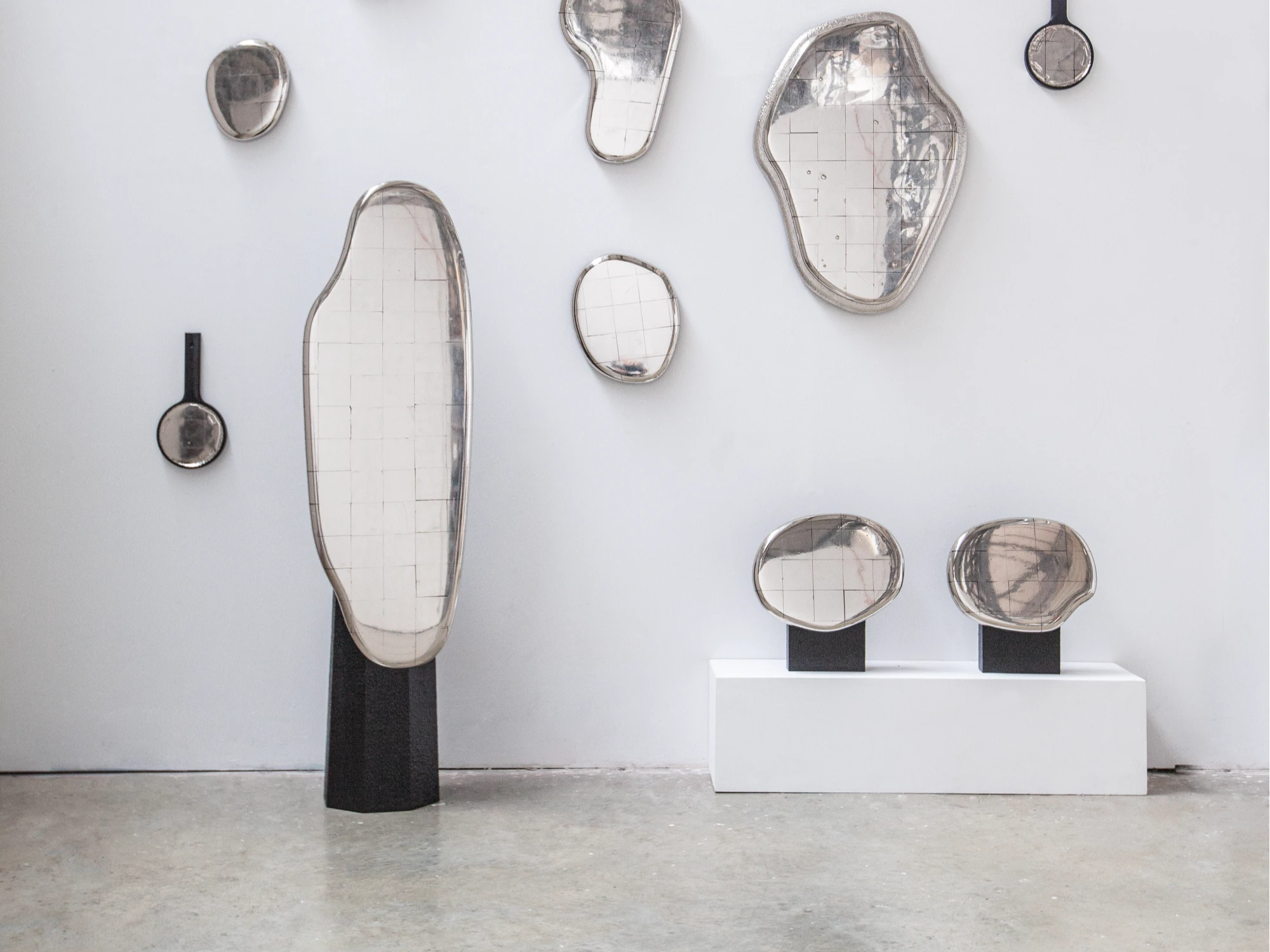
In Mercure: Alchemy of Wood and Light, Quentin Vuong returns the mirror to its most primordial state—not as a passive reflector of reality but as a living, breathing surface of transformation.
Quentin Vuong presents a family of mirrors that reject the cold precision of modern industrial glass. Instead, he crafts softened, undulating forms from chiselled, blackened beech, resin, and a rare Caplain leaf—an alloy of 24-karat gold and palladium. The effect is quietly alchemical: the works don’t just reflect light; they melt it.
In their irregular, organic contours, these sculptural mirrors evoke polished river stones, ancient tools, or fragments of something once whole and sacred. Their surfaces are subtly gridded, bearing the fine scars and seams of manual assembly. Light passes over them not like a beam but like a breath—softened, bent, and diffused. There’s an intimacy to how the viewer encounters their reflection here. Not head-on, but gently, as if glimpsing oneself in water.
Vuong’s pieces are not mirrors in the traditional sense; they are philosophical instruments. They decelerate the act of looking. In their distortions and tactile imperfections, they ask us to consider how we see, and what is worth seeing. Their shimmering surfaces resist the impulse of self-inspection and invite, instead, a moment of reverie. Time slows. Images slip. What remains is not likeness but sensation—a lingering trace of light, shape, gesture.
This collection sits somewhere between object and relic, charged with a quiet power. Vuong’s refusal of speed is not nostalgic but visionary. In an age obsessed with clarity and immediacy, his work proposes a more tender kind of attention—one grounded in the handmade, in slowness, in the imperfect beauty of presence. These mirrors are not about vanity but about rediscovery—of materials, of gestures, of the self.


