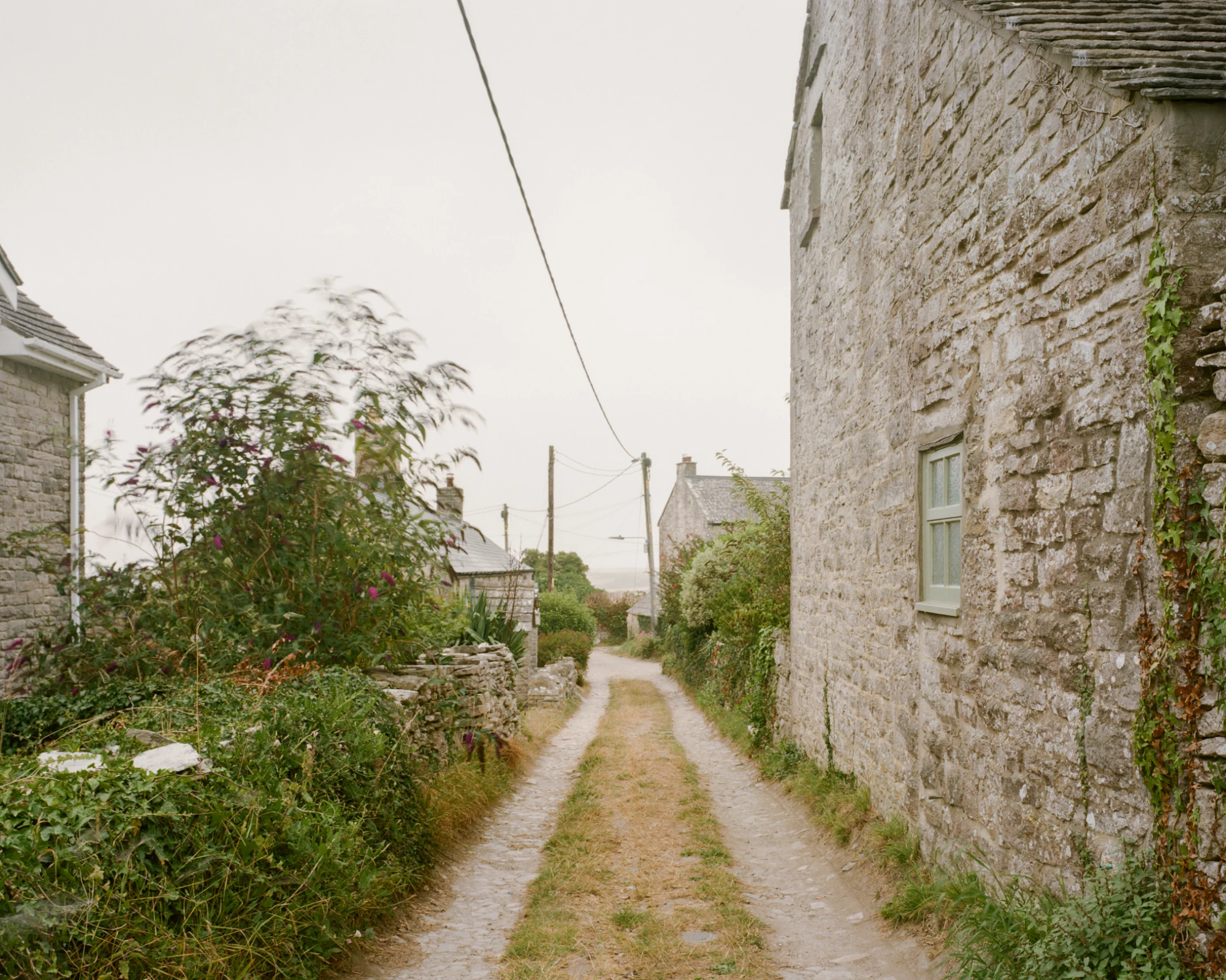
At Purbeck Cottage on the Jurassic Coast, London practice TYPE adjusts rather than replaces, stitching two 19th-century quarrymen's cottages from joists denailed by hand and stone sinks cut from quarry off-cuts.
The client brief rejected the fresh, clean look of a standard renovation. TYPE responded with what the studio calls radical reuse: before specifying anything new, the practice catalogued what could be kept, repaired, moved, or adapted across the two adjoining stone shells. Old joists were denailed by hand and put back as studwork. Damaged floorboards became ceiling cladding. Original staircases were lifted, reconfigured, and dropped back into place. Even the stone sinks were carved from leftover fragments at a nearby Purbeck quarry.
The 85 sq m plan stitches the two cottages into a single dwelling without disguising the seam. A double-height central volume anchors the house, with exposed rubble-stone walls, flagstone floors, vertical timber boarding, a deep masonry fireplace, and a reclaimed French stove dropped into the hearth. The kitchen sits one room over, linked back through a restored butler's window above a stone sink. Cabinet fronts are salvaged timber boards still carrying their red and green factory paint, hinged with hand-forged butterfly straps.
Upstairs, two sleeping zones occupy opposite ends of the house, separated by the taller central volume. One side holds the principal bedroom, opening through a wide internal window framed in reclaimed boarding so the room reads into the living space below. The other side is a mezzanine writer's room, a single desk under a pitched timber ceiling, with a small wood-burner set into a brick-lined recess. The plan refuses the open-everything logic of most rural retrofits and keeps the directness of the original cottage rooms.
The envelope was left almost untouched. No extension, no roof lift, no glazed box plugged onto the back. The energy work followed the same logic as the material strategy: improve the building without turning it into a new one. Wood-fiber insulation was tucked into the roof, lime-based insulating lime plaster replaced cement render across the walls, and the old fossil-fuel boiler was swapped for an air-source heat pump and roof-mounted solar. Hand-bent green-painted steel balustrades, a blue range cooker, and the pale blue stable doors are among the few moves that read as new.
Purbeck Cottage feels convincing because the reuse is not decorative. It sits in the structure, the fittings, the surfaces, and the small decisions that let the house stay close to what it already was, a quarryman's cottage that has been adjusted rather than replaced.