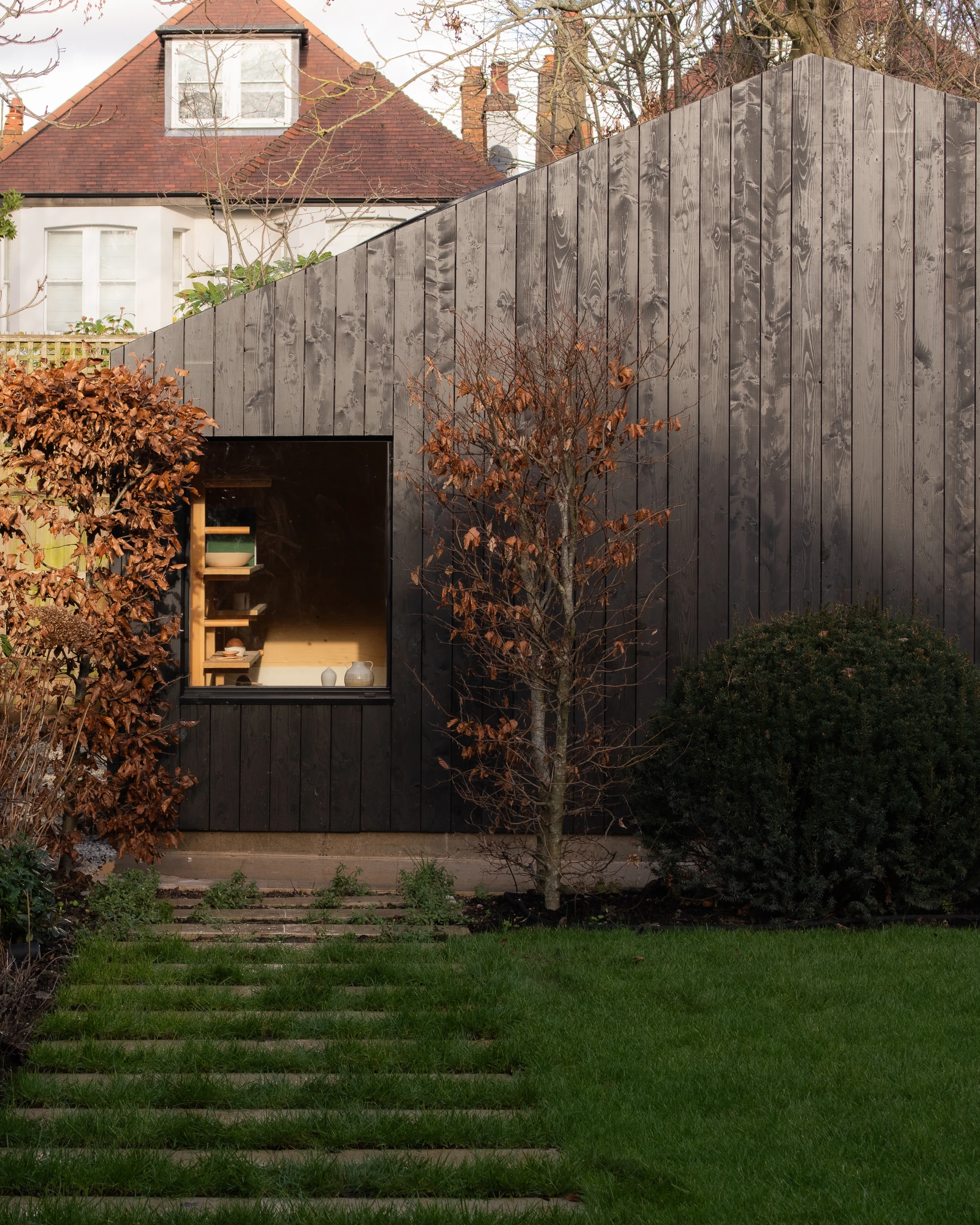
In the rear garden of a Victorian house in North West London, Piercy&Company sinks a timber-lined pottery studio 600mm into the ground — capped with a circular oculus that fills the room with the particular quality of light that clay seems to require.
The site is constrained on every axis that matters. The Mapesbury Conservation Area in North West London imposes strict planning rules on new development, limiting building height, massing, and visual impact within the garden settings of its largely Edwardian and Victorian housing stock. The existing garden studio being replaced was small, unremarkable, and occupying the same footprint. The brief was to relocate the owner's pottery practice from the house's attic — where the clay dust and the wheel's splash zone had never quite settled in — to a dedicated structure that could hold the mess and the focus that the work requires.
Piercy&Company, working in collaboration with Anthony Boulanger, found the solution in the ground. By sinking the studio 600 millimetres below the garden level, the building achieves a generous internal height of approximately 2.8 metres while presenting a shallow gabled profile to the neighbours — barely higher than the garden wall, disappearing under the tree canopy of the rear garden. The move is elegant in its logic: a constraint transformed into a spatial quality, the sense of enclosure that a sunken room provides becoming an asset for a practice that requires concentration.
The interior is constructed entirely in spruce plywood — walls, ceiling, shelving, workbench — so that the room reads as a single warm volume, its materiality undivided. The circular oculus at the apex of the gabled ceiling is the spatial event around which everything else organises. Through it, the tree canopy above the garden becomes the room's view: a framed circle of branches and sky that changes with the seasons and the light, anchoring the studio's contemplative atmosphere without requiring a window in a direction that would compromise the conservation area's visual continuity. South-facing openings along the gable faces allow working light to enter at a lower angle, casting the long shadows across the plywood surfaces that photographers of craft interiors understand immediately.
An 18-square-metre building is barely a room. But rooms built for specific practices have a way of enlarging themselves through use — and in the photographs by Alex Jackson, the studio already reads as a space that has been inhabited, that holds the accumulated attention of the work done within it. There is a potter's wheel, a Belfast sink, shelves of white objects at various stages of completion. The circular oculus frames bare branches. The plywood glows amber in the afternoon light. It is exactly the right room, in exactly the right place.