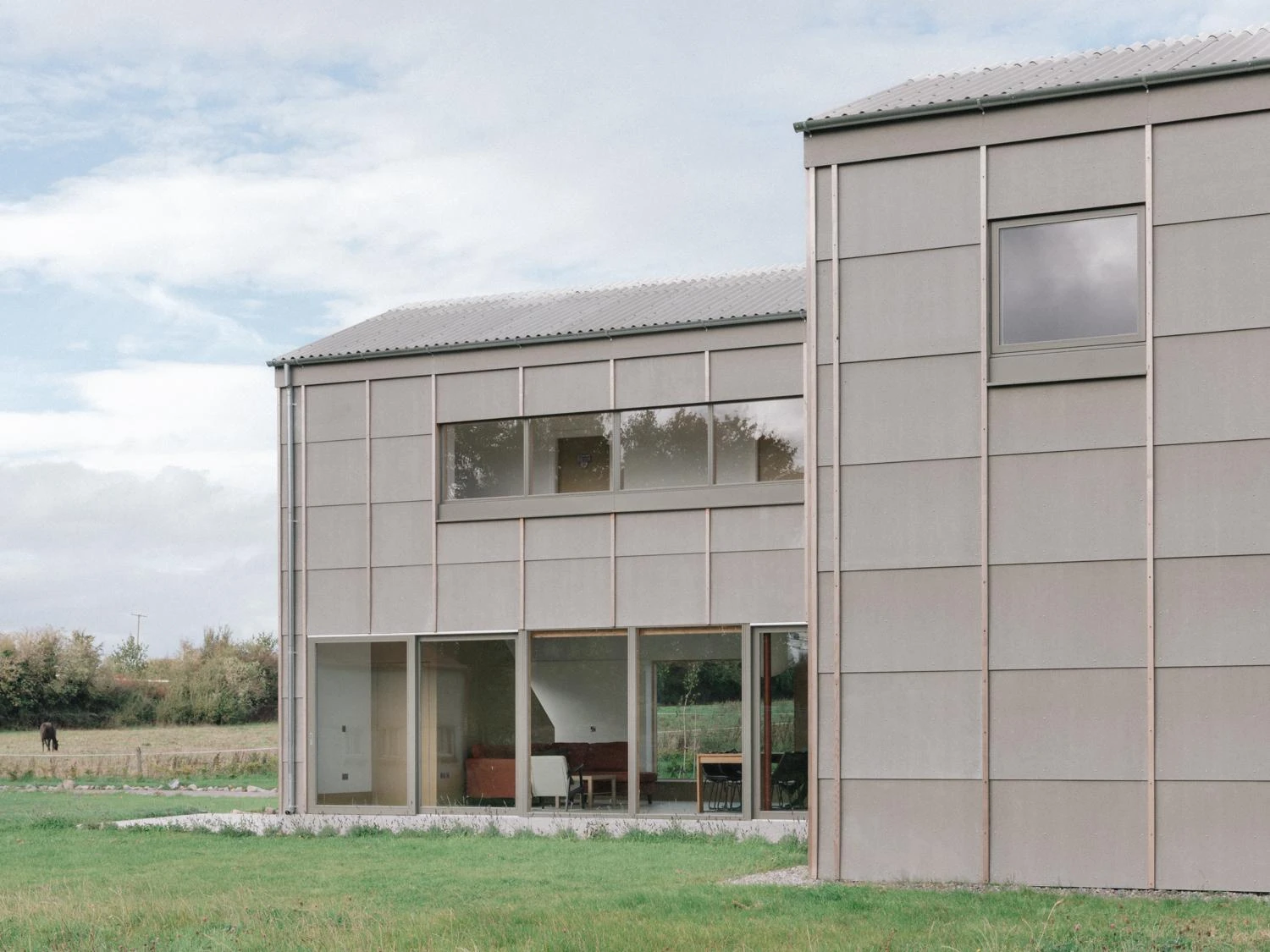
In Ireland's rural midlands, O.B. Architect delivers Suburban Family House, a 210 m² timber-frame dwelling, pitched as a working argument against standardised housing.
The case is made in numbers. SCSI data puts a standard 115 m² three-bed semi at roughly €2,000/m² ex-VAT before land, fees or scheme infrastructure. Comparable bespoke one-off houses at this scale sit closer to €3,000 to €3,500/m². Thomas O'Brien's 210 m² detached house in Tipperary has come in at €2,250/m² ex-VAT, nearly twice the floor area of the standard semi, finished to a markedly higher standard, and pegged at the lower end of the bespoke range.
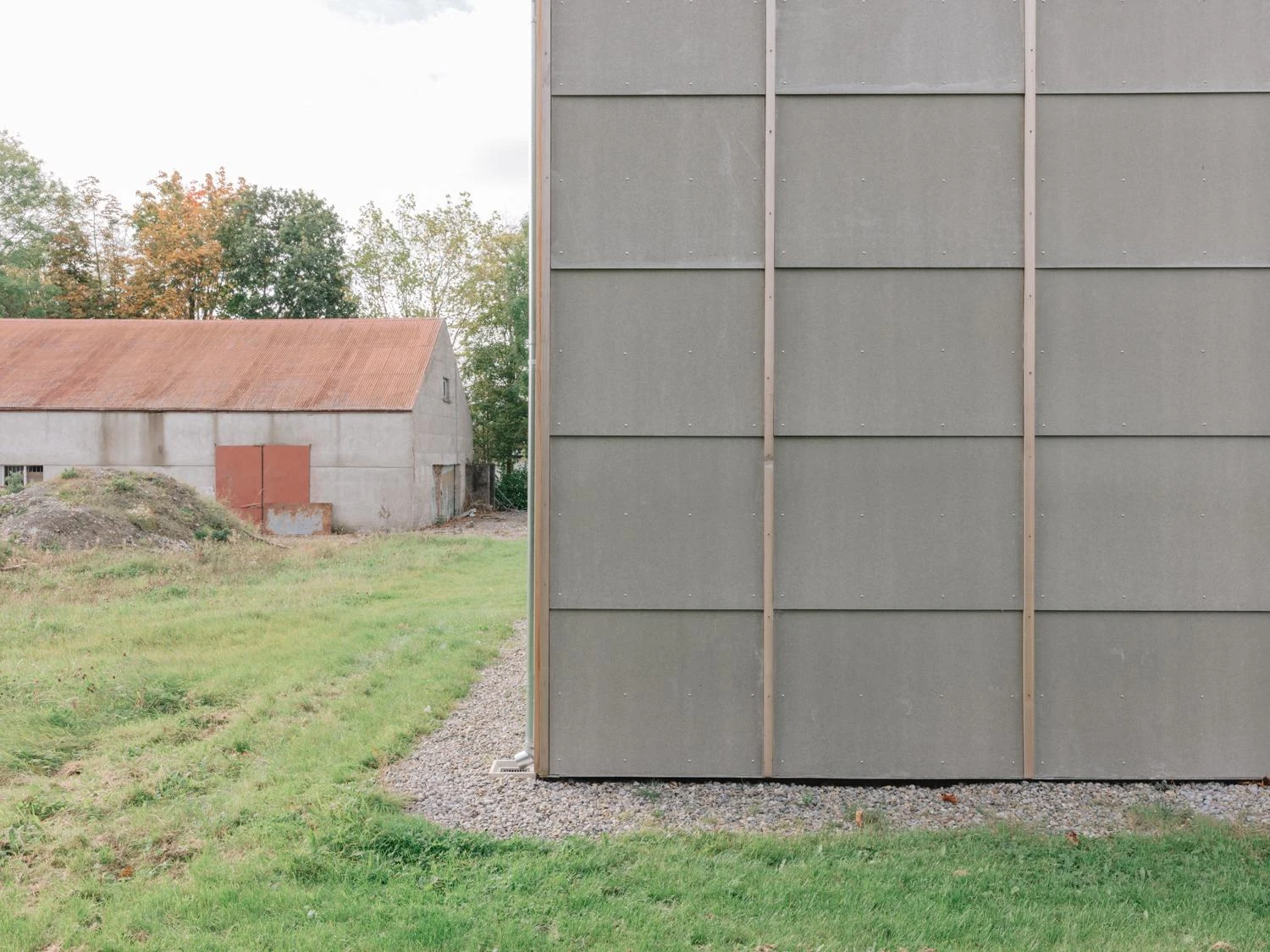
The envelope does the heavy lifting. A carefully detailed timber-frame construction, high insulation, airtightness and a heat-pump-based system land the house at A2 on the BER scale. Cement-board panels clad the pitched volumes outside, fixed in a grid of vertical timber battens with exposed nail heads pressed flat against the surface. Two gabled forms, roofed in shallow corrugated metal, sit side by side on a flat green plot. The vocabulary is recognisably agricultural, edited down.
Inside, the structure is left declarative. Glulam beams in pale spruce run the length of the open ground floor, propped at the junctions by slim red-painted steel columns capped with visible bolted plates. Large square sliding doors in pine framing open the living room to the garden. A square punched window over the dining table frames a single tree. The kitchen runs in birch-ply joinery against a wall of small white tiles; counters in solid pine, sandy MDF islands underneath. Floors are pale large-format porcelain.
What the architect calls a dry, numbers-focussed presentation is in fact an argument addressed to policy makers and developers. "Crucially, nothing about the construction logic of this house is inherently unrepeatable," O'Brien writes. The same disciplined approach to fabric, orientation, section, daylight, material choice, ventilation and services, the studio insists, could scale into developer-led terraces, semis and apartments without defaulting to a minimal permissible spatial quality. Given €2,000/m², the studio says, a lot more could be done.
The build was made possible by an exceptional and value-orientated main contractor, and that dependency is named honestly. But the techniques on display, generous section, oriented glazing, durable cement-board cladding, a legible timber structure, are not in themselves luxuries. "What distinguishes this project is not indulgence," the studio writes, "but the intentional use of design to extract more environmental and spatial value from each square metre." The conclusion follows: design quality is not an excess. It is the mechanism by which a 210 m² suburban dwelling at €2,250/m² is even possible.