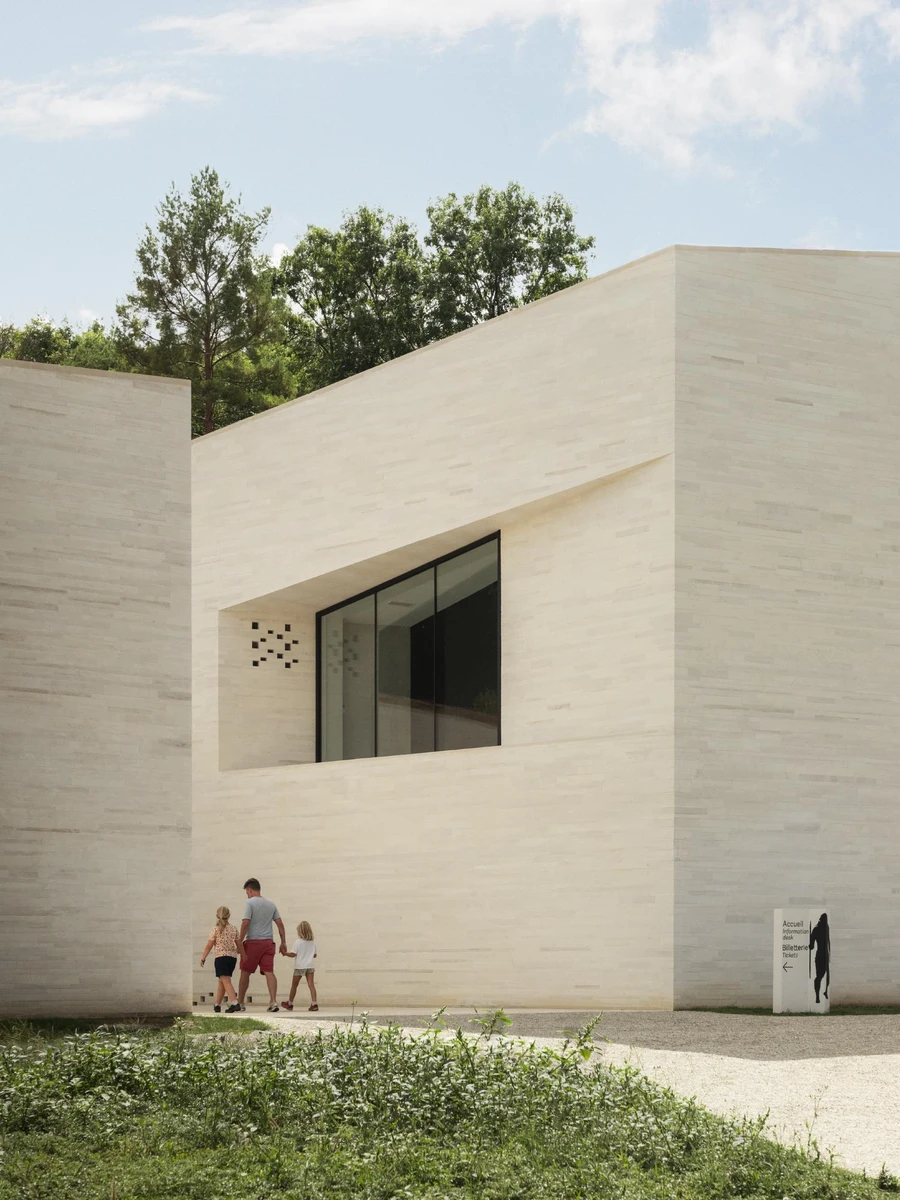
In the Correze village of La Chapelle-aux-Saints, where the first complete Neanderthal skeleton was unearthed at Bouffia Bonneval, W-Architectures builds a museum poured from the site's own aggregate.
The building is less a destination than a route. It reads as a path that begins at the edge of the village and ends at Bouffia Bonneval, the cave where the burial that changed how the world thought about Neanderthals was found in 1908. Between the two, the museum threads itself through a place whose history is tied to the caves below it, staging shadow and light, full and empty, past and present as a sequence a visitor walks rather than a set of rooms to be toured.
The walls are the argument. W-Architectures casts them in layered concrete, mixed with aggregate drawn from the site and poured in situ in successive passes, each lift leaving a horizontal seam. The result carries the color of the region's limestone outcrops and the logic of how they were made: sedimentation, deposit, stratum, time pressed into rock. The pale cream mass sits against the ochre stone farmhouses and the octagonal church tower without imitating them, a modern building that refuses to disguise itself as old.
Rather than sit on the land, the volumes follow it. The floors extend outward and only the buildings emerge, so that a roof becomes an original ground plane laid back over the slope. In several images the roof reads as a raised timber walkway threading past the parish cemetery, its stone crosses left in place, the church tower framed dead center between two sheer walls. The link to the existing fabric is made through emptiness, through the gaps between masses rather than any forced connection.
Inside, the register shifts from limestone pallor to raw board-formed concrete, its tie-holes and grain left visible, the word Neandertal set in white across the lobby wall above a low bench. The exhibition halls go dark and cold, a descent that echoes the caves themselves, screens and lit vitrines suspended in near-black while the concrete ramp carries visitors down through the story of the burial. Between the volumes, courtyards open to the sky, floored in the same pale stone, glazed with slim black-framed walls.
The studio describes the intent as reaching out beyond the physical limits of the village with determination and restraint. Not to overhaul the site but to reveal it. The museum earns its boldness by holding still, letting the church, the caves, the graves and the valley landscape stay the subject, and offering itself as the calm connective tissue between them.