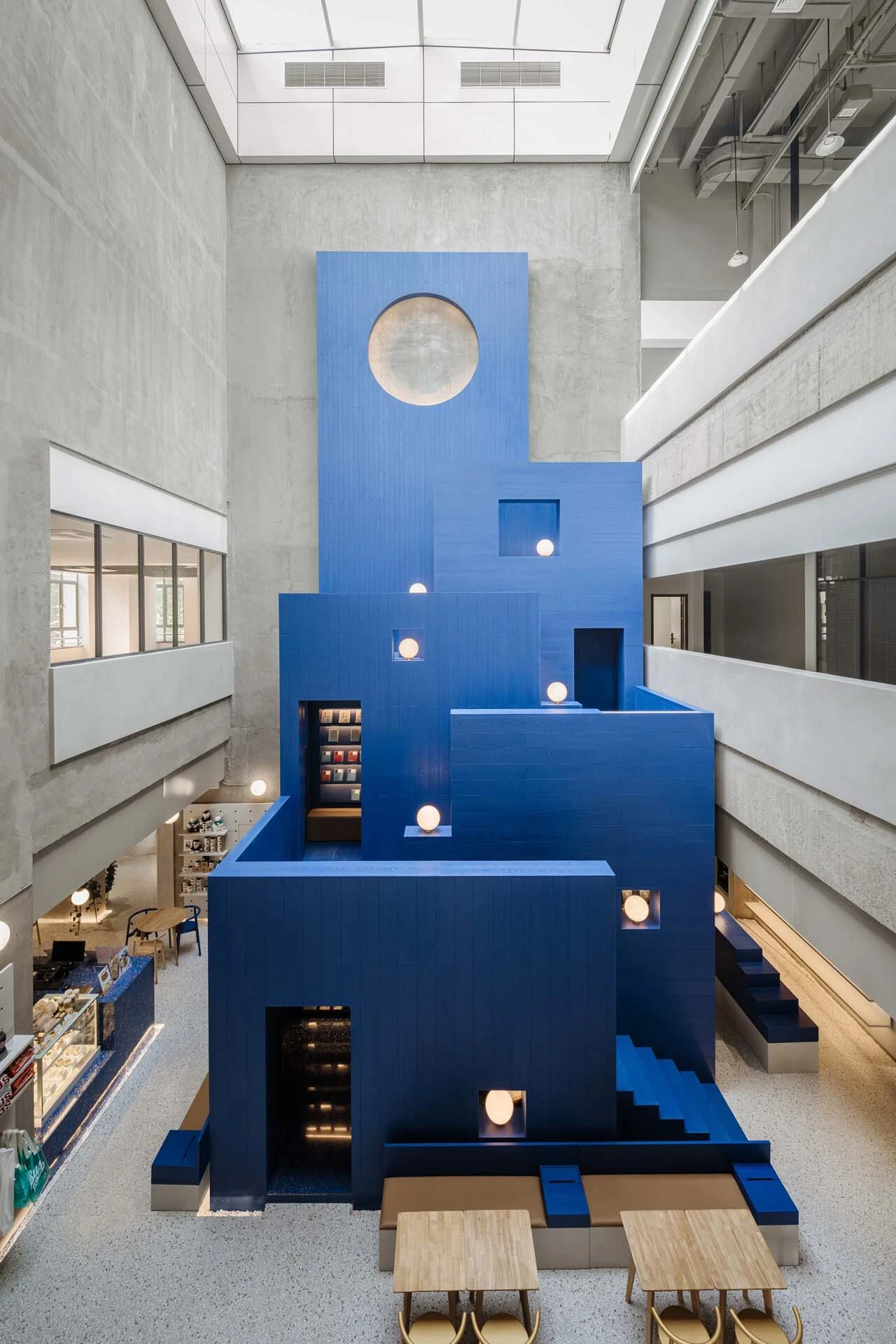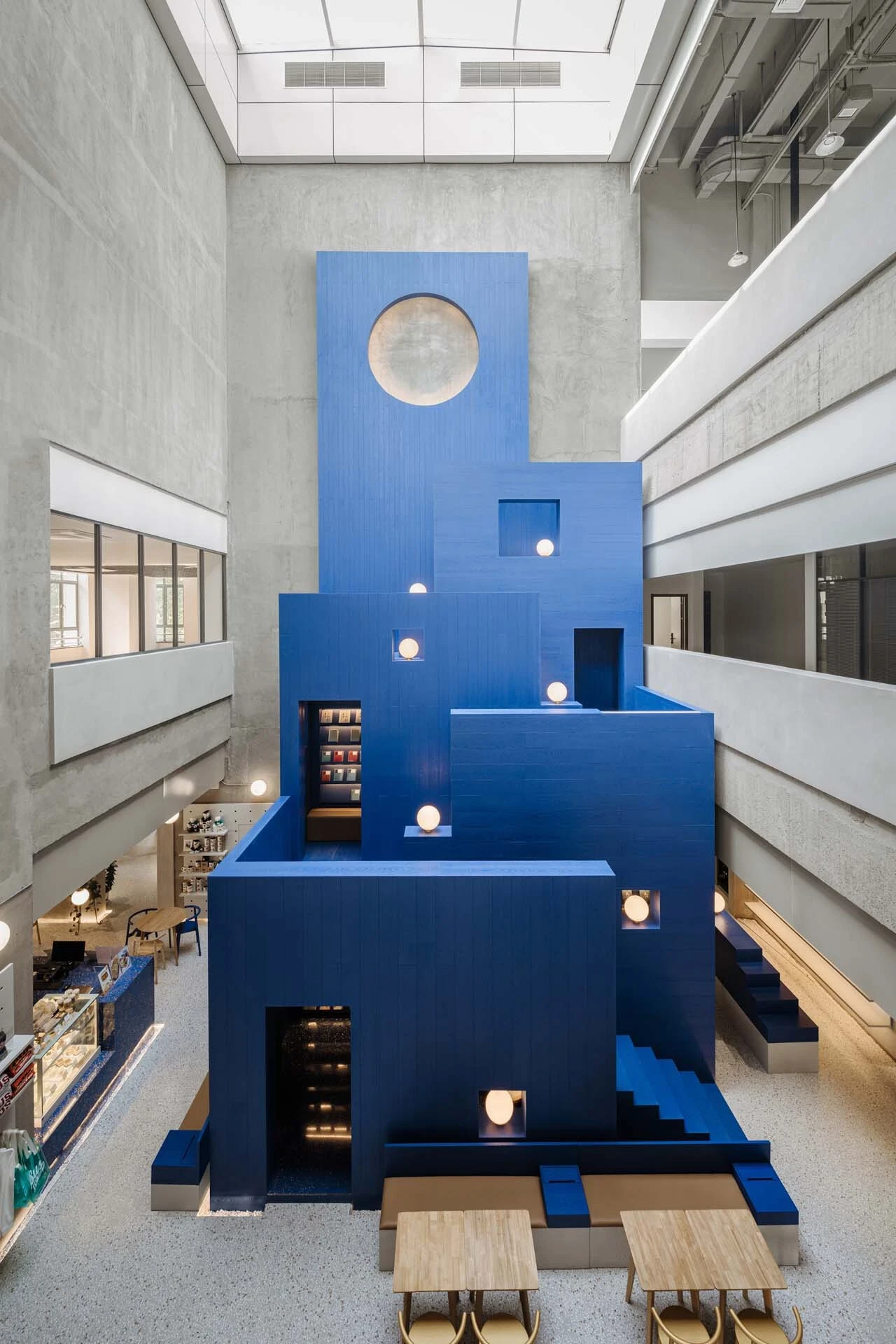
Inside the Ping-Pong Academy of Shanghai University of Sport, Studio YUDA and Studio NOR build LVWA Bookstore around Mingyue Mountain, a thirteen-metre indoor peak of blue oak.
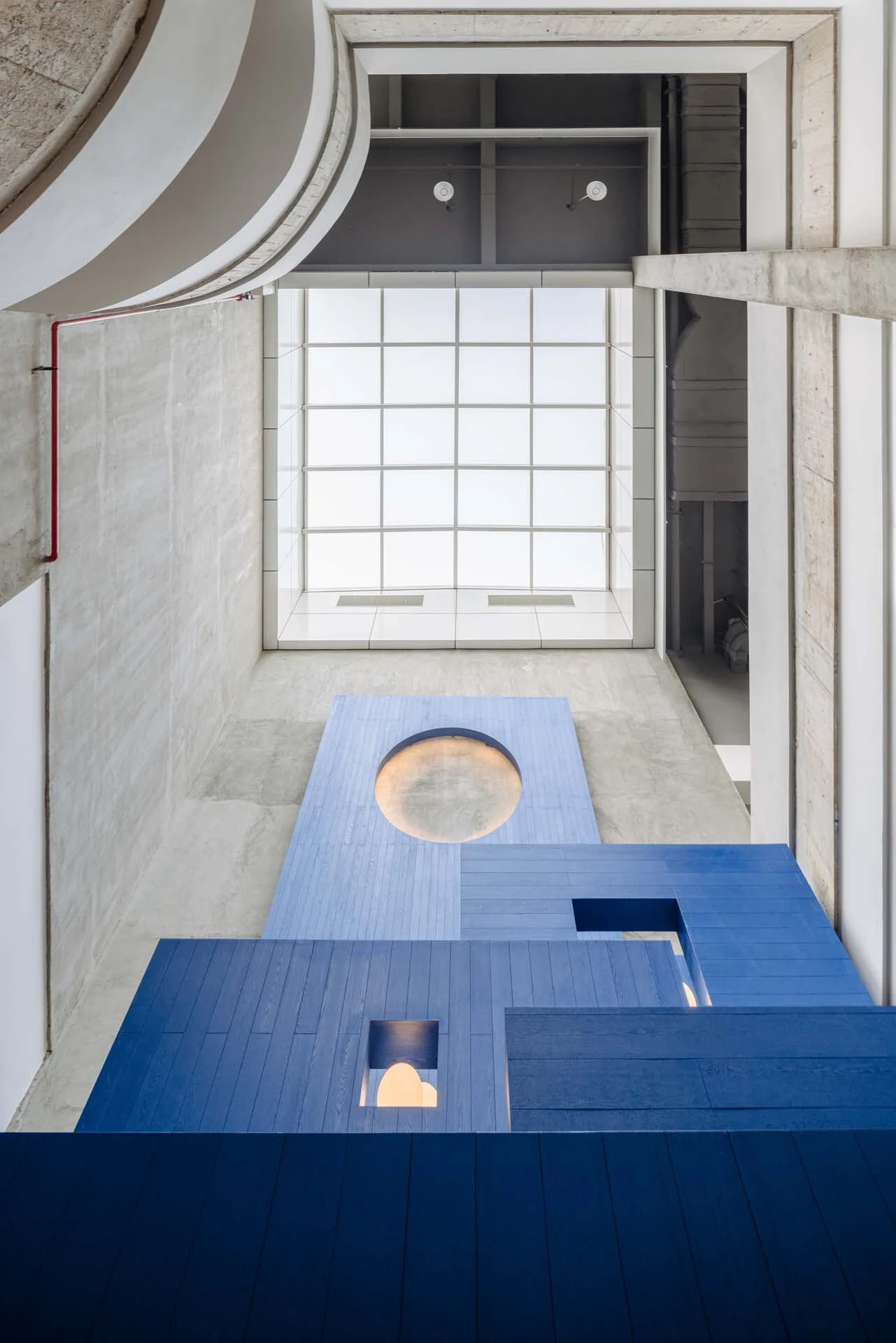
The brief from Shanghai University of Sport and Shanghai Century Publishing asked for one thing: use the seventeen-metre skylit atrium to build a landmark. That instruction, more often heard at the scale of a district than a single-floor retail interior, rerouted the project from a horizontal plan to a vertical section. LVWA, the first sports-themed bookstore in the city, would have to grow upward.
Studio YUDA and Studio NOR sit inside a long tradition of Chinese interior practice that answers programmatic problems by stacking mountains. Here, the metaphor earns its place. Books carry knowledge; sport disciplines the body; both ask the same effort of the reader and the climber. The studios call it Mingyue Mountain, a thirteen-metre main peak that rises across the west wall of the atrium and concentrates the building's two appetites into one form.
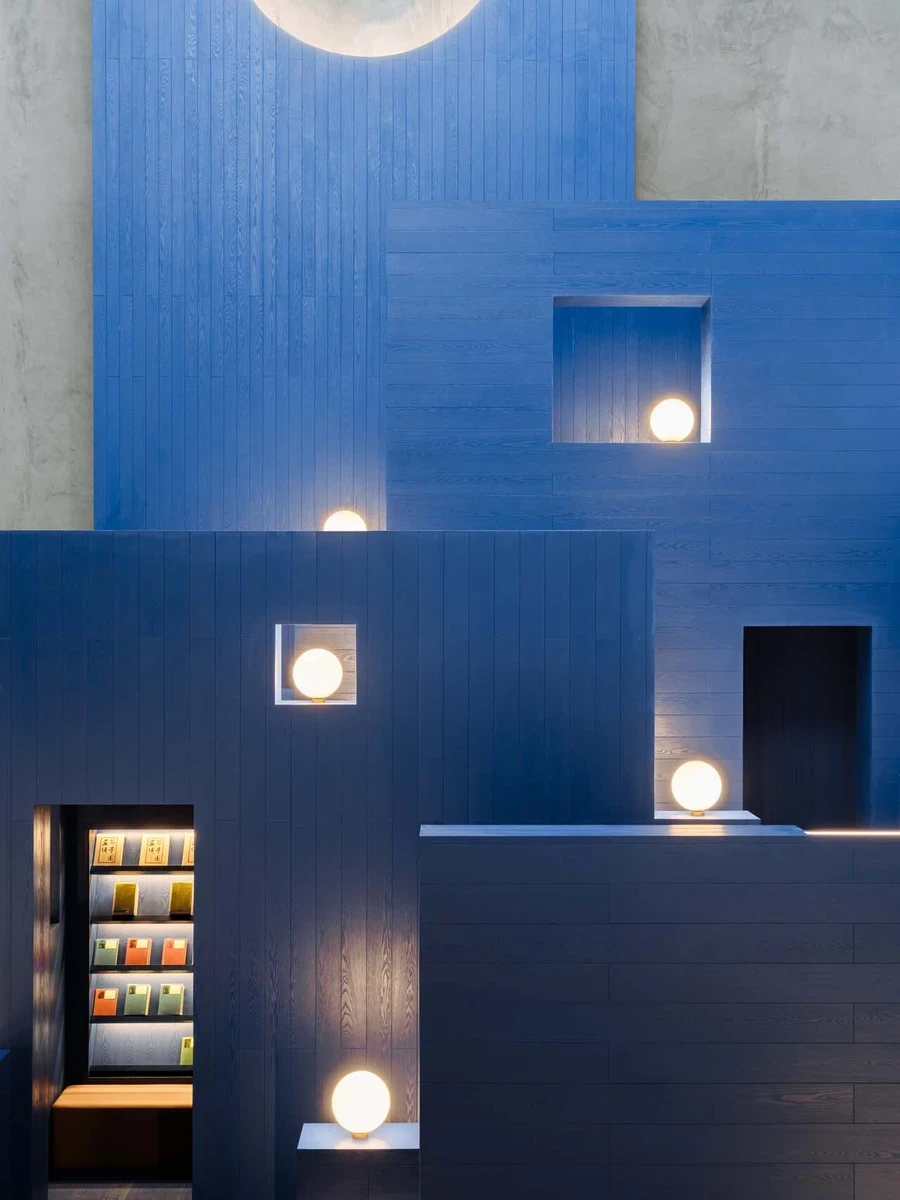
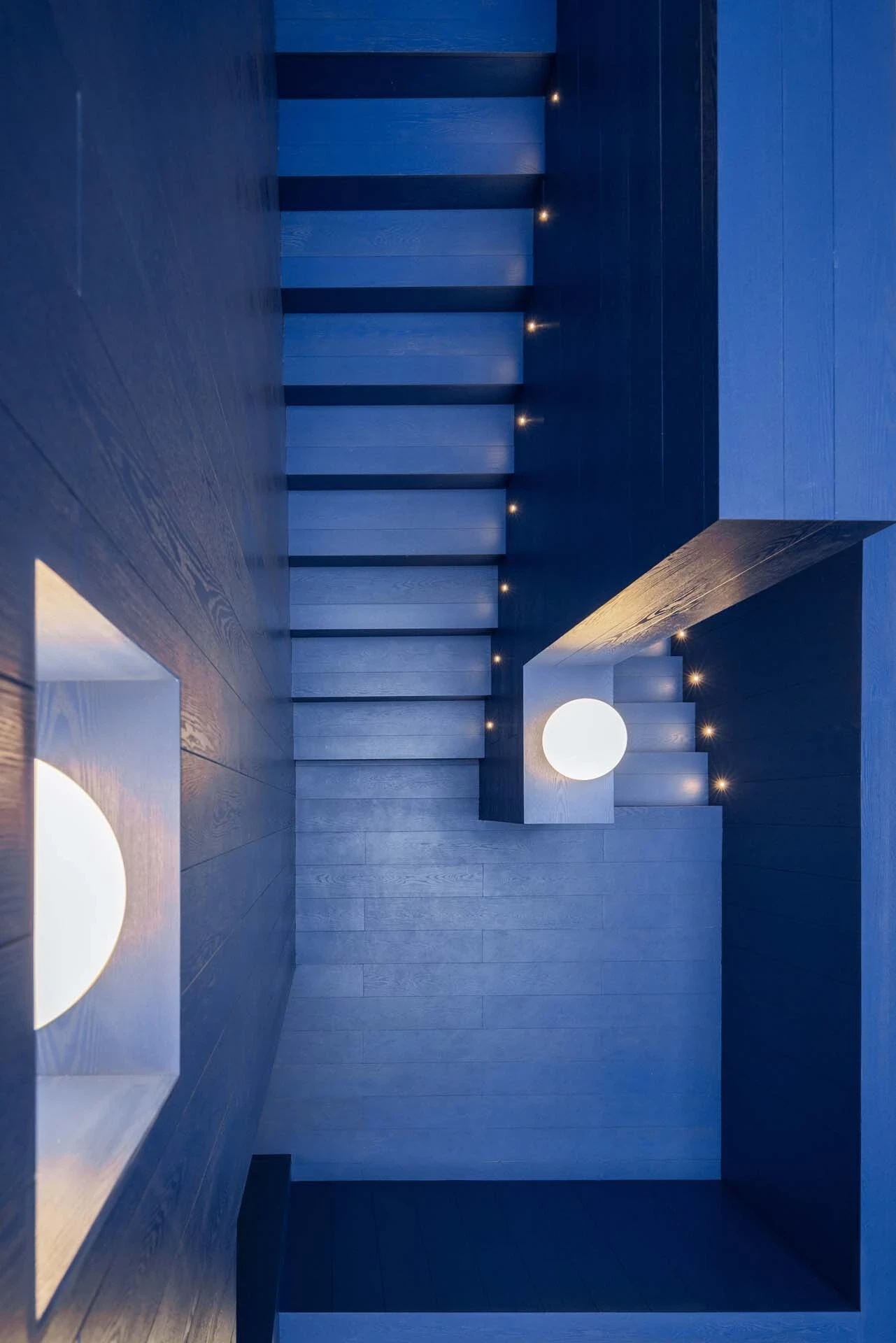
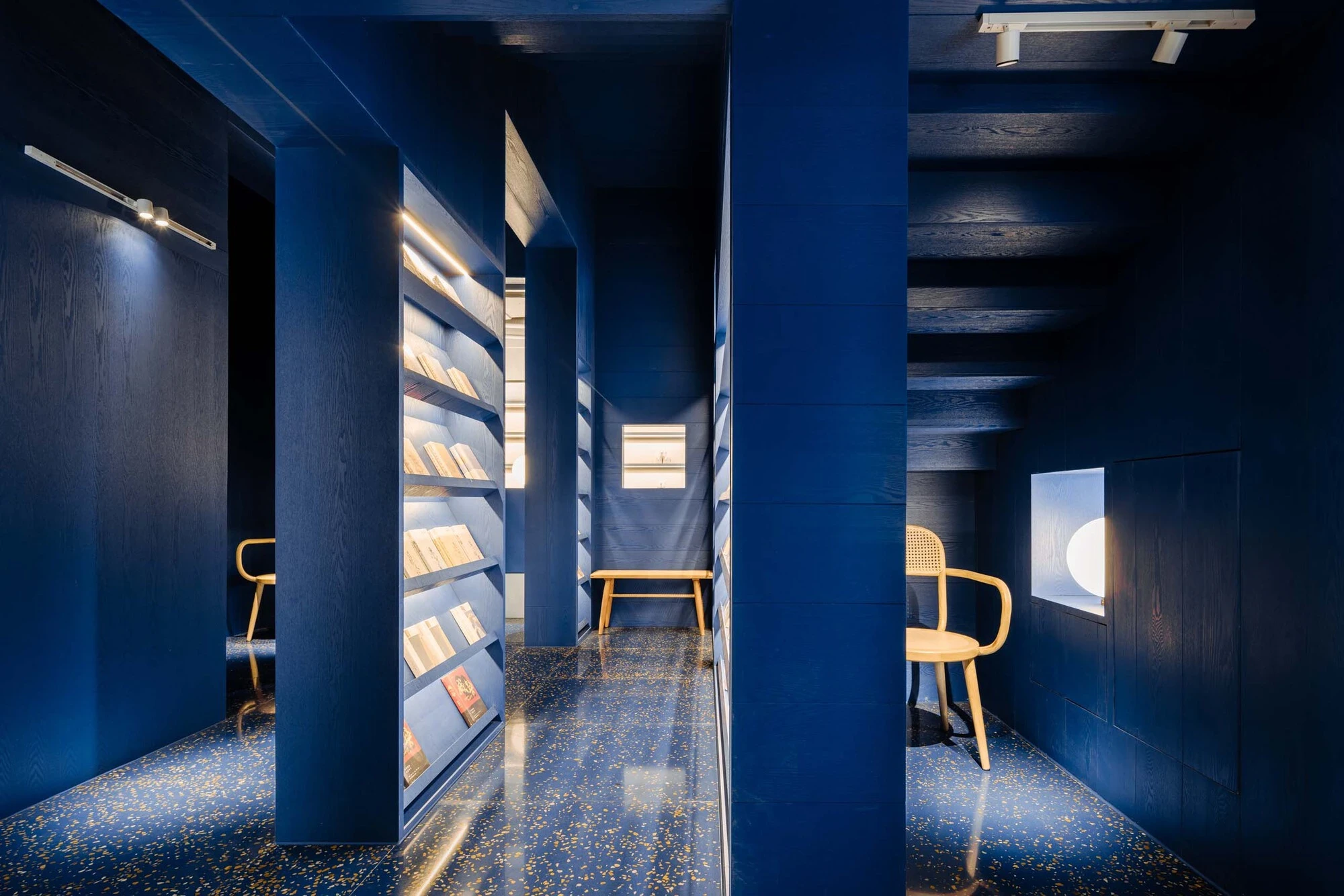
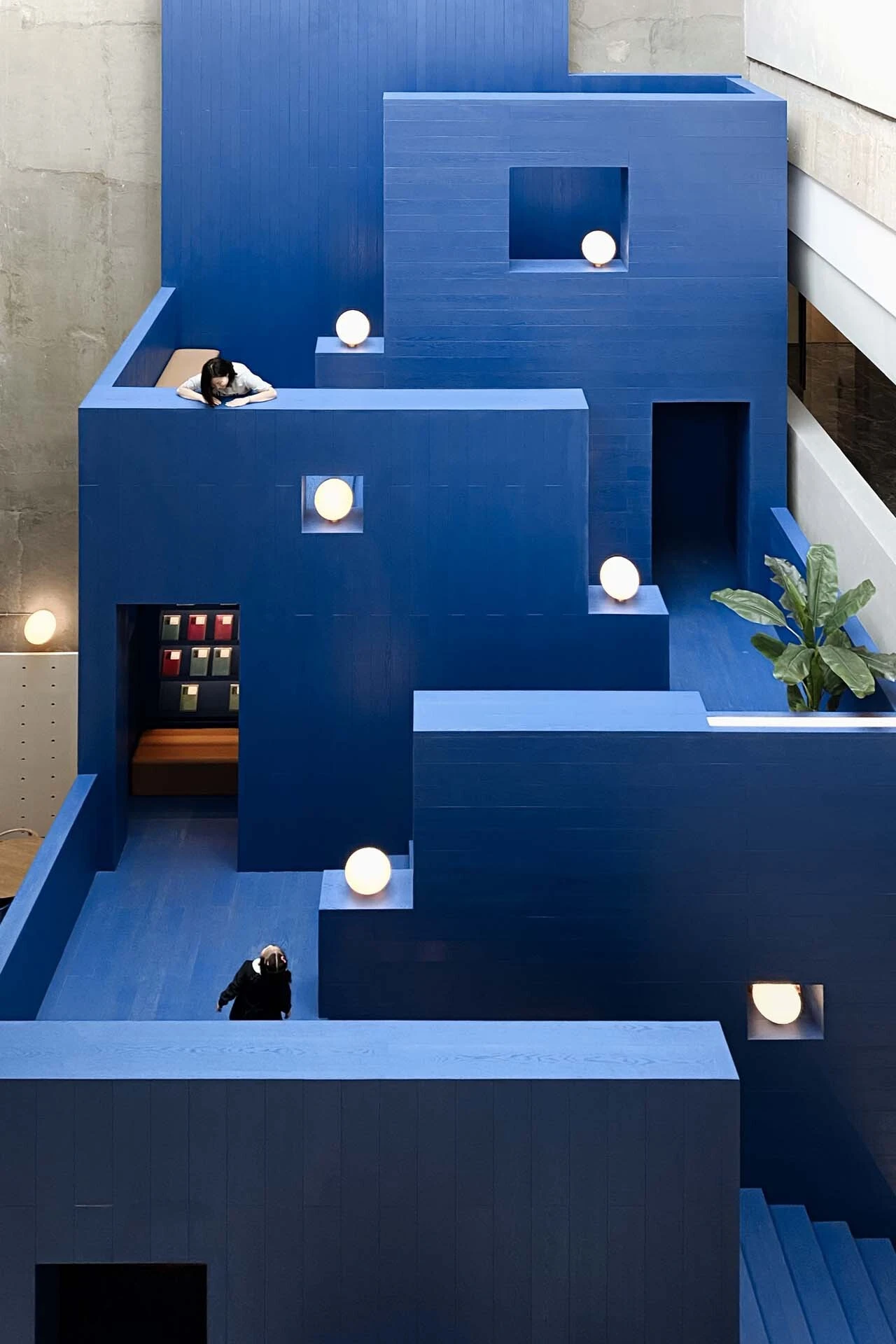
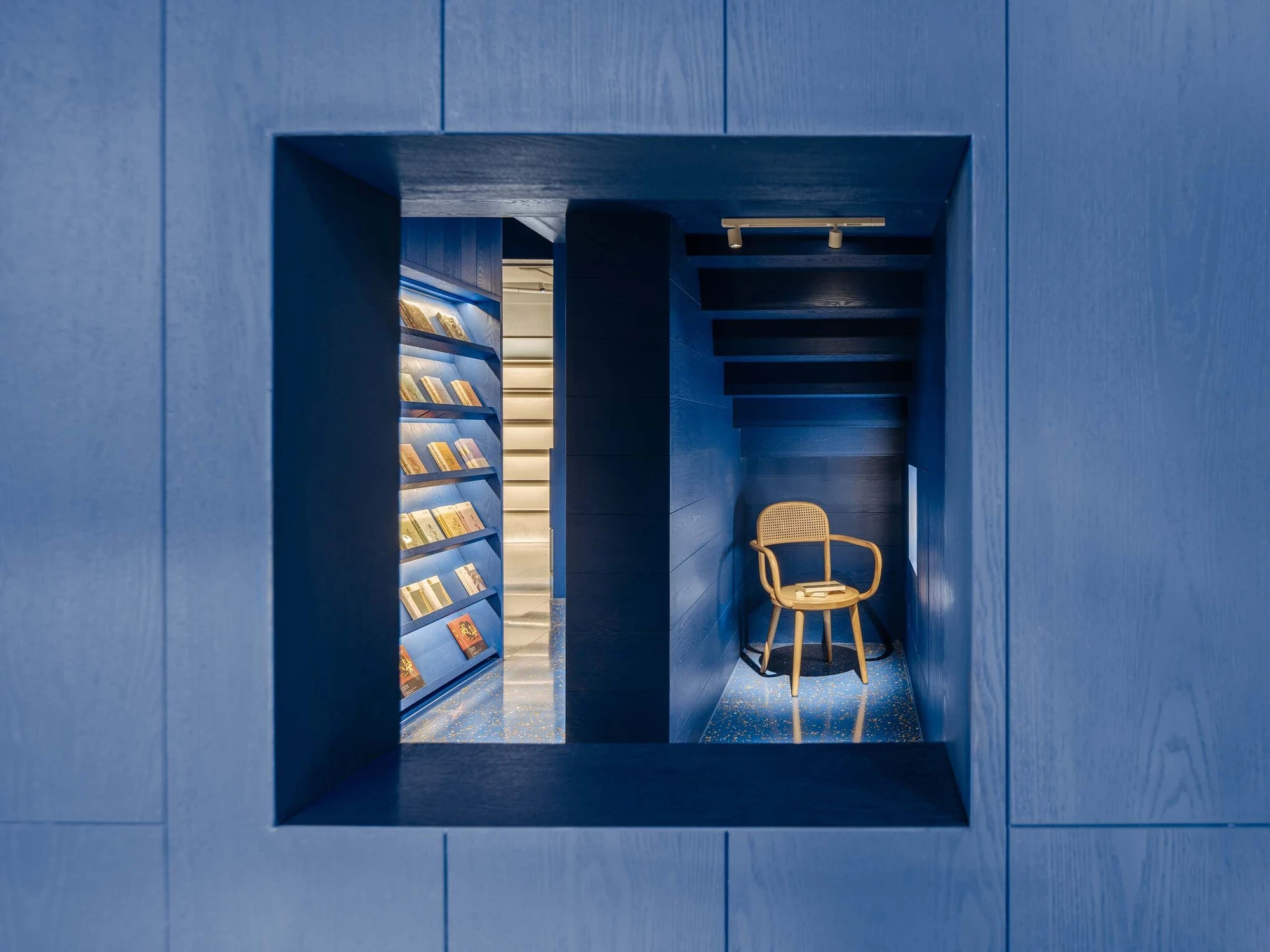
A reader enters from the southeast under a deliberately low, dark ceiling, then turns west into the atrium and the ceiling jumps fivefold. The peak is faced in vertical blue-oak boards that read as a single object from the ground and break, on closer approach, into five recessed terraces, three carved-out caves and four reading platforms. A round opening at the summit, halved by light, reads as a moon and nods to the ping-pong sculptures planted in the flower beds outside, where the Ping-Pong Academy Building still announces itself.
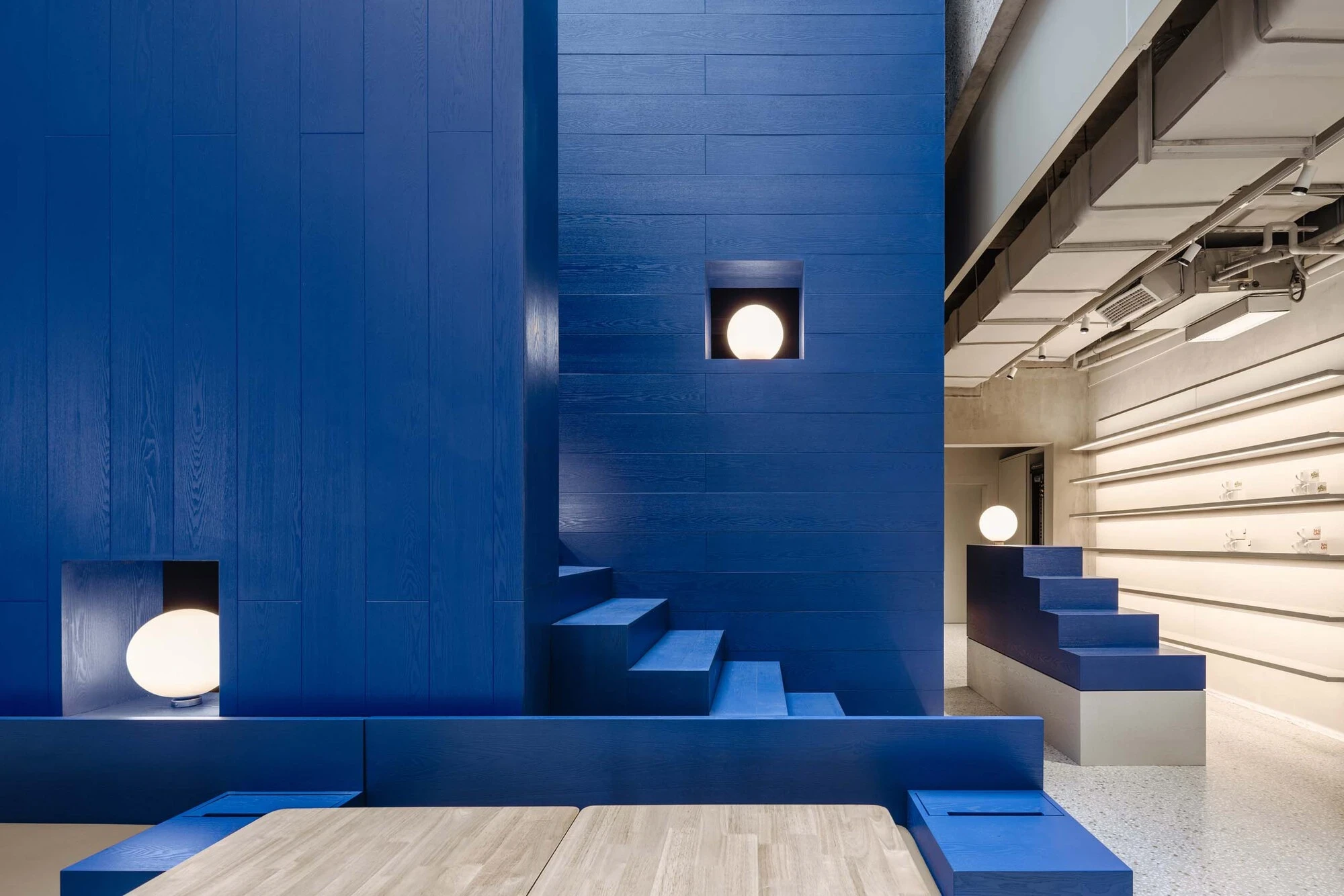
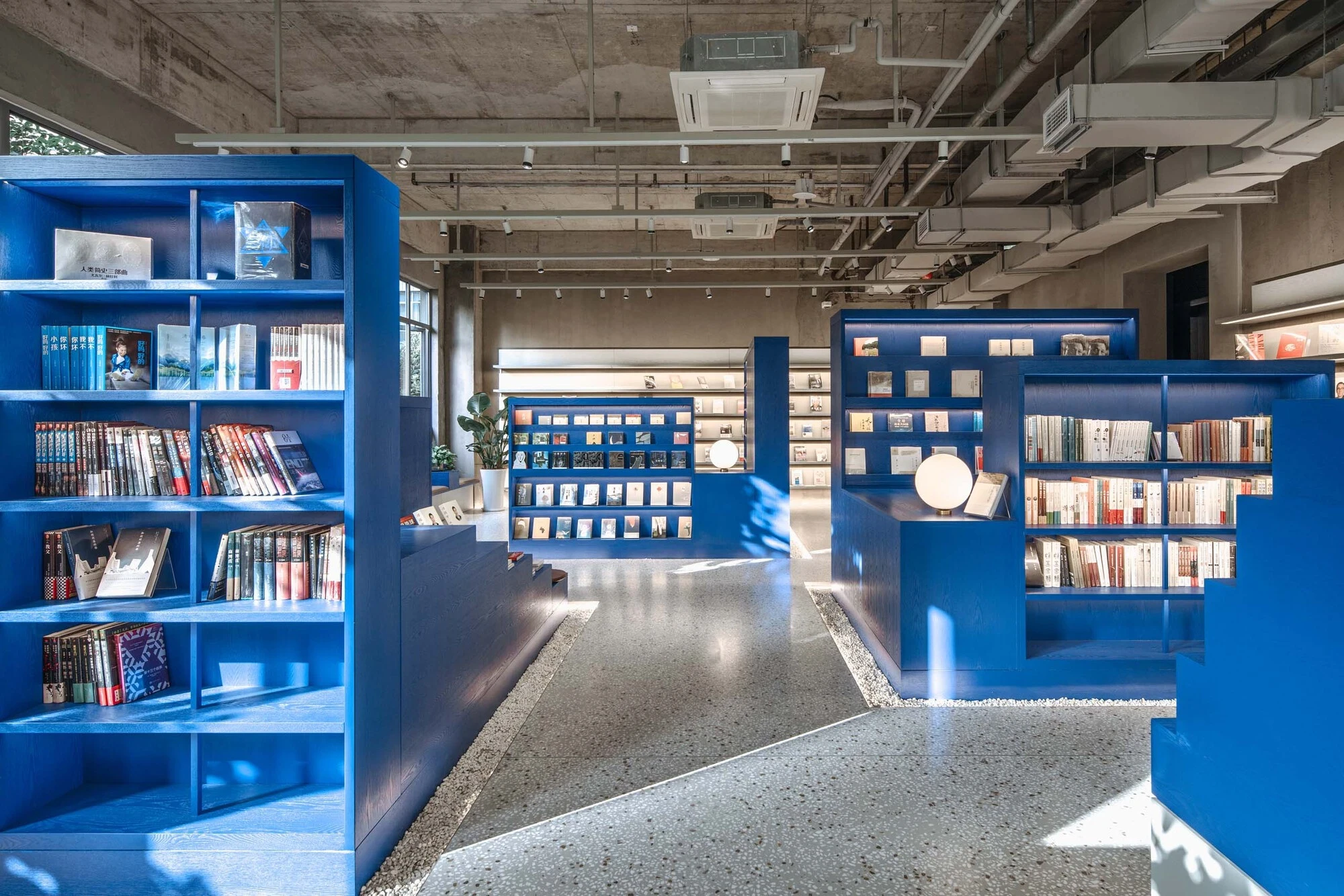
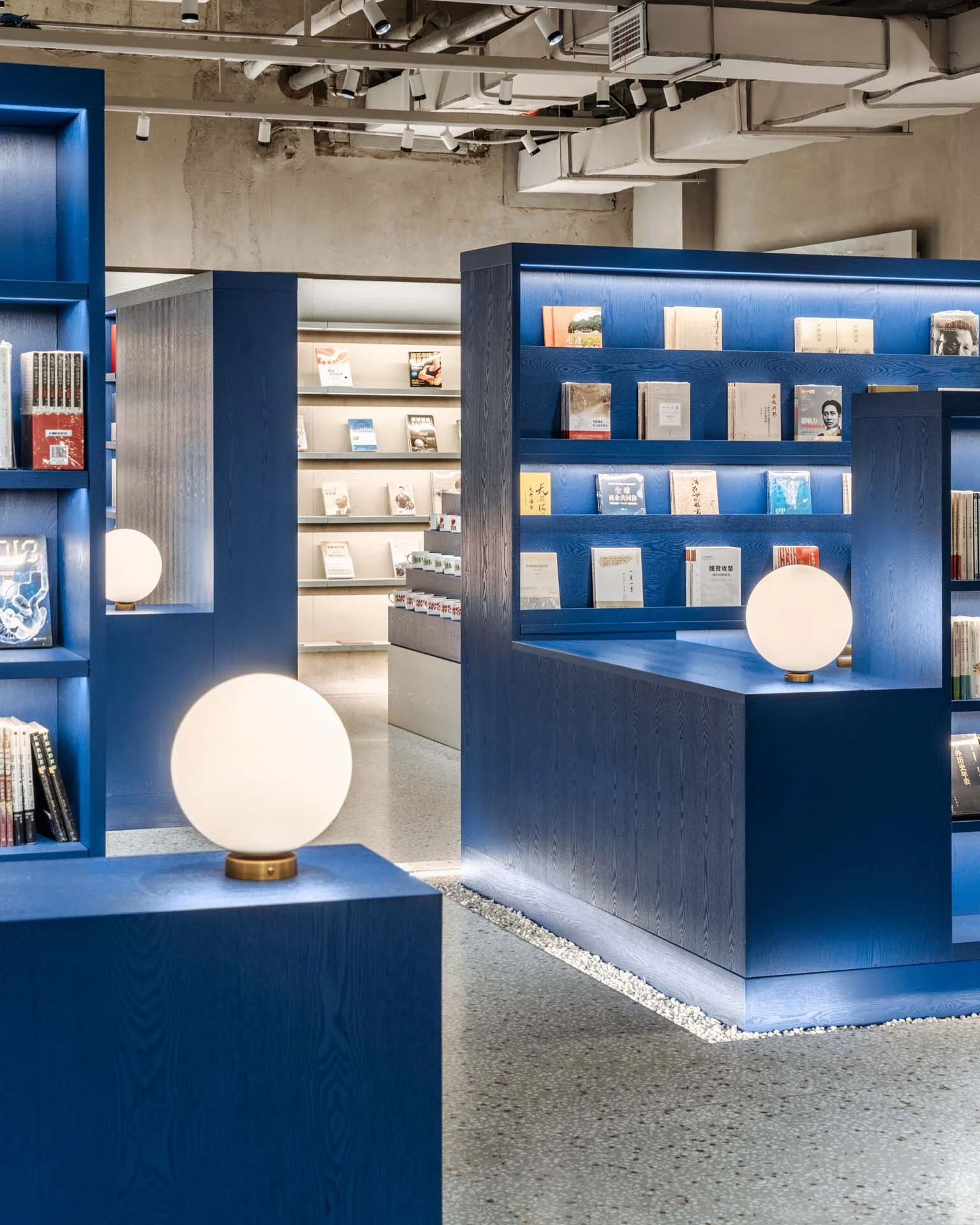
Around the central peak, fifteen smaller book mountains are scattered through four interconnected rooms. They take the form of stepped blue-oak blocks that double as shelving, seating, counters and lecture podiums. The studios describe the result as an isomorphic mountain system. Each block is a stop; the floor between them is a walking place; the visit becomes a route from mountain to mountain rather than a corridor lined with shelves.
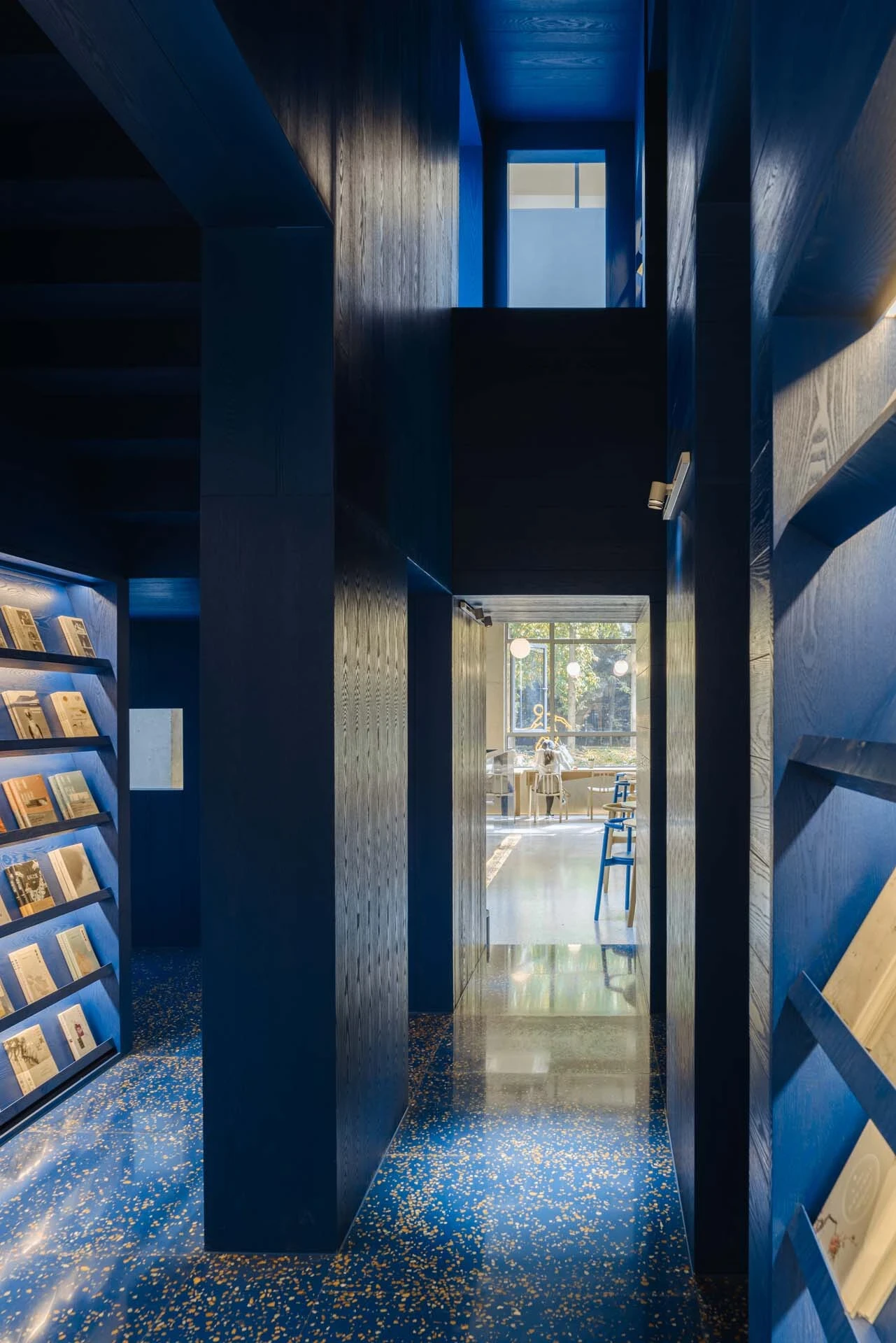
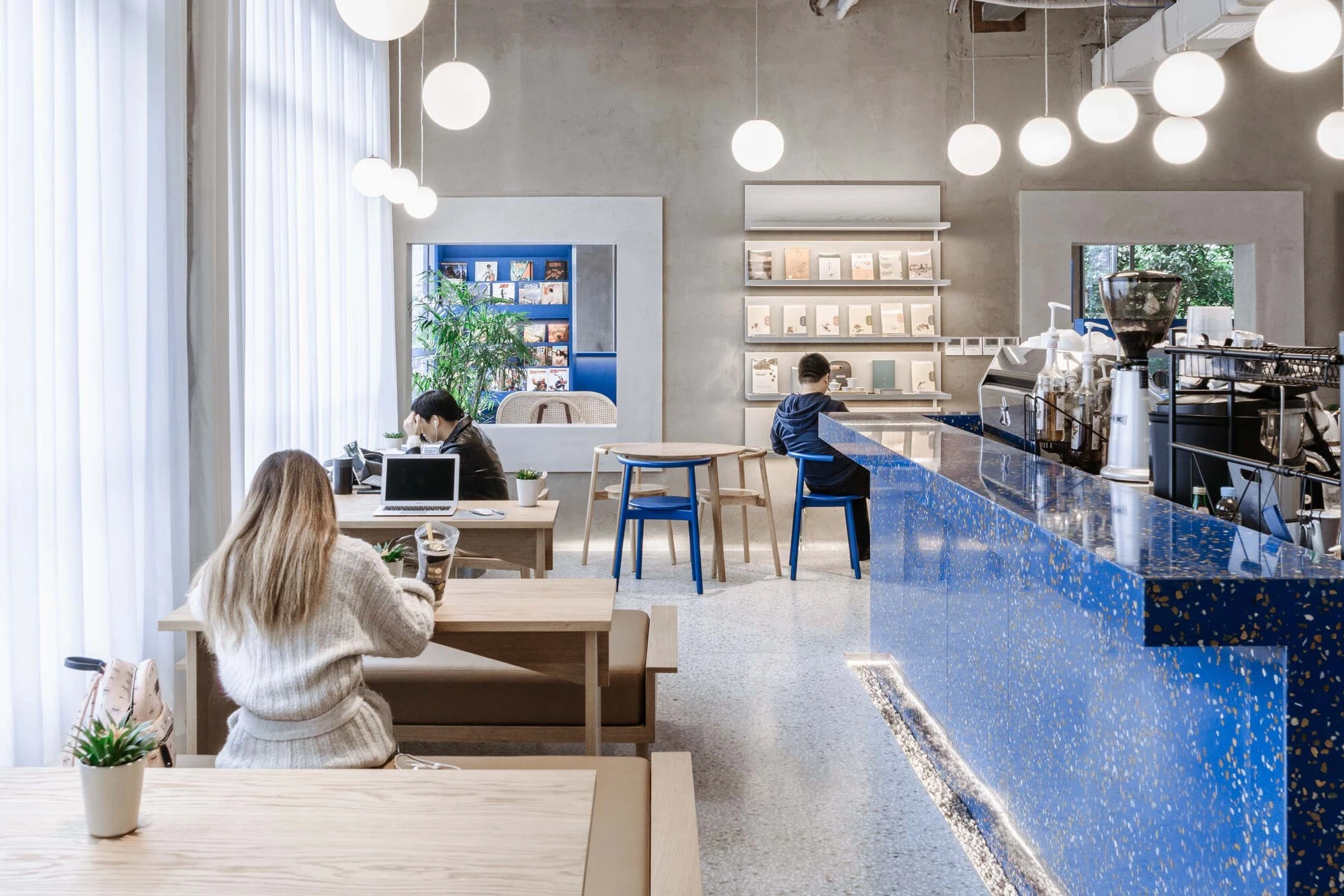
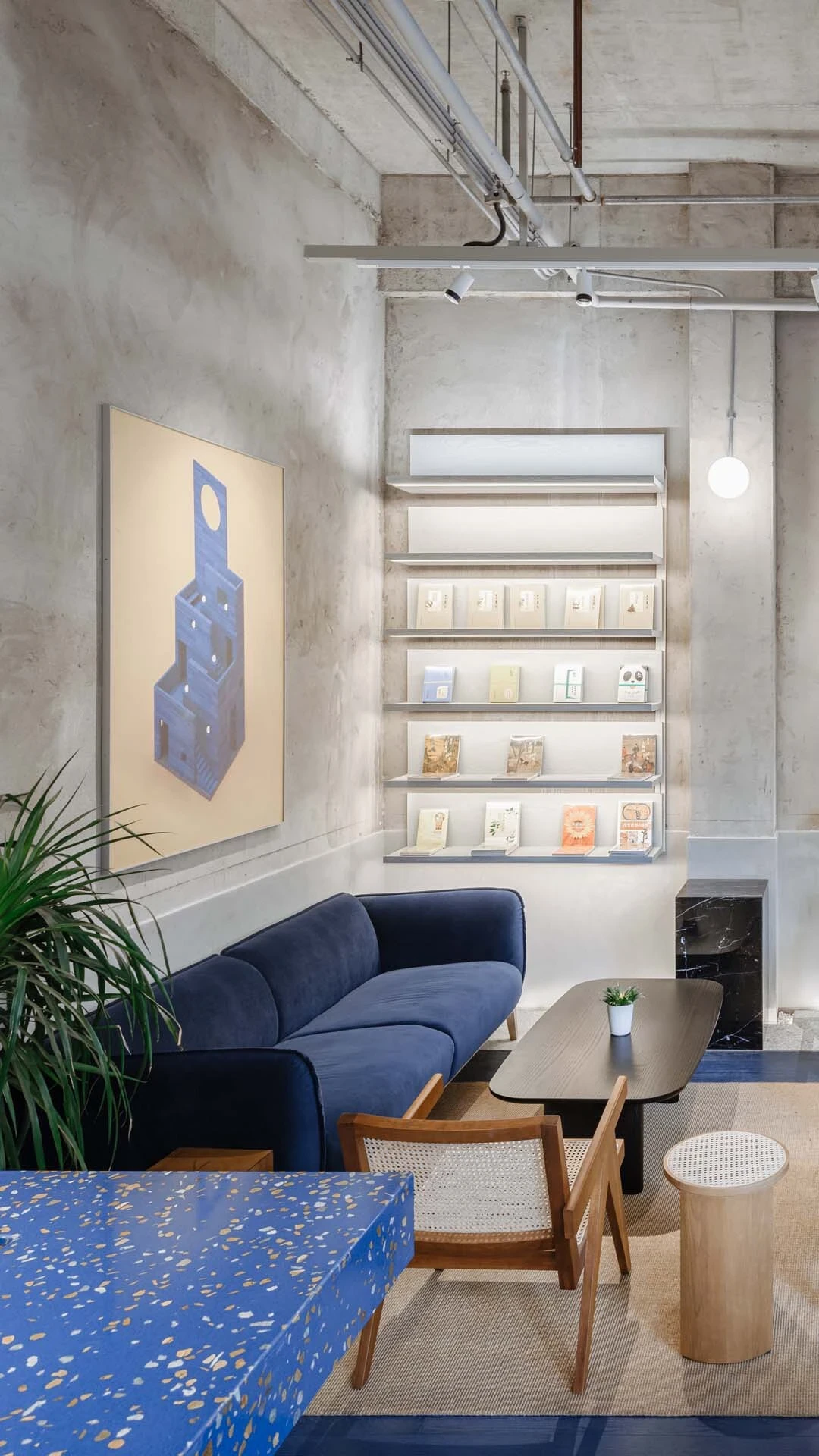
The palette arrived on the first site visit. An unpeeled blue protective film on an exterior metal door sat against gray real-stone paint on the surrounding wall; the studios kept both. Inside, blue-oak boards run against board-formed concrete columns and a terrazzo floor flecked with the same blue and a warm gold. The blue is allowed to shift in meaning as it moves: the cobalt of a table-tennis surface, the blue of Aegean light, the indigo of Song-dynasty landscape painting, the cut paper of Matisse. Globe sconces and table lamps with brass collars hang in front of the boards and turn the mountain into a constellation after dark.
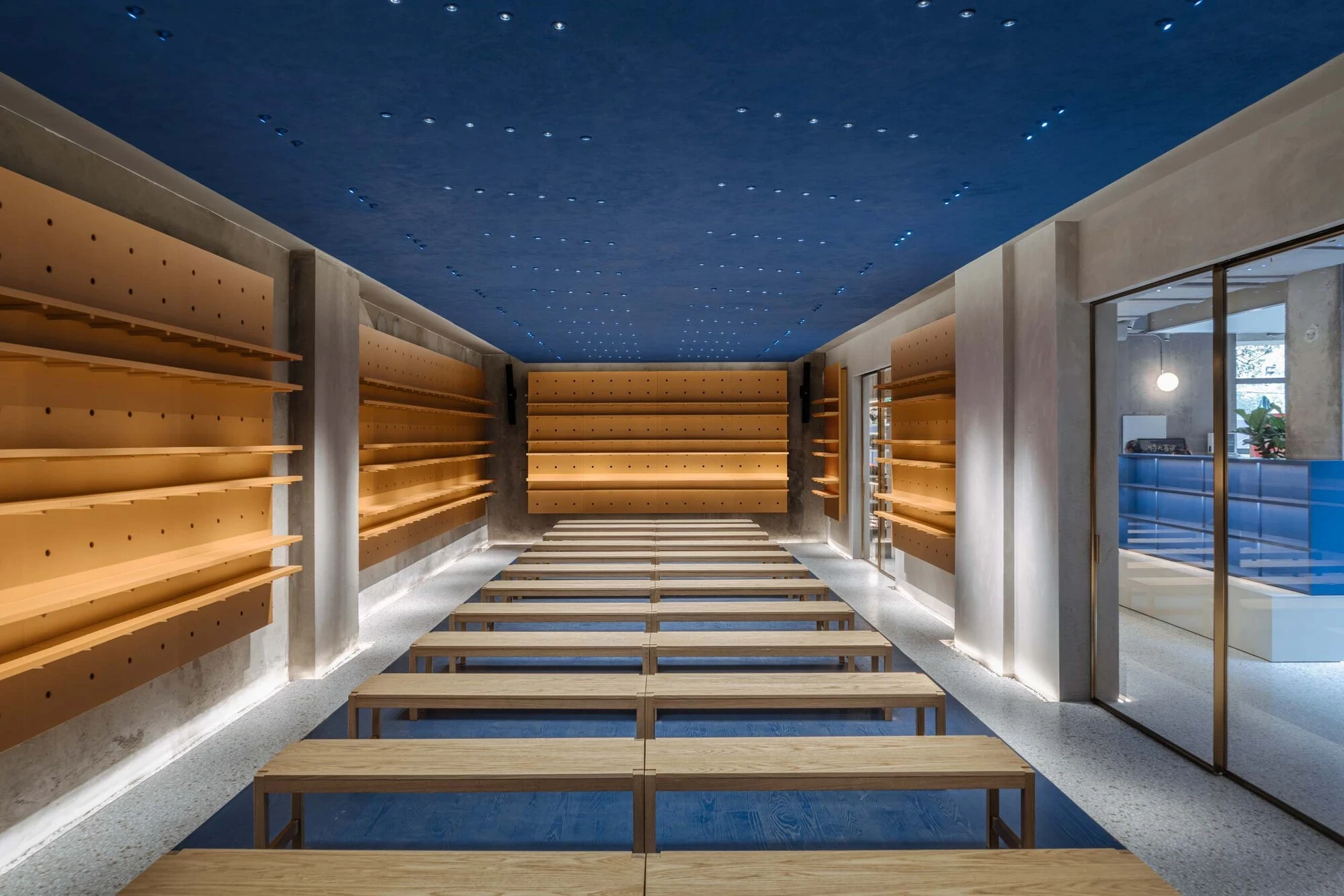
The lecture hall closes the project on a quieter note. A blue-felt ceiling speckled with pinpoint downlights covers benches in pale ash; the side walls carry perforated panels whose shelves can be relocated by hand, switching the room between exhibition and talk. The benches stack vertically into shelves of their own. Through small openings cut in nearly every wall, the bookstore lets sight lines and footfall braid back through one another, holding the reader inside the climb rather than walking them past it.