Thisispaper Community
Join today.
Enter your email address to receive the latest news on emerging art, design, lifestyle and tech from Thisispaper, delivered straight to your inbox.
Oops! Something went wrong while submitting the form.
Instant access to new channels
The top stories curated daily
Weekly roundups of what's important
Original features and deep dives
Exclusive community features
Thisispaper+ Member

Jil Sander Flagship Store Ginza by Casper Mueller Kneer Architects

Dates:
✧ Collect Post
Tokyo Guide
under the patronage of
Jil Sander Flagship Store Ginza by Casper Mueller Kneer Architects
Alexander Zaxarov
Jun 10, 2026

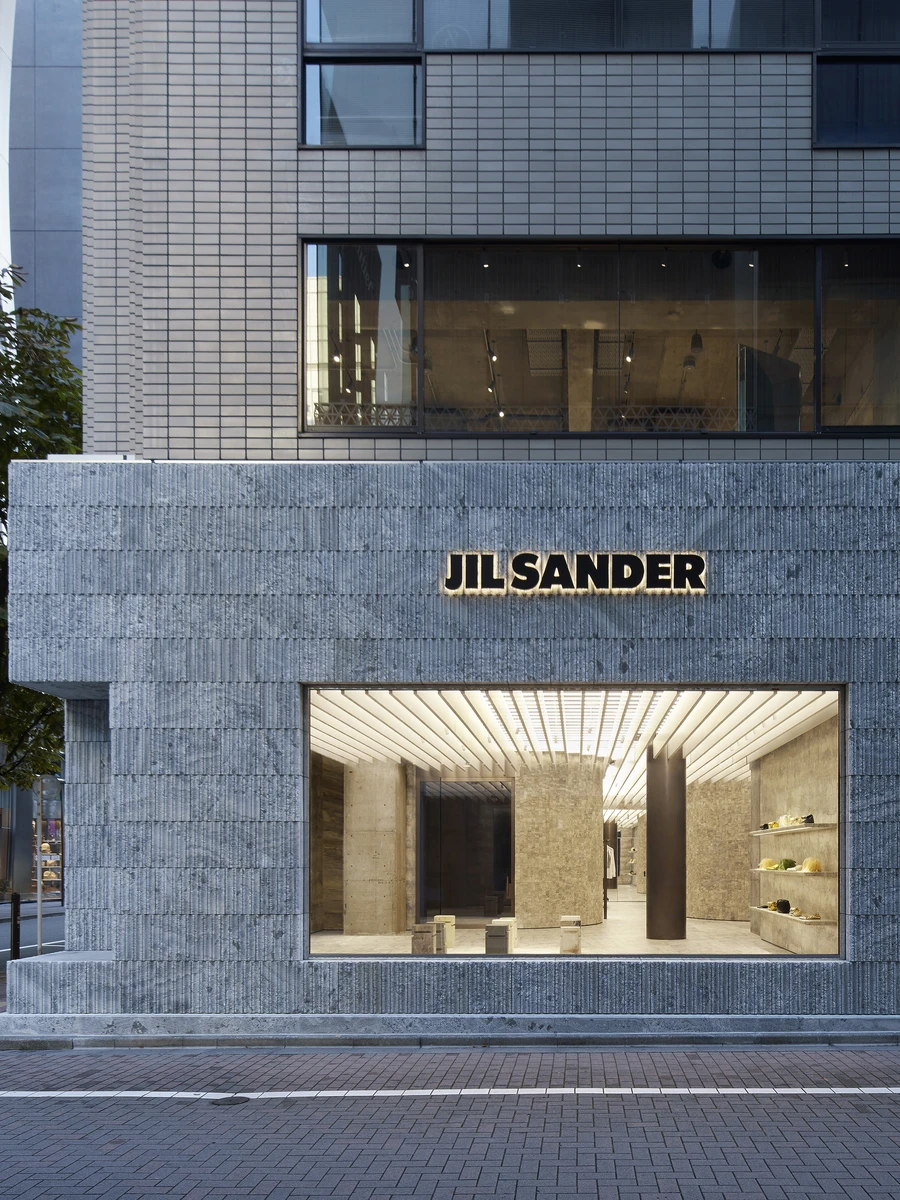
Behind a chiselled grey-green granite facade in Tokyo's Ginza, Casper Mueller Kneer carve the Jil Sander flagship from a single mineral idea, silver-blue travertine stacked floor to ceiling.

Casper Mueller Kneer extends the material language they set with the brand's earlier Jil Sander flagship, now scaled into the largest outpost the studio has built for the house. The shop occupies the ground and first floors of a Ginza building, opening through gallery-scale windows onto the street.

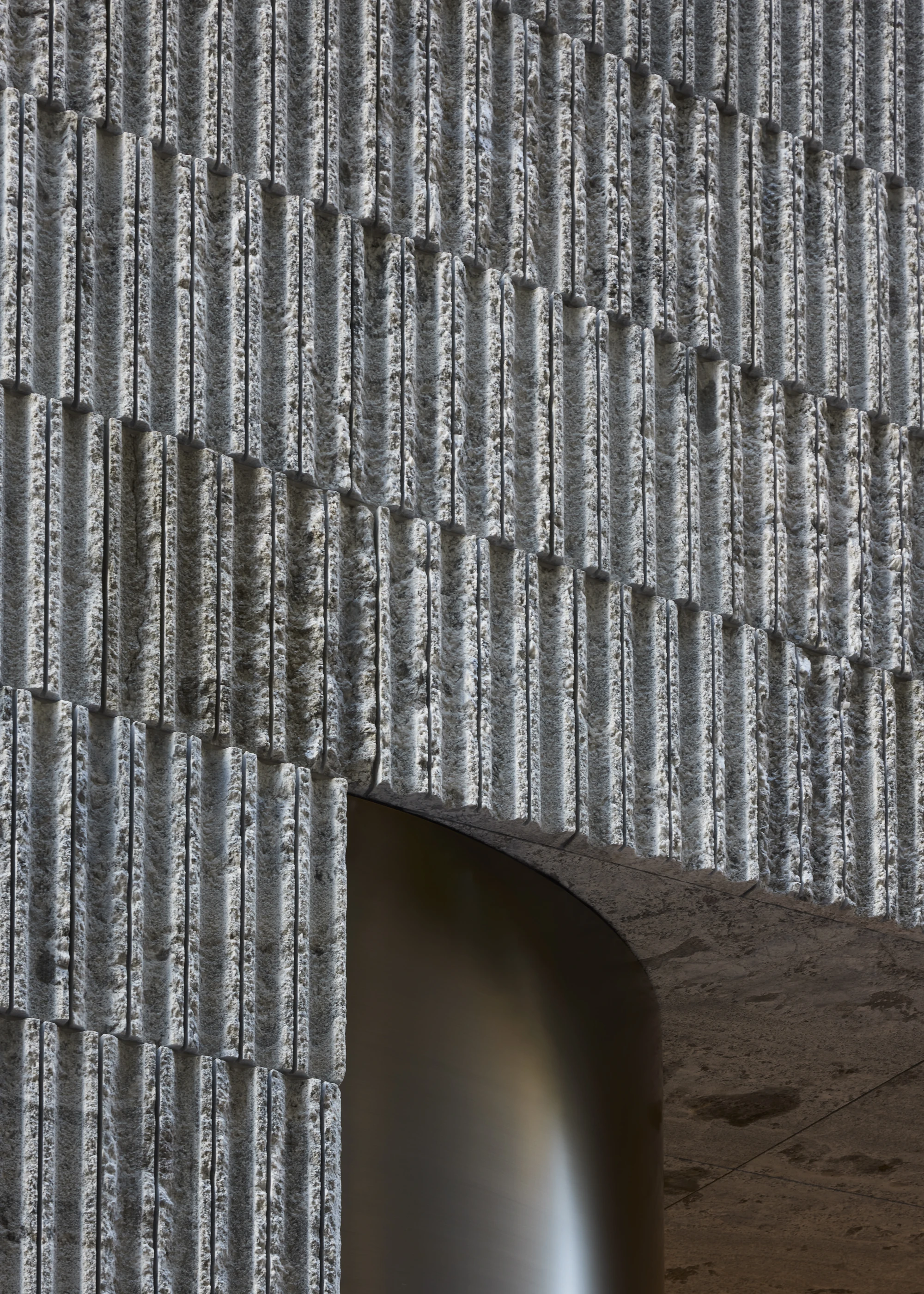
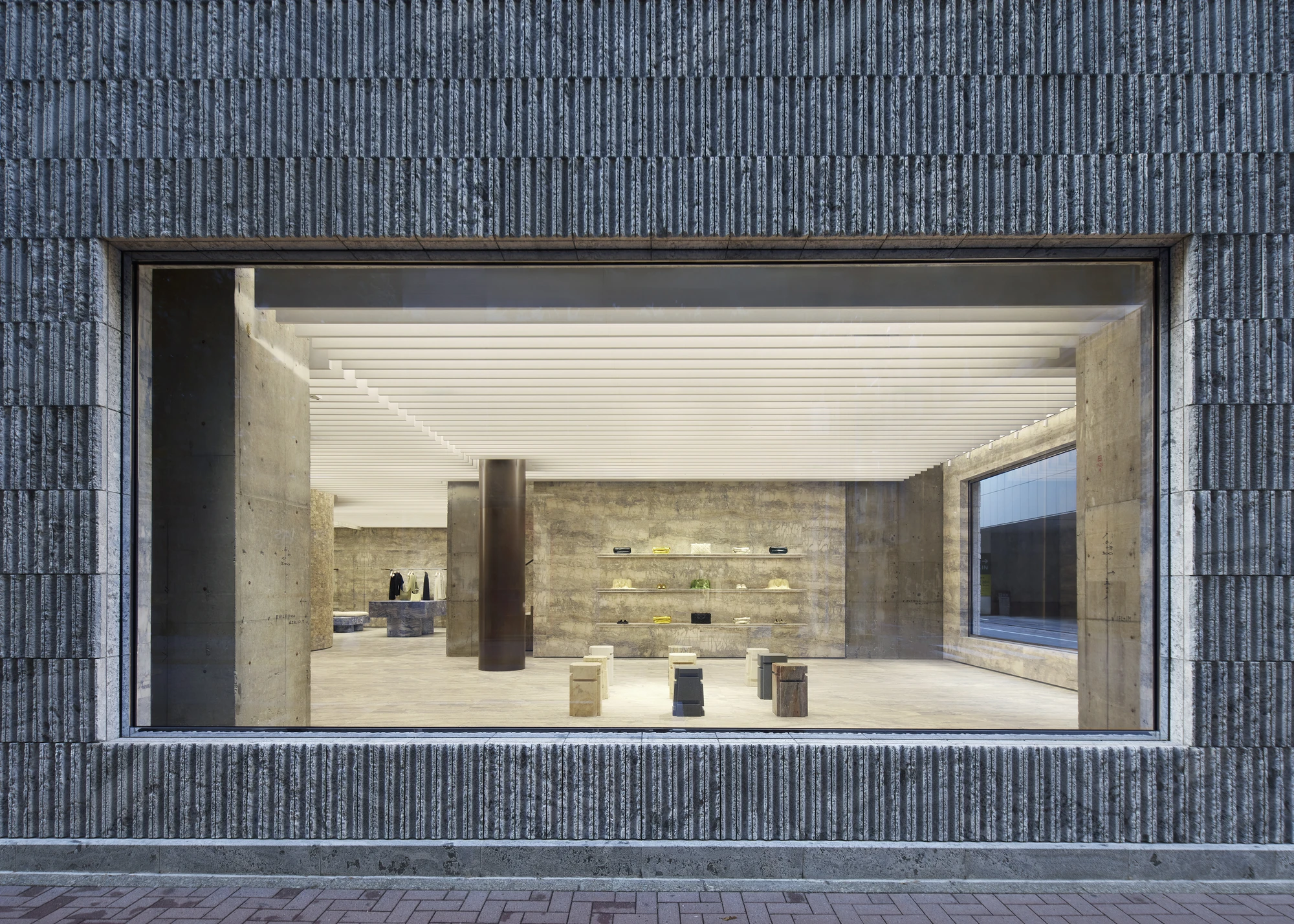
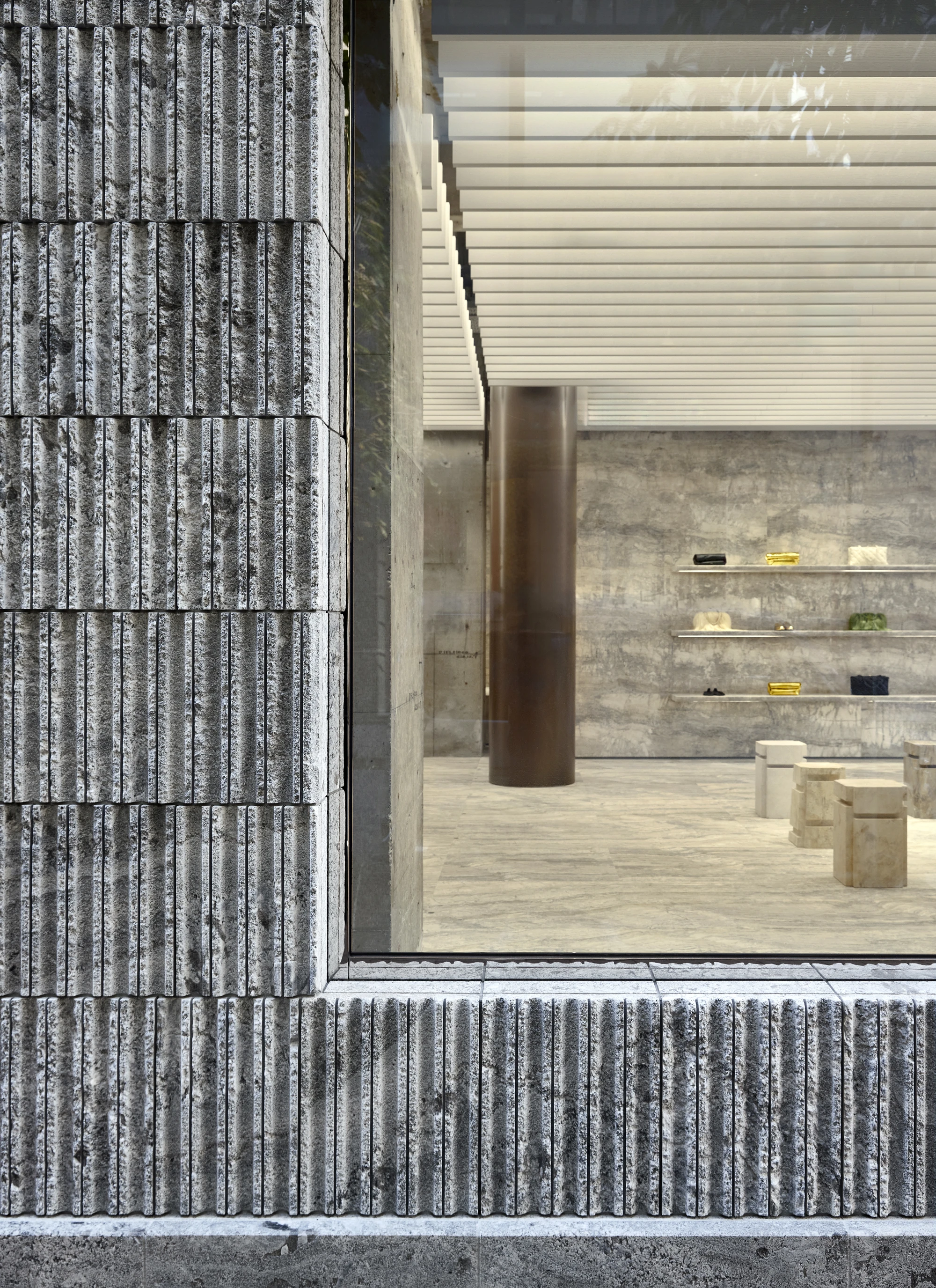
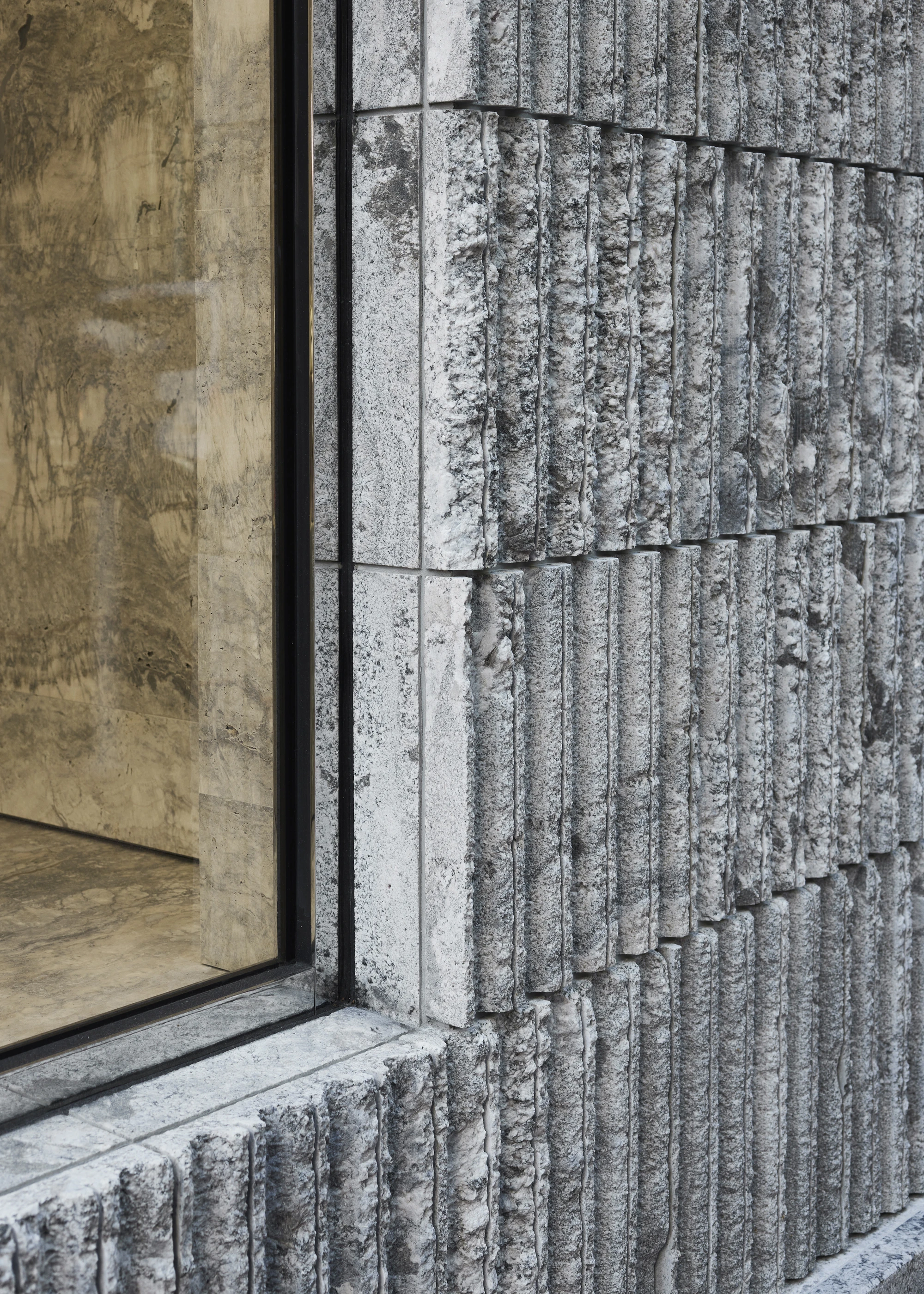
The translation begins outside. A textural grey-green granite, scored and carved into vertical staggers, is stacked across the ground-floor elevations like a quarry face cropped to street height. Gallery-scale windows and brass-framed vitrines puncture the wall, tying the shop to the rhythm of the block and allowing passers-by to read the interior as a sequence of sculptural still lifes. The entrance is a curved patinated brass panel, the only soft gesture in an otherwise rectilinear elevation.

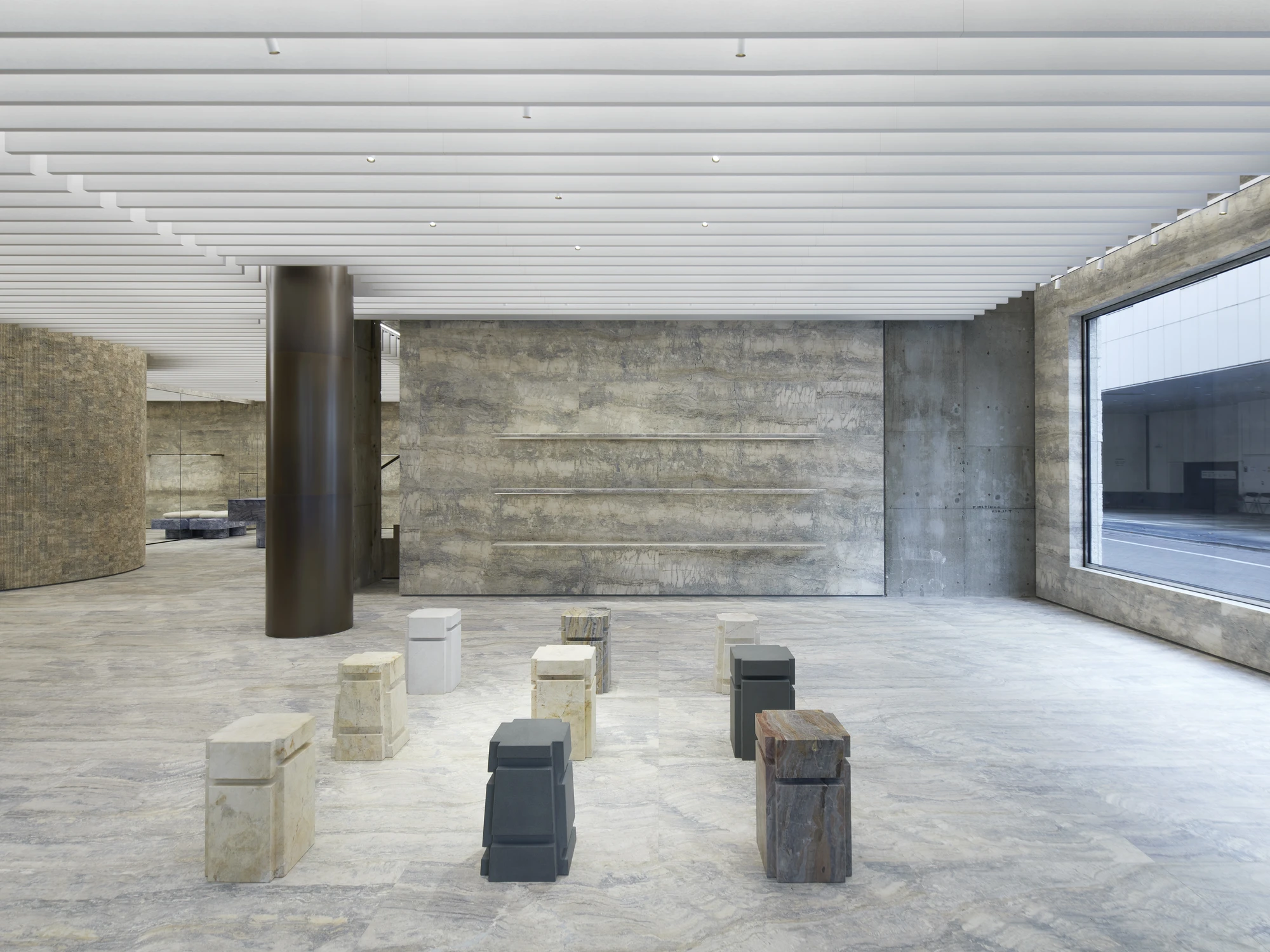
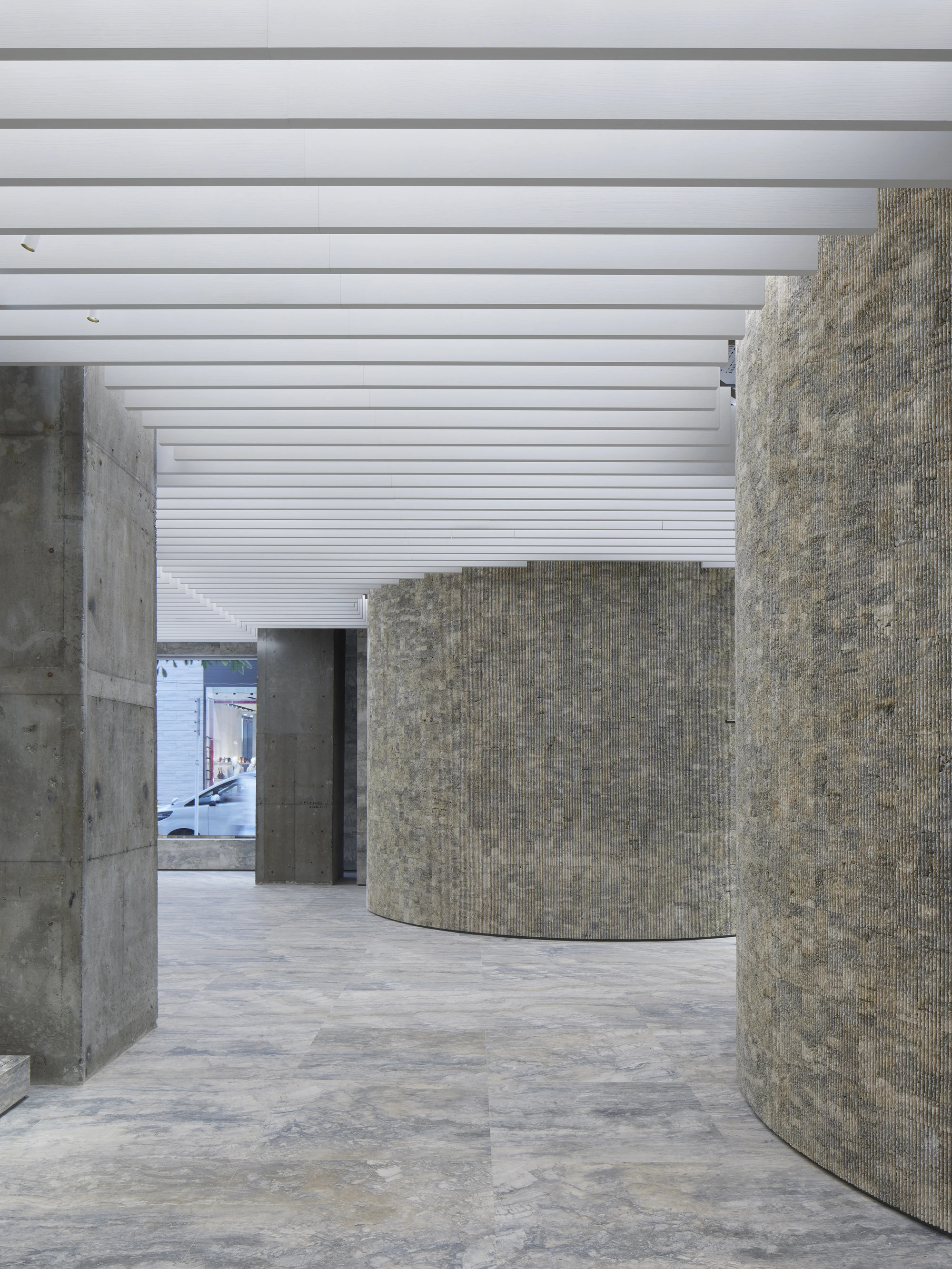
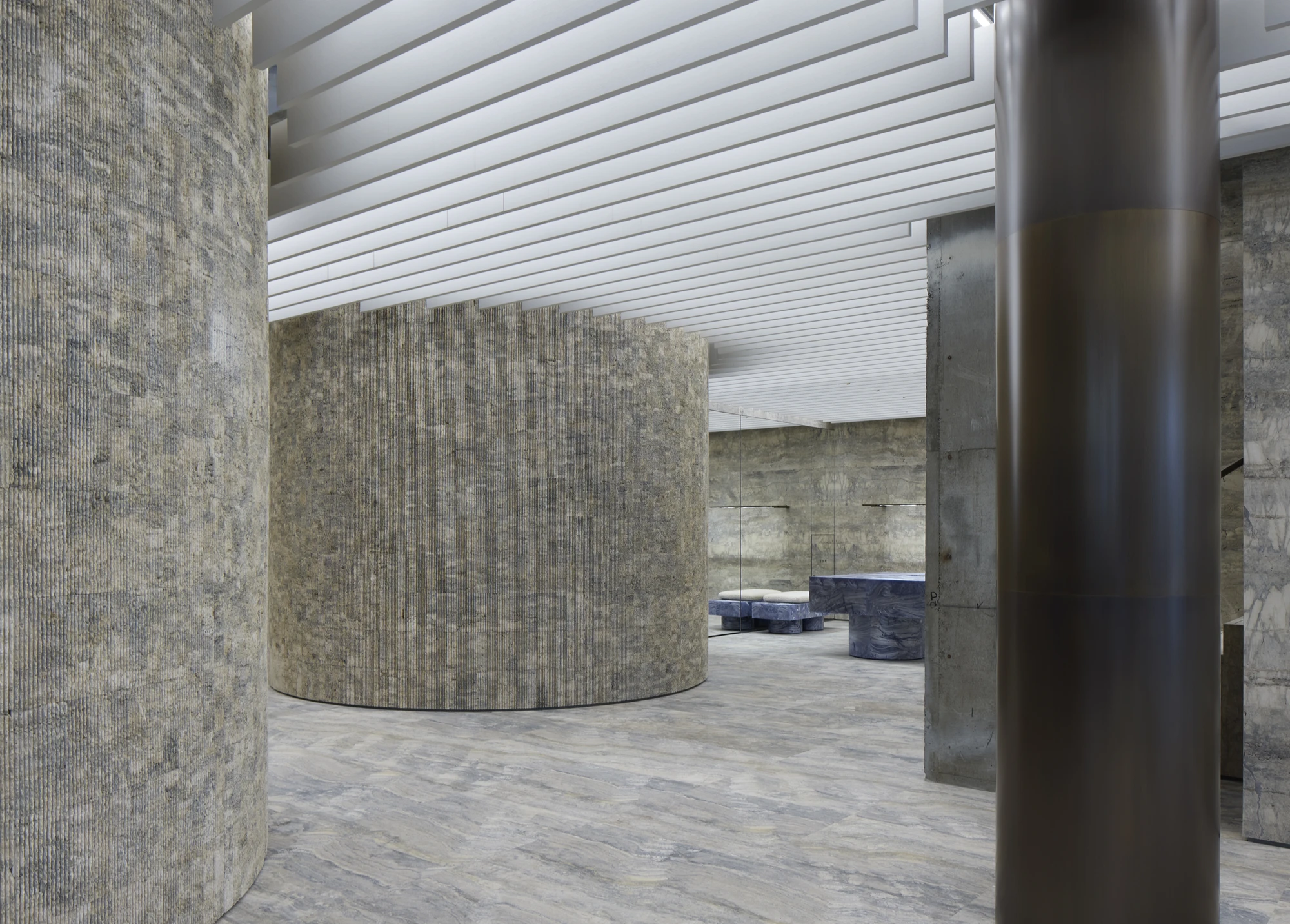
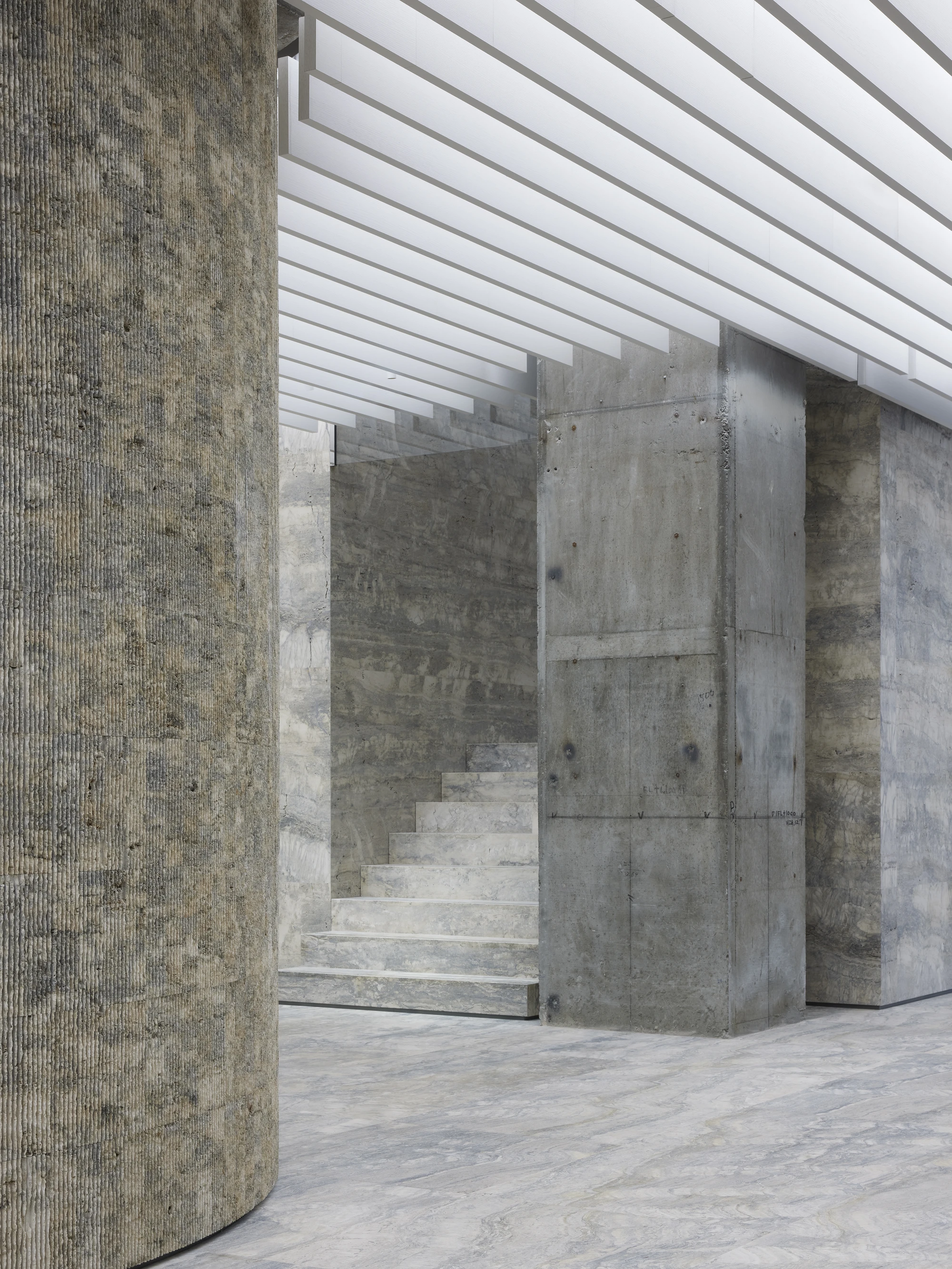
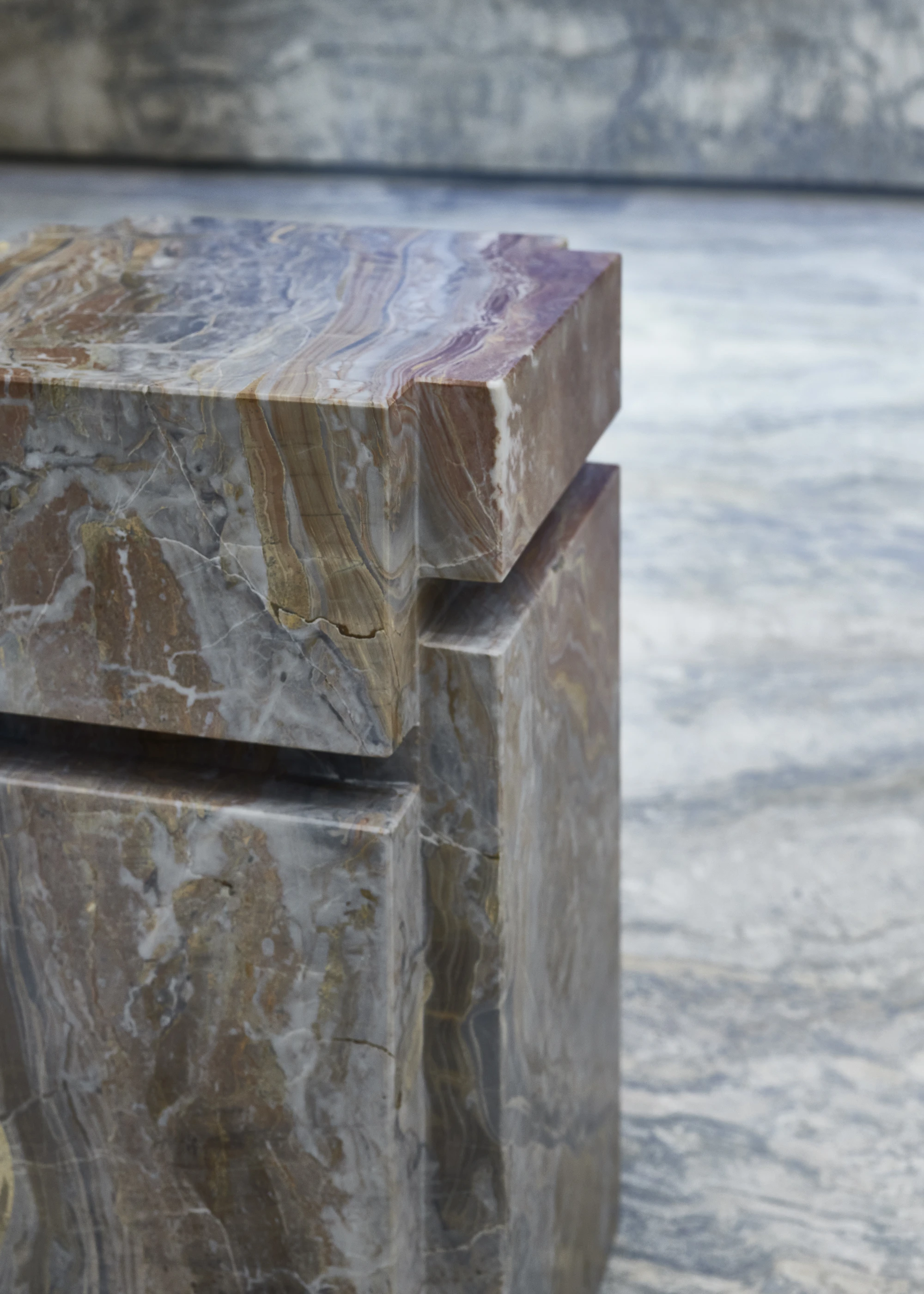
Inside, the geometry sharpens. Floors, walls, stairs, and benches are cut from a single silver-blue travertine, finished either roughly honed or finely scored depending on where a hand or foot meets the stone. Two rotundas, one clad in pressed mineral aggregate and one in board-formed concrete, are inserted into the otherwise rectilinear plan as structuring drums around which the shop unfolds. The first room a visitor enters is given over to art rather than product: marble sculptures by Rachel Whiteread, banded with purple, ochre, and ice-grey veining, sit on the travertine floor like geological cores raised from beneath the city.

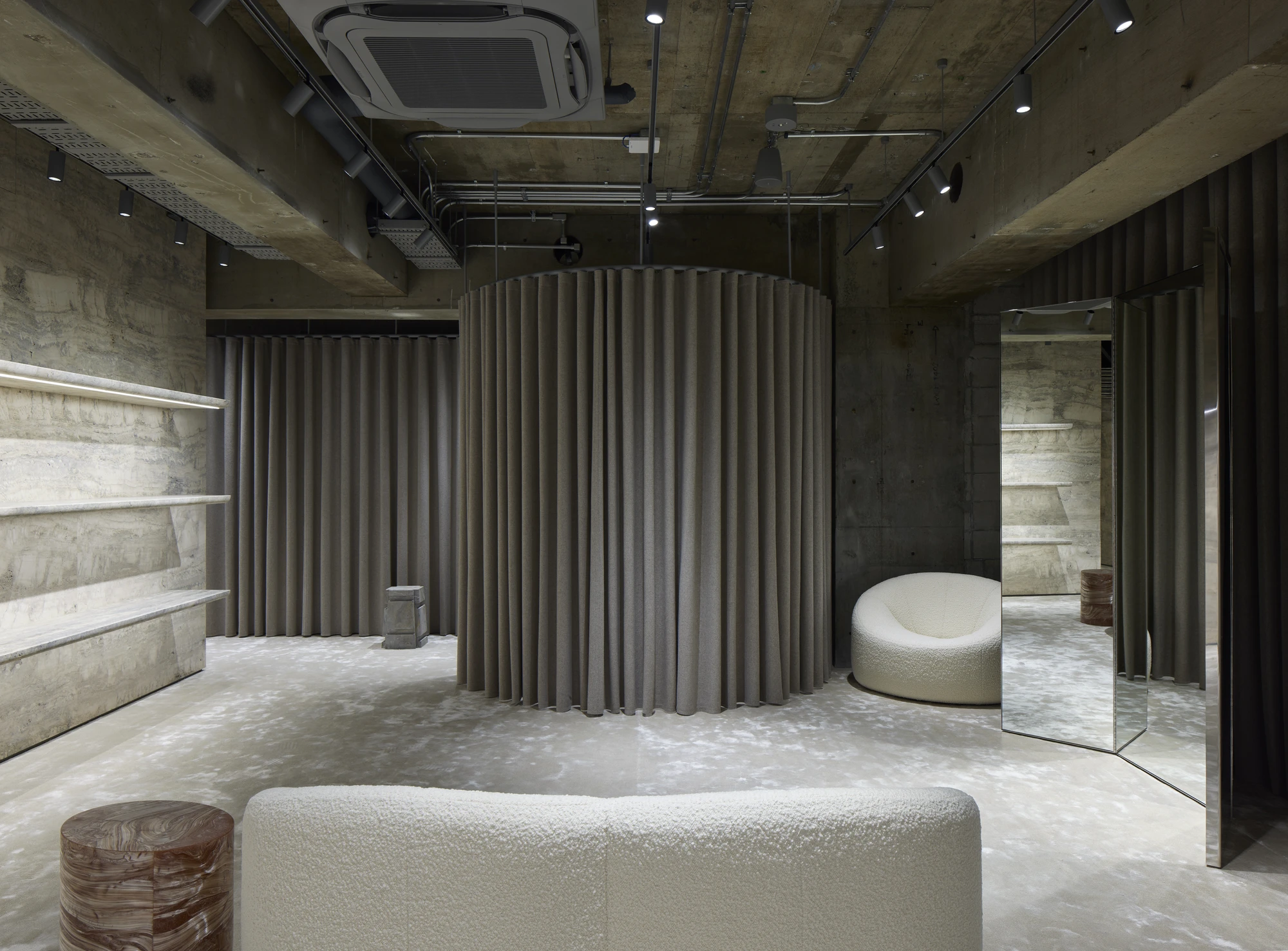
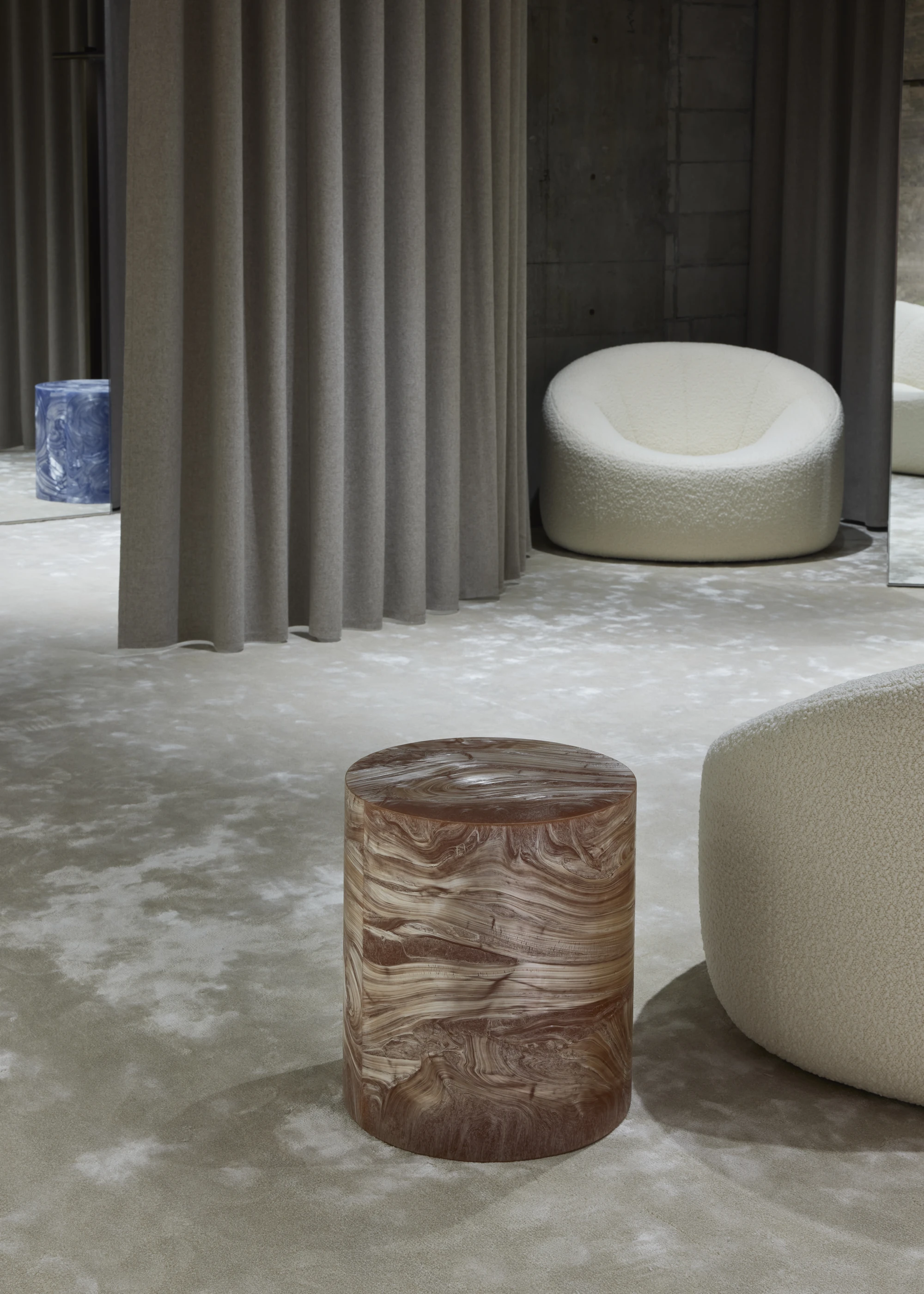
The store reads as a single excavated room rather than a sequence of decorated zones. Display vitrines, tables, and low seats are cast in sheets of recycled plastic in saturated orange, purple, and green, set deliberately against the stone's neutrality. Timber appears in drawer units and the marbled cylindrical stools that recur through the plan. Felt fabric, in heavy folded curtains and fitting-room linings, supplies acoustic softness against a palette otherwise tuned to mineral hardness.

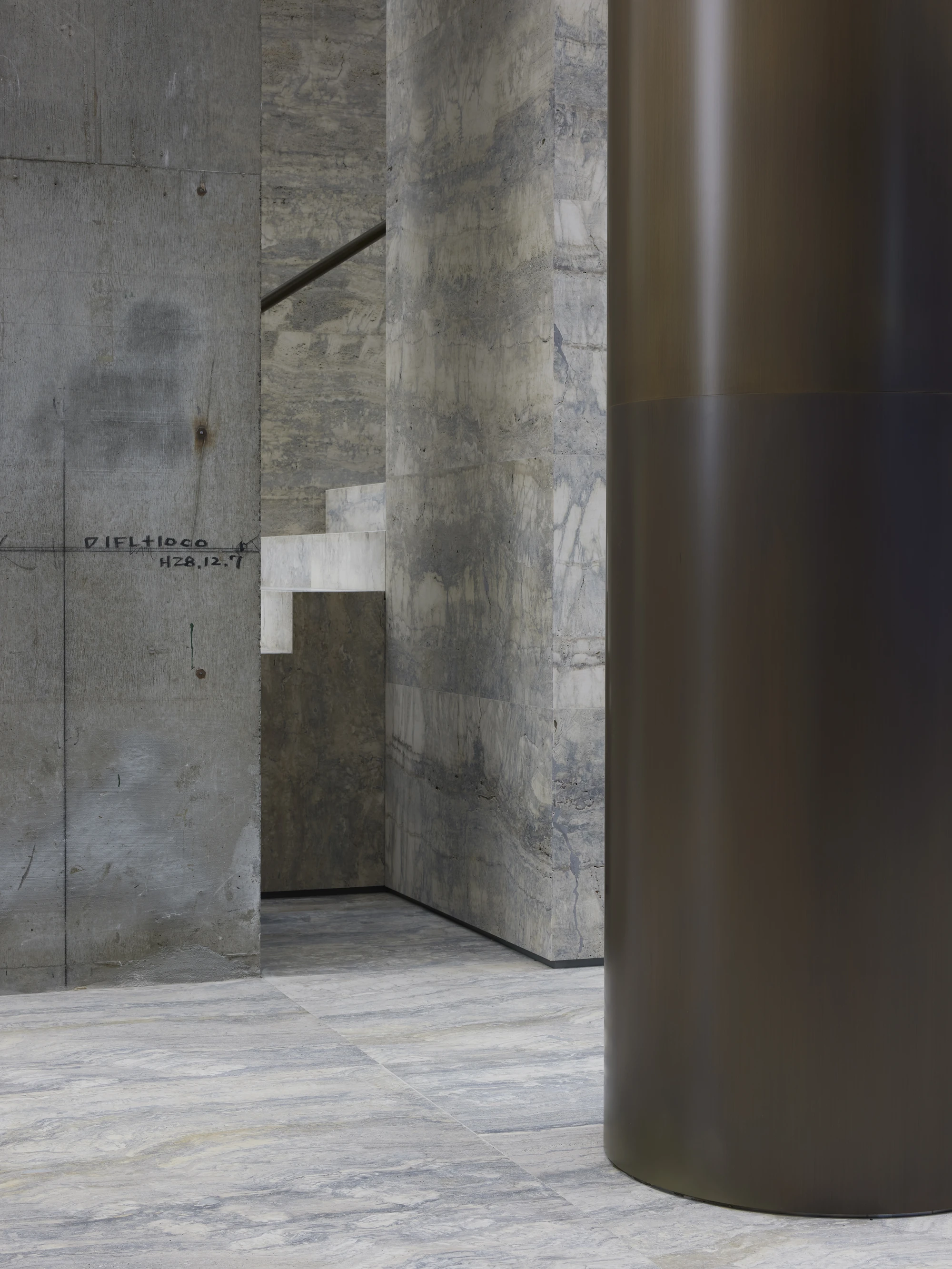
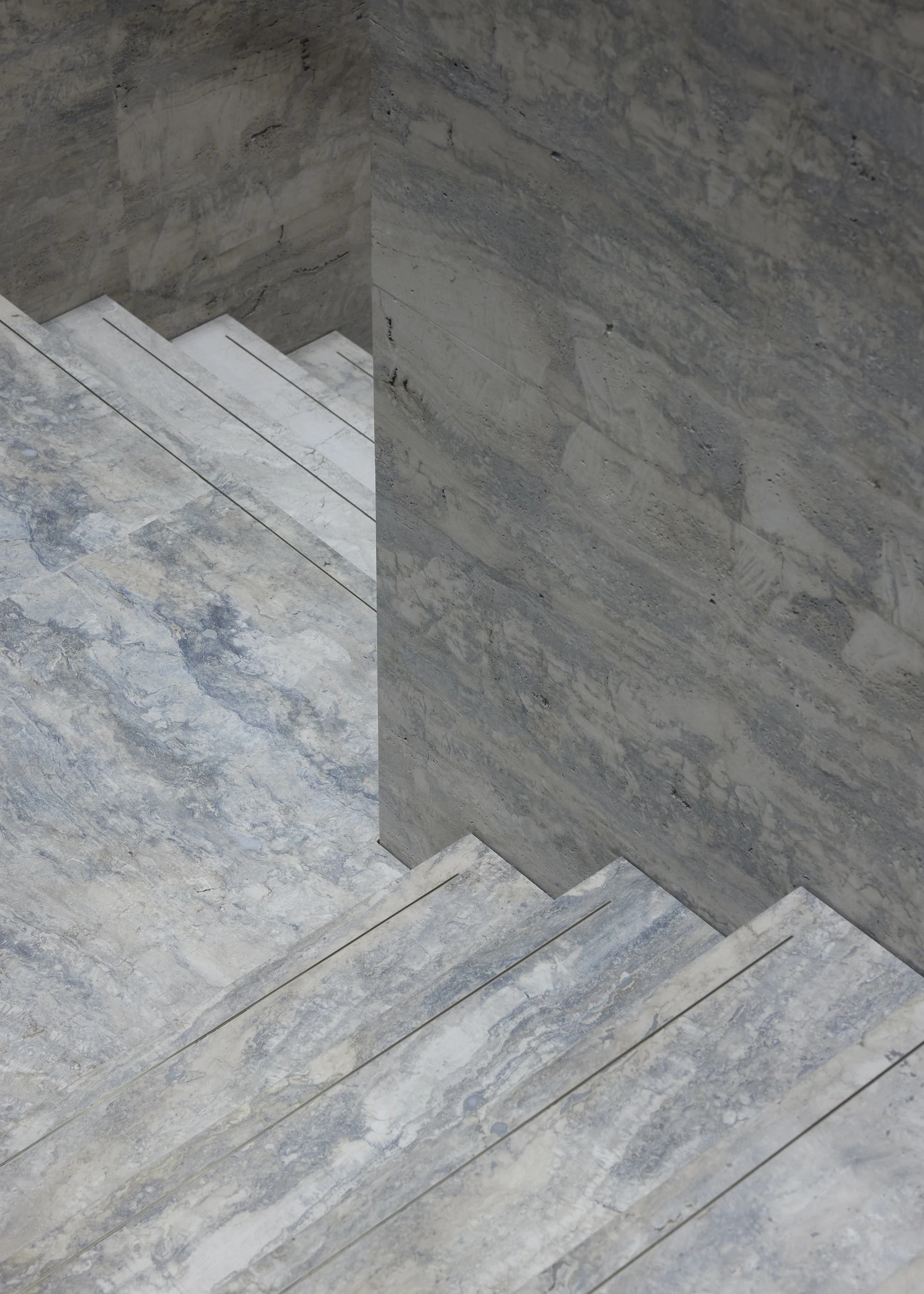
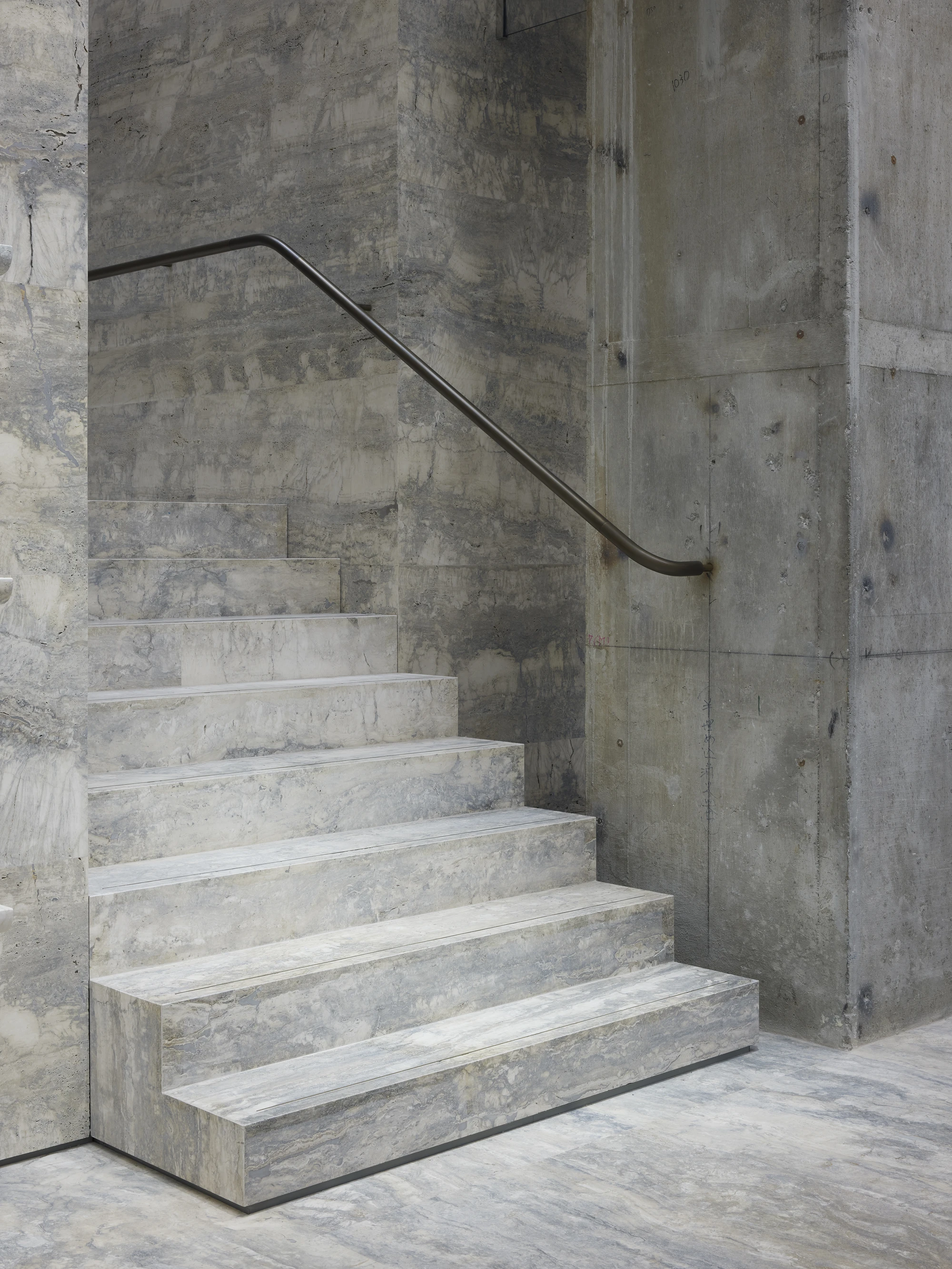
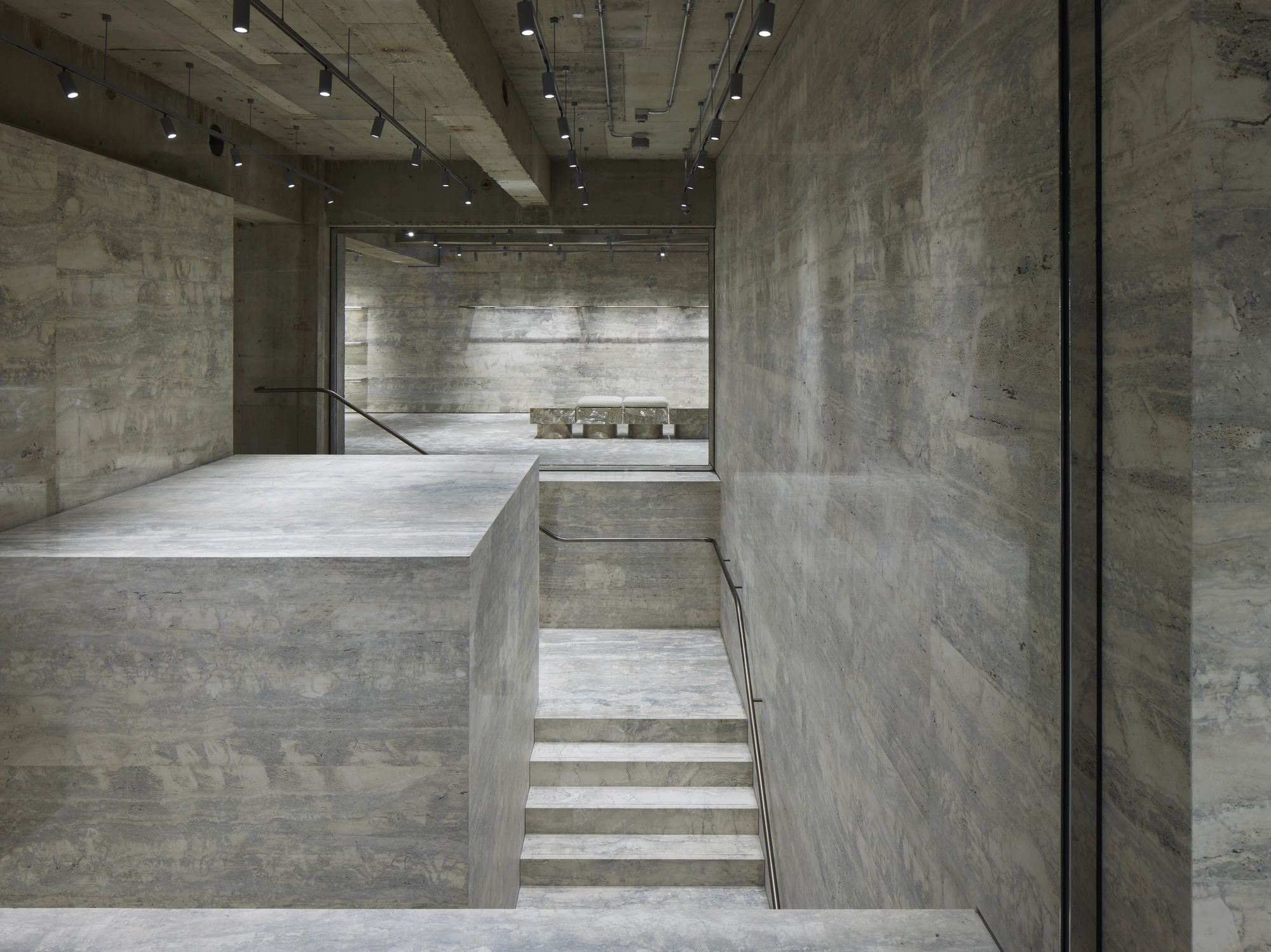
A canyon-cut staircase runs upward between travertine walls, the steps slotted in like ledges in a section drawing. Light slants from the upper landing and rakes across the stone's banded grain, making the route feel less like circulation than descent through strata. A patinated brass handrail traces the wall, a single warm note in the climb.

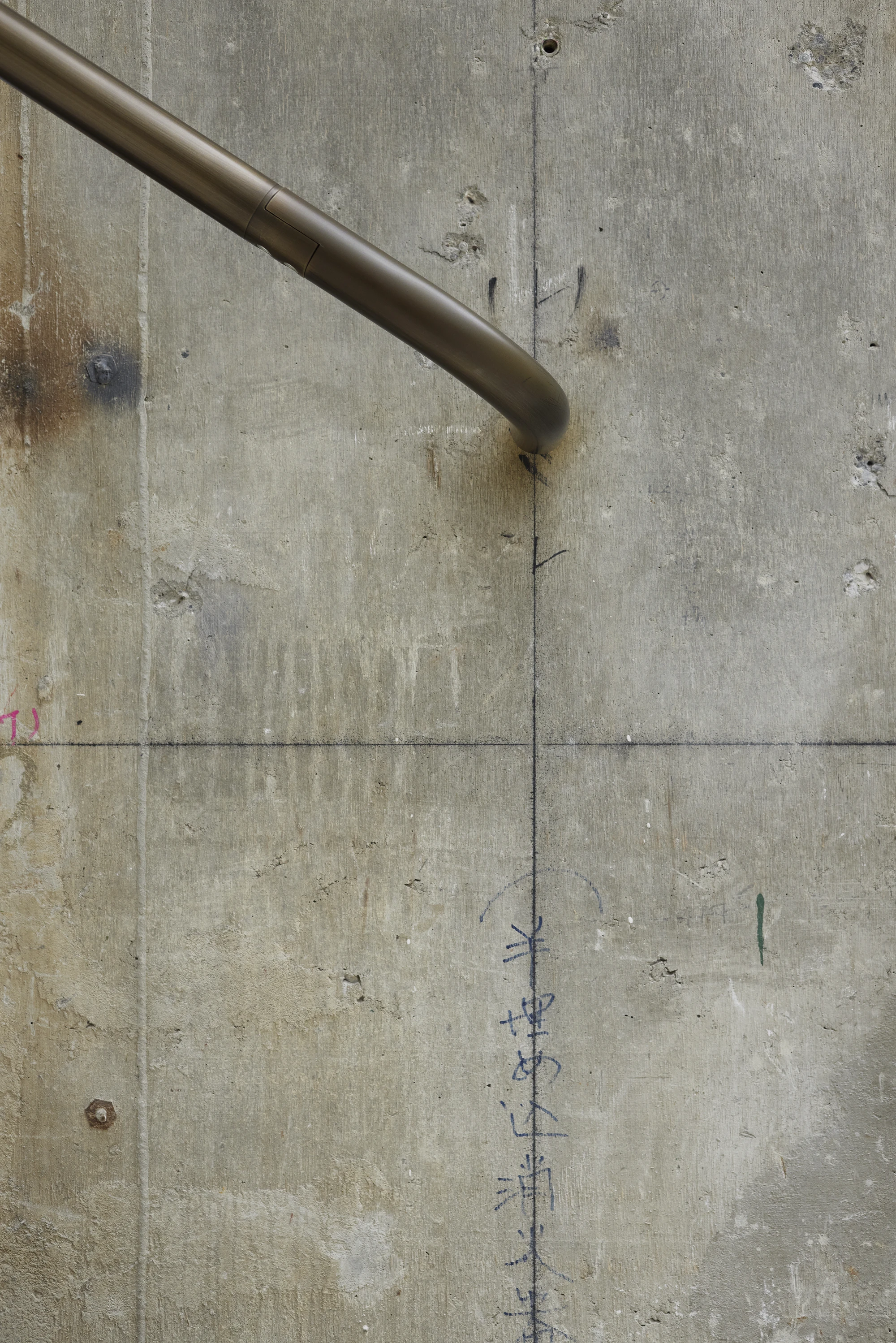
The upper floor changes register. Carpet replaces stone underfoot, and the existing building's shuttered concrete shell, complete with Japanese construction markings and pinhole tie scars, has been uncovered, cleaned, and kept as the room's finish. Horizontal ribbon windows wash the rough surface with daylight, while board-formed walls and silver-blue travertine continue to meet without transition strips. The studio writes that beauty lives in materials as they age, a position that finds first-floor light falling on preserved concrete as comfortably as on freshly cut stone.
Interested in Showcasing Your Work?

If you would like to feature your works on Thisispaper, please visit our Submission page and sign up to Thisispaper+ to submit your work. Once your submission is approved, your work will be showcased to our global audience of 2 million art, architecture, and design professionals and enthusiasts.
No items found.
We love less
but there is more.
Become a Thisispaper+ member today to unlock full access to our magazine, advanced tools, and support our work.
Get two months FREE
with annual subscription
We love less
but there is more.
Become a Thisispaper+ member today to unlock full access to our magazine, advanced tools, and support our work.
Get two months FREE
with annual subscription
No items found.
Alexander Zaxarov
Jun 10, 2026

Behind a chiselled grey-green granite facade in Tokyo's Ginza, Casper Mueller Kneer carve the Jil Sander flagship from a single mineral idea, silver-blue travertine stacked floor to ceiling.

Casper Mueller Kneer extends the material language they set with the brand's earlier Jil Sander flagship, now scaled into the largest outpost the studio has built for the house. The shop occupies the ground and first floors of a Ginza building, opening through gallery-scale windows onto the street.

The translation begins outside. A textural grey-green granite, scored and carved into vertical staggers, is stacked across the ground-floor elevations like a quarry face cropped to street height. Gallery-scale windows and brass-framed vitrines puncture the wall, tying the shop to the rhythm of the block and allowing passers-by to read the interior as a sequence of sculptural still lifes. The entrance is a curved patinated brass panel, the only soft gesture in an otherwise rectilinear elevation.

Inside, the geometry sharpens. Floors, walls, stairs, and benches are cut from a single silver-blue travertine, finished either roughly honed or finely scored depending on where a hand or foot meets the stone. Two rotundas, one clad in pressed mineral aggregate and one in board-formed concrete, are inserted into the otherwise rectilinear plan as structuring drums around which the shop unfolds. The first room a visitor enters is given over to art rather than product: marble sculptures by Rachel Whiteread, banded with purple, ochre, and ice-grey veining, sit on the travertine floor like geological cores raised from beneath the city.

The store reads as a single excavated room rather than a sequence of decorated zones. Display vitrines, tables, and low seats are cast in sheets of recycled plastic in saturated orange, purple, and green, set deliberately against the stone's neutrality. Timber appears in drawer units and the marbled cylindrical stools that recur through the plan. Felt fabric, in heavy folded curtains and fitting-room linings, supplies acoustic softness against a palette otherwise tuned to mineral hardness.

A canyon-cut staircase runs upward between travertine walls, the steps slotted in like ledges in a section drawing. Light slants from the upper landing and rakes across the stone's banded grain, making the route feel less like circulation than descent through strata. A patinated brass handrail traces the wall, a single warm note in the climb.

The upper floor changes register. Carpet replaces stone underfoot, and the existing building's shuttered concrete shell, complete with Japanese construction markings and pinhole tie scars, has been uncovered, cleaned, and kept as the room's finish. Horizontal ribbon windows wash the rough surface with daylight, while board-formed walls and silver-blue travertine continue to meet without transition strips. The studio writes that beauty lives in materials as they age, a position that finds first-floor light falling on preserved concrete as comfortably as on freshly cut stone.
Interested in Showcasing Your Work?

If you would like to feature your works on Thisispaper, please visit our Submission page and subscribe to Thisispaper+. Once your submission is approved, your work will be showcased to our global audience of 2 million art, architecture, and design professionals and enthusiasts.
Thisispaper+
Tokyo Guide
40+ Locations
Web Access
Link to Maps
Architecture in Tokyo — micro-houses on narrow residential lots, Kengo Kuma's public works, Sou Fujimoto's transparent volumes, and the quiet experiments of young studios working where density forces invention. The city where the smallest plot produces the most spatial ambition.
Explore
Tokyo Guide

Join Thisispaper+
Unlock access to 2500 stories, curated guides + editions, and share your work with a global network of architects, artists, writers and designers who are shaping the future.
Get two months FREE
with annual subscription
Travel Guides
Immerse yourself in timeless destinations, hidden gems, and creative spaces—curated by humans, not algorithms.
Explore All Guides +
Submission Module
Submit your project and gain the chance to showcase your work to our worldwide audience of over 2M architects, designers, artists, and curious minds.
Learn More+
Curated Editions
Dive deeper into carefully curated editions, designed to feed your curiosity and foster exploration.
Off-the-Grid
Jutaku
Sacral Journey
minimum
The New Chair
Explore All Editions +
Atlas
A new and interactive way to explore the most inspiring places around the world.
Interactive map
Linked to articles
300+ curated locations
Google + Apple directions
Smart filters
Subscribe to Explore+
Become a Thisispaper+ member today to unlock full access to our magazine, submit your project and support our work.
Join Thisispaper+Join Thisispaper+
€ 9 EUR
/month
Cancel anytime
Get two months FREE
with annual subscription