On the outskirts of Kyoto, kooo architects recalibrate an existing Sukiya-style residence on a gently sloping site at the edge of a wooded hillside — introducing a designed waterfall between main house and annex, and extracting the spatial logic of traditional Japanese architecture to serve contemporary life.
The property comprises a two-storey main house and a detached two-storey annex, connected through a carefully orchestrated garden. Between them, the architects introduced a newly designed waterfall, making use of the site's natural gradient. Visible from the living spaces of both buildings, the flow of water becomes at once focal point and ambient presence, folding sound, movement, and reflection into the domestic routine. Garden, mountain backdrop, and the subtle presence of water are not treated as picturesque scenery but as intrinsic elements woven into the cadence of everyday life, echoed indoors through the tactile simplicity of timber, plaster, and stone.
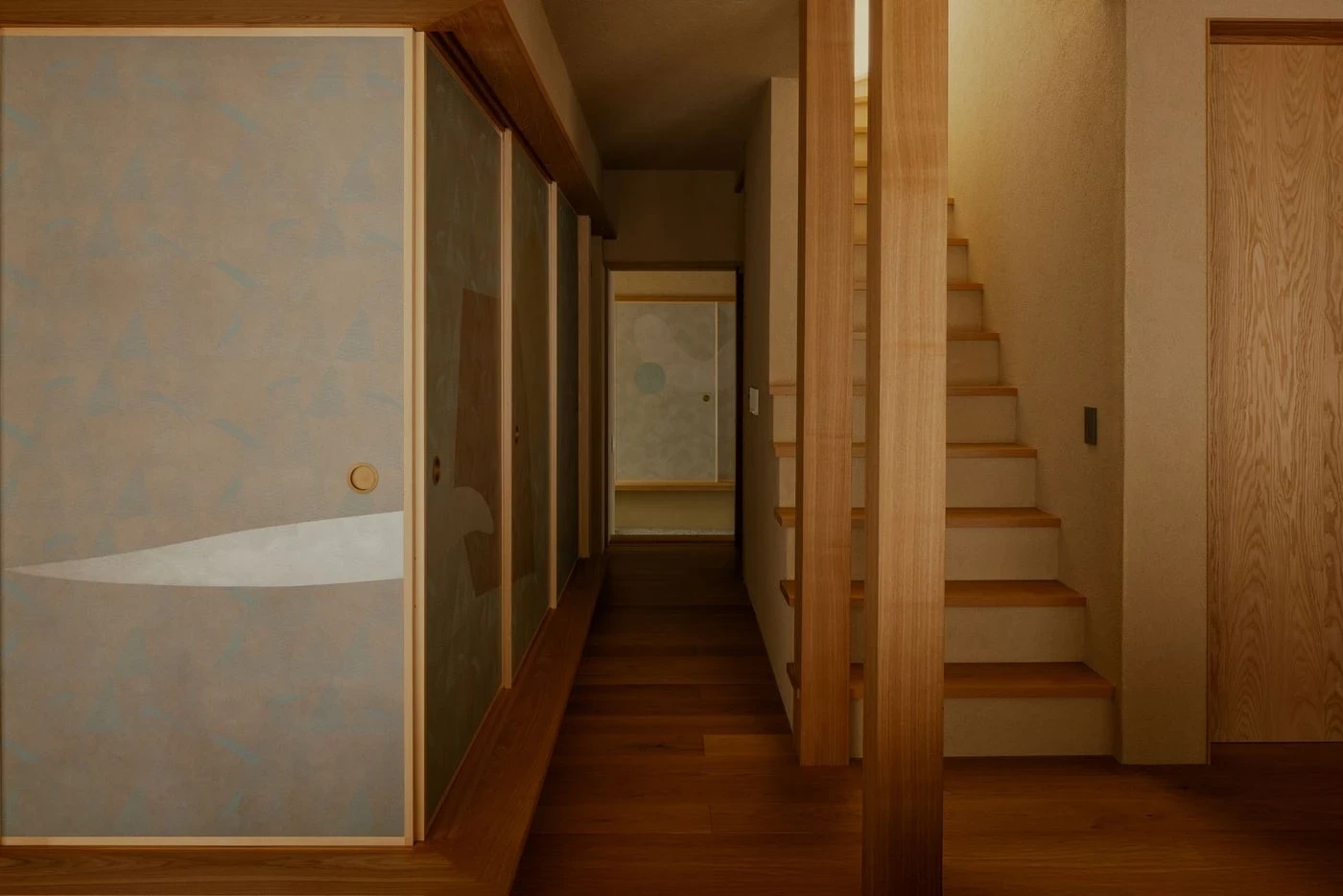
The reconfiguration of the main house begins with the doma — an earthen-floored passage that bisects the ground floor, linking the stone-paved entrance at the front to the landscaped garden at the rear. More than a corridor, it functions as a spatial hinge, separating everyday living areas from spaces intended for formal entertaining, while also operating as an atmospheric threshold. Fusuma sliding panels featuring abstract geometric compositions by Noda Print Studio, acclaimed for their modern use of karakami hand-printing techniques, imbue the space with a muted graphic rhythm.
On one side of the passage, the original tatami rooms have been consolidated into a large reception hall for entertaining. On the other, a fluid living, dining, and kitchen area opens onto the garden through floor-to-ceiling timber-framed sliding doors on two sides. When fully retracted, the space expands onto the engawa — the traditional covered veranda extending along the outer perimeter — and into the garden. Additional rooms separated by sliding partitions can also be incorporated into the main space, allowing the house to contract or expand according to use.
Throughout, light filtered through deep eaves and shoji screens moves gently across surfaces. Juraku plaster lends the walls and ceilings a velvety depth, softening illumination, while hardwood floors, timber posts and beams, and wooden furnishings in natural grain add warm tonal shifts. Conceived as a separate guest house, the annex includes a lounge that opens toward the main house, and three guest rooms. In one upstairs suite, a hinoki bath connects seamlessly with the bedroom, turning bathing into a contemplative act oriented toward filtered light and seasonal change. Rather than preserving the house as a historical artefact, kooo architects have extracted and adapted it — the result is a home that feels neither nostalgic nor overtly modern, but measured and enduring.