Thisispaper Community
Join today.
Enter your email address to receive the latest news on emerging art, design, lifestyle and tech from Thisispaper, delivered straight to your inbox.
Oops! Something went wrong while submitting the form.
Instant access to new channels
The top stories curated daily
Weekly roundups of what's important
Original features and deep dives
Exclusive community features
Jutaku
under the patronage of
Floating-roof House by Masahiro Miyake (y+M design office)
Alexander Zaxarov
Jan 8, 2026

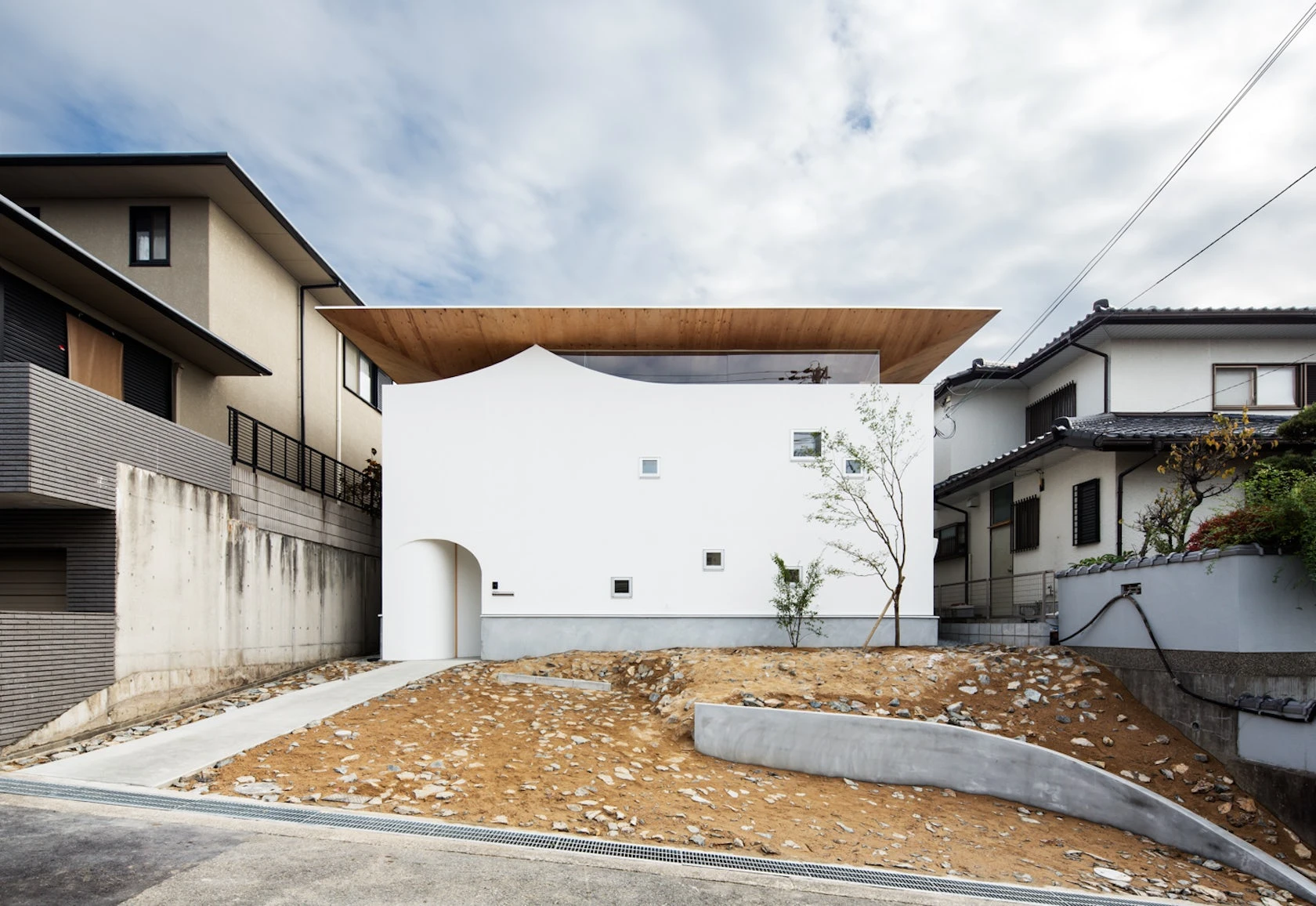
In a quiet residential pocket of Hyogo, Japan, architect Masahiro Miyake of y+M design office has crafted a home that shimmers with quiet defiance.

The Floating Roof House, completed in 2015, is not so much a shelter as it is a deliberate counterpoint to the anonymous blur of urban façades. Rising like a soft pavilion amid the density of Kobe, it suggests a new domestic archetype—one where privacy and community find unlikely harmony beneath a canopy that quite literally floats.

Miyake returns here to a language he began developing with the Rain Shelter House in Yanogo, refining it into something leaner and more legible. The Floating Roof House becomes a statement of identity—a private beacon within the city. Its most striking gesture, the eponymous roof, is suspended above the core living space on thin pillars, hovering delicately like a stretched canvas or a ritual offering. Beneath it, the home’s walls hang like pale curtains, visually “grasping” the floating structure while allowing light and air to pool in between.

The architectural strategy is both poetic and performative. By distancing the main roof from the inner volume, Miyake generates a thermal and luminous buffer zone—what might be called a breathing ceiling. Natural light filters through the slits created by this gap, entering the home obliquely, softly, avoiding the harshness of direct sunlight. The central pathway, carved into the southern wall, is less a corridor and more a civic gesture—an inward-facing street that encourages circulation, reflection, and community within the shell of a single-family home.

In typical Japanese fashion, three sides of the house are virtually windowless, introspective rather than exhibitionist. But inside, the space dissolves boundaries: there are no sealed-off rooms, only gestures of enclosure that define function without isolating. The ground floor hosts the essentials—daytime and nighttime functions—while the upper floor, nestled between sloping roof planes, offers a mutable zone for play and temporary activities. It feels like a miniature village, a central square under one large roof, each part aware of the others.

Interested in Showcasing Your Work?

If you would like to feature your works on Thisispaper, please visit our Submission page and sign up to Thisispaper+ to submit your work. Once your submission is approved, your work will be showcased to our global audience of 2 million art, architecture, and design professionals and enthusiasts.
No items found.
We love less
but there is more.
Become a Thisispaper+ member today to unlock full access to our magazine, advanced tools, and support our work.
Get two months FREE
with annual subscription
We love less
but there is more.
Become a Thisispaper+ member today to unlock full access to our magazine, advanced tools, and support our work.
Get two months FREE
with annual subscription
No items found.
Alexander Zaxarov
Jan 8, 2026

In a quiet residential pocket of Hyogo, Japan, architect Masahiro Miyake of y+M design office has crafted a home that shimmers with quiet defiance.

The Floating Roof House, completed in 2015, is not so much a shelter as it is a deliberate counterpoint to the anonymous blur of urban façades. Rising like a soft pavilion amid the density of Kobe, it suggests a new domestic archetype—one where privacy and community find unlikely harmony beneath a canopy that quite literally floats.

Miyake returns here to a language he began developing with the Rain Shelter House in Yanogo, refining it into something leaner and more legible. The Floating Roof House becomes a statement of identity—a private beacon within the city. Its most striking gesture, the eponymous roof, is suspended above the core living space on thin pillars, hovering delicately like a stretched canvas or a ritual offering. Beneath it, the home’s walls hang like pale curtains, visually “grasping” the floating structure while allowing light and air to pool in between.

The architectural strategy is both poetic and performative. By distancing the main roof from the inner volume, Miyake generates a thermal and luminous buffer zone—what might be called a breathing ceiling. Natural light filters through the slits created by this gap, entering the home obliquely, softly, avoiding the harshness of direct sunlight. The central pathway, carved into the southern wall, is less a corridor and more a civic gesture—an inward-facing street that encourages circulation, reflection, and community within the shell of a single-family home.

In typical Japanese fashion, three sides of the house are virtually windowless, introspective rather than exhibitionist. But inside, the space dissolves boundaries: there are no sealed-off rooms, only gestures of enclosure that define function without isolating. The ground floor hosts the essentials—daytime and nighttime functions—while the upper floor, nestled between sloping roof planes, offers a mutable zone for play and temporary activities. It feels like a miniature village, a central square under one large roof, each part aware of the others.

Interested in Showcasing Your Work?

If you would like to feature your works on Thisispaper, please visit our Submission page and subscribe to Thisispaper+. Once your submission is approved, your work will be showcased to our global audience of 2 million art, architecture, and design professionals and enthusiasts.
Thisispaper+
Jutaku
90+ Projects
Web Access
Link to Maps
‘Jūtaku’ is the Japanese word for ‘house’. Nowhere in the world have architects built so many small and exceptional homes as in Japan, and nowhere with such ingenuity and success.
Explore
Jutaku

Join Thisispaper+
Unlock access to 2500 stories, curated guides + editions, and share your work with a global network of architects, artists, writers and designers who are shaping the future.
Get two months FREE
with annual subscription
Atlas
A new and interactive way to explore the most inspiring places around the world.
Interactive map
Linked to articles
300+ curated locations
Google + Apple directions
Smart filters
Subscribe to Explore+
Travel Guides
Immerse yourself in timeless destinations, hidden gems, and creative spaces—curated by humans, not algorithms.
Explore All Guides +
Curated Editions
Dive deeper into carefully curated editions, designed to feed your curiosity and foster exploration.
Off-the-Grid
Jutaku
Sacral Journey
minimum
The New Chair
Explore All Editions +
Submission Module
Submit your project and gain the chance to showcase your work to our worldwide audience of over 2M architects, designers, artists, and curious minds.
Learn More+
Become a Thisispaper+ member today to unlock full access to our magazine, submit your project and support our work.
Join Thisispaper+Join Thisispaper+
€ 9 EUR
/month
Cancel anytime
Get two months FREE
with annual subscription