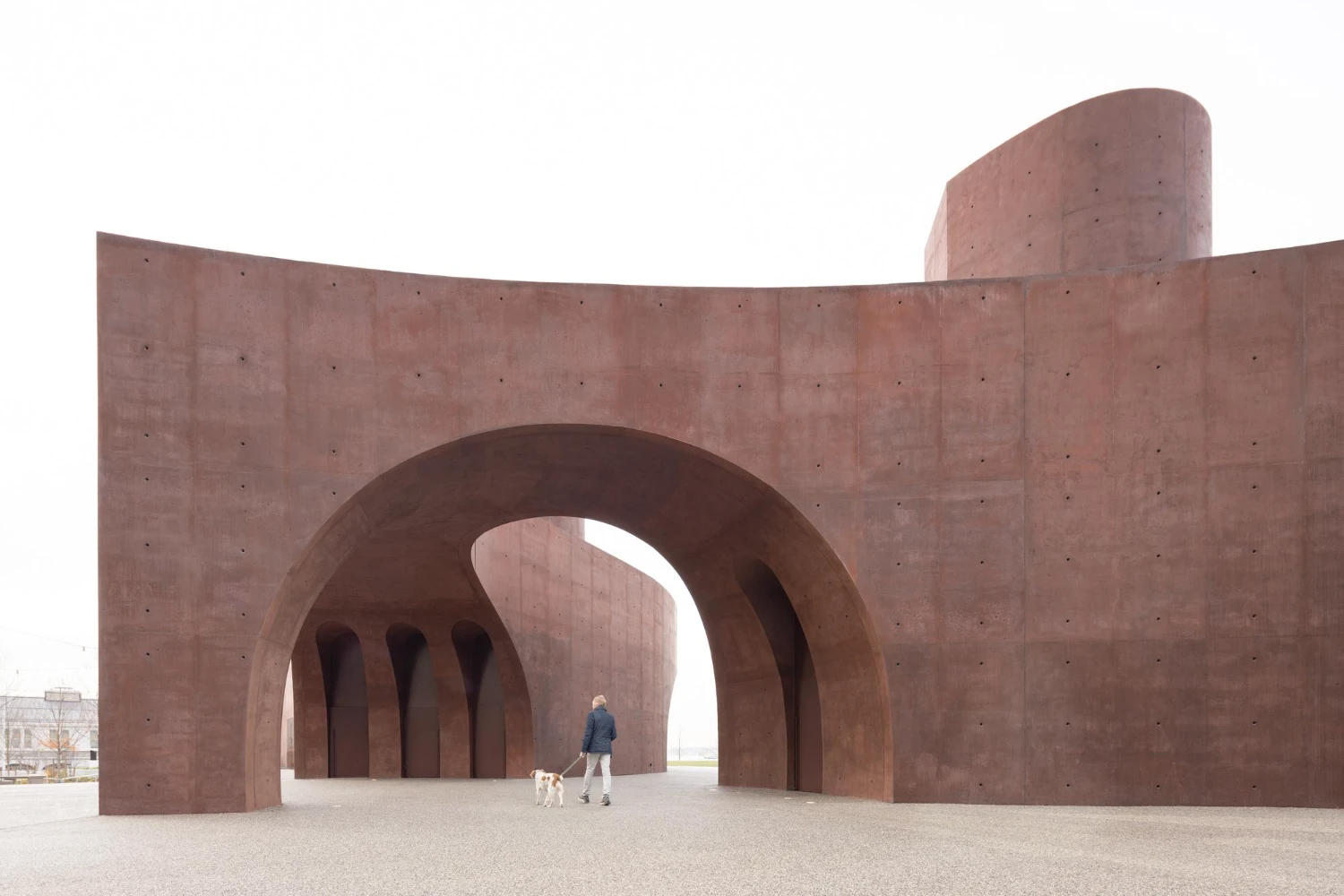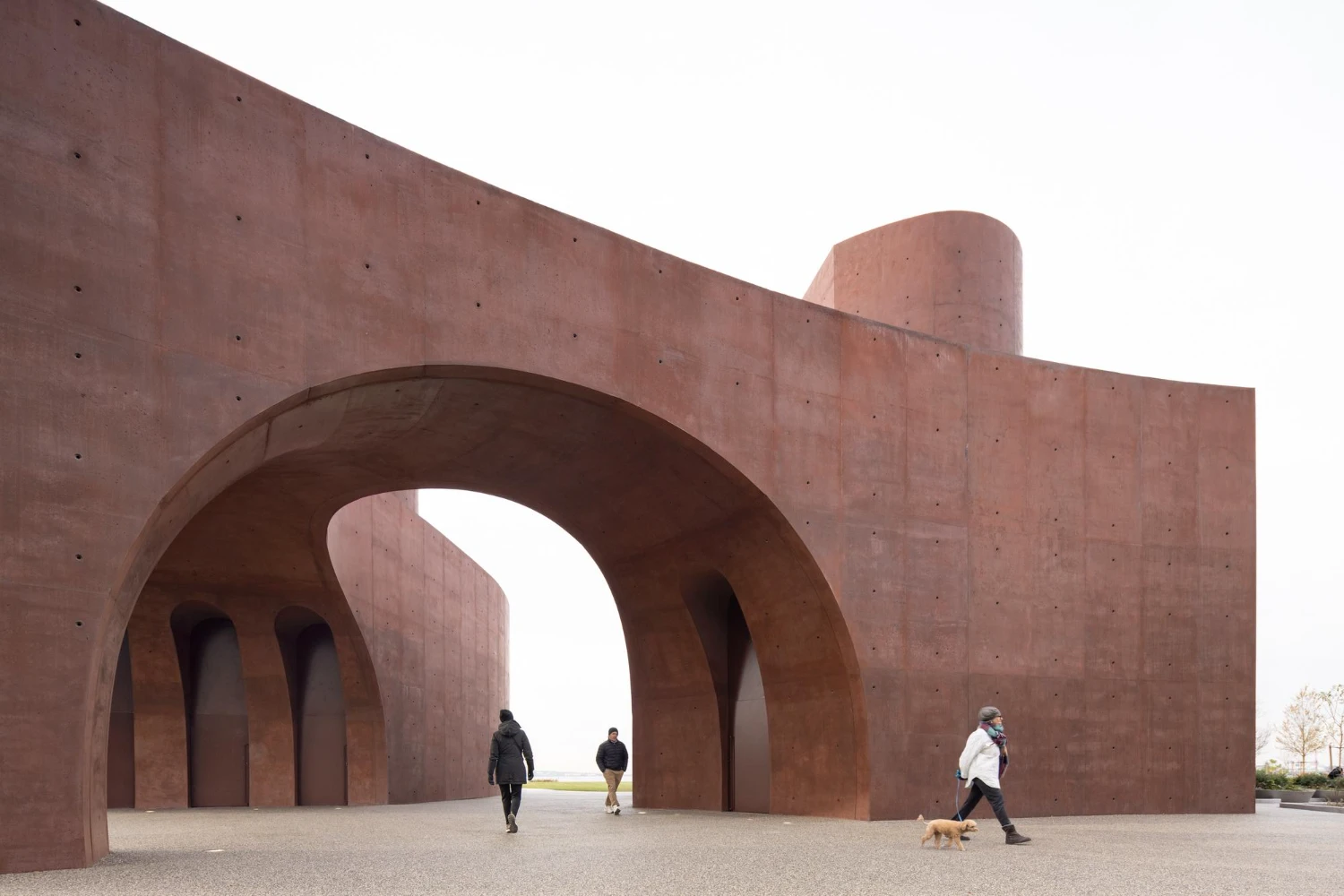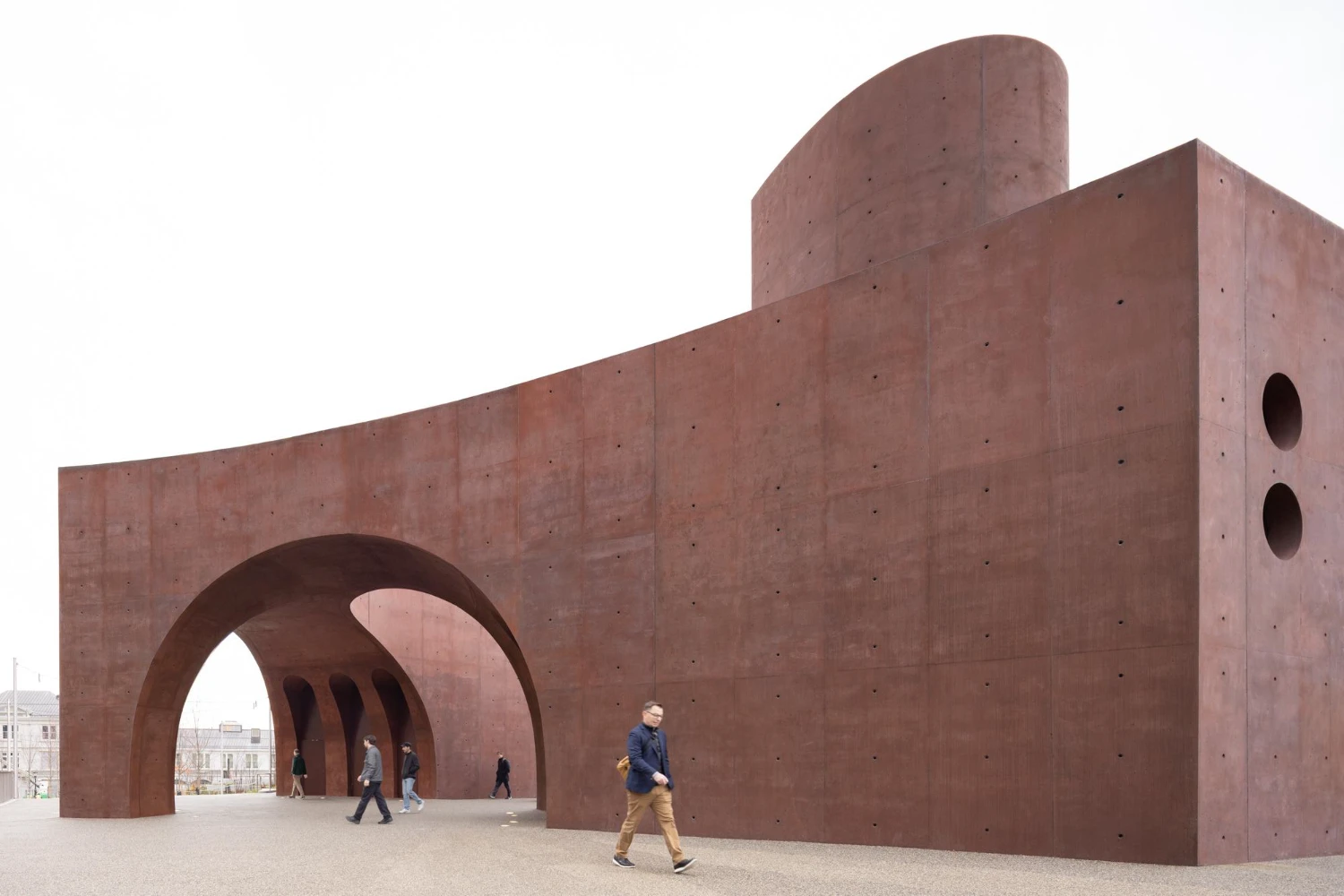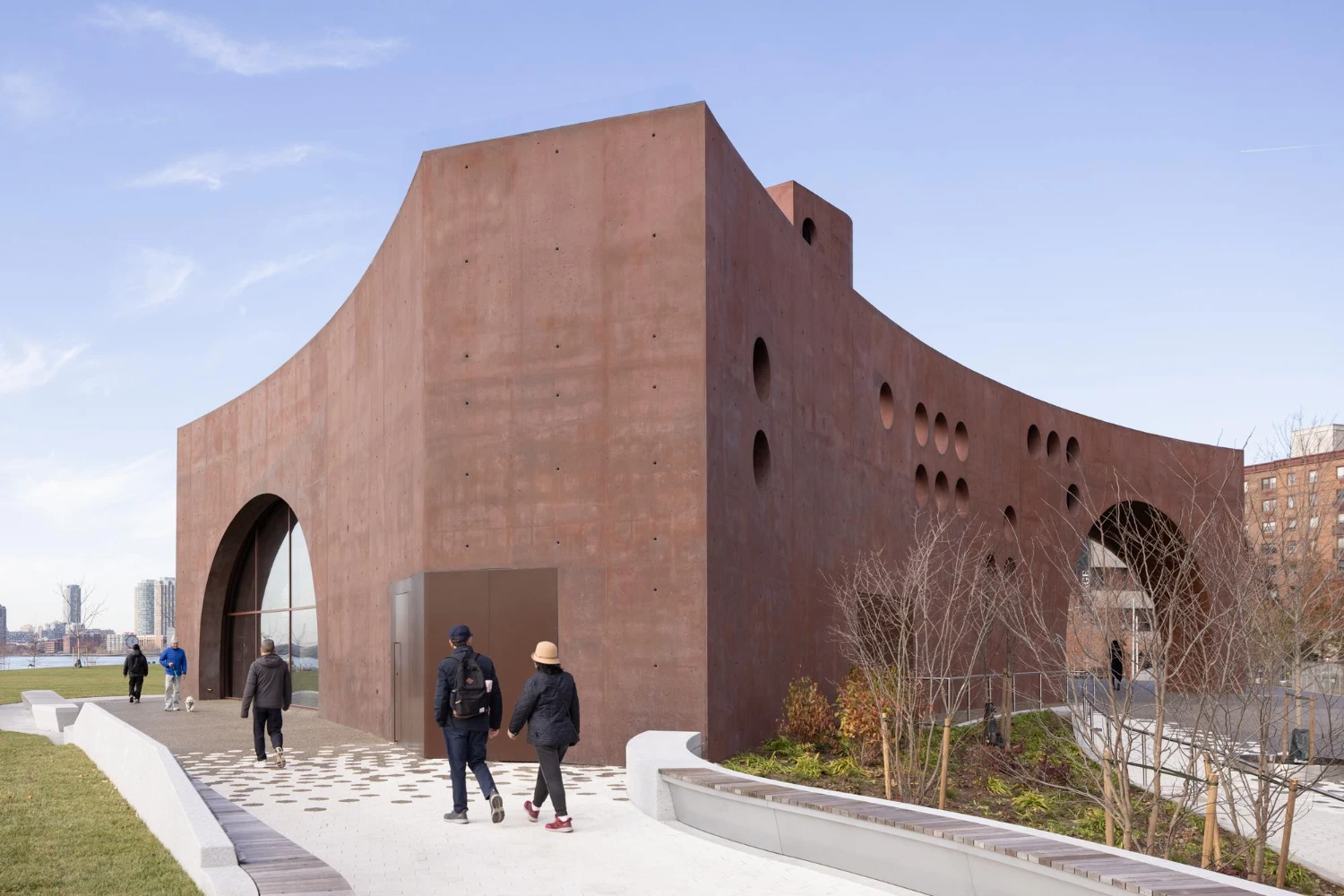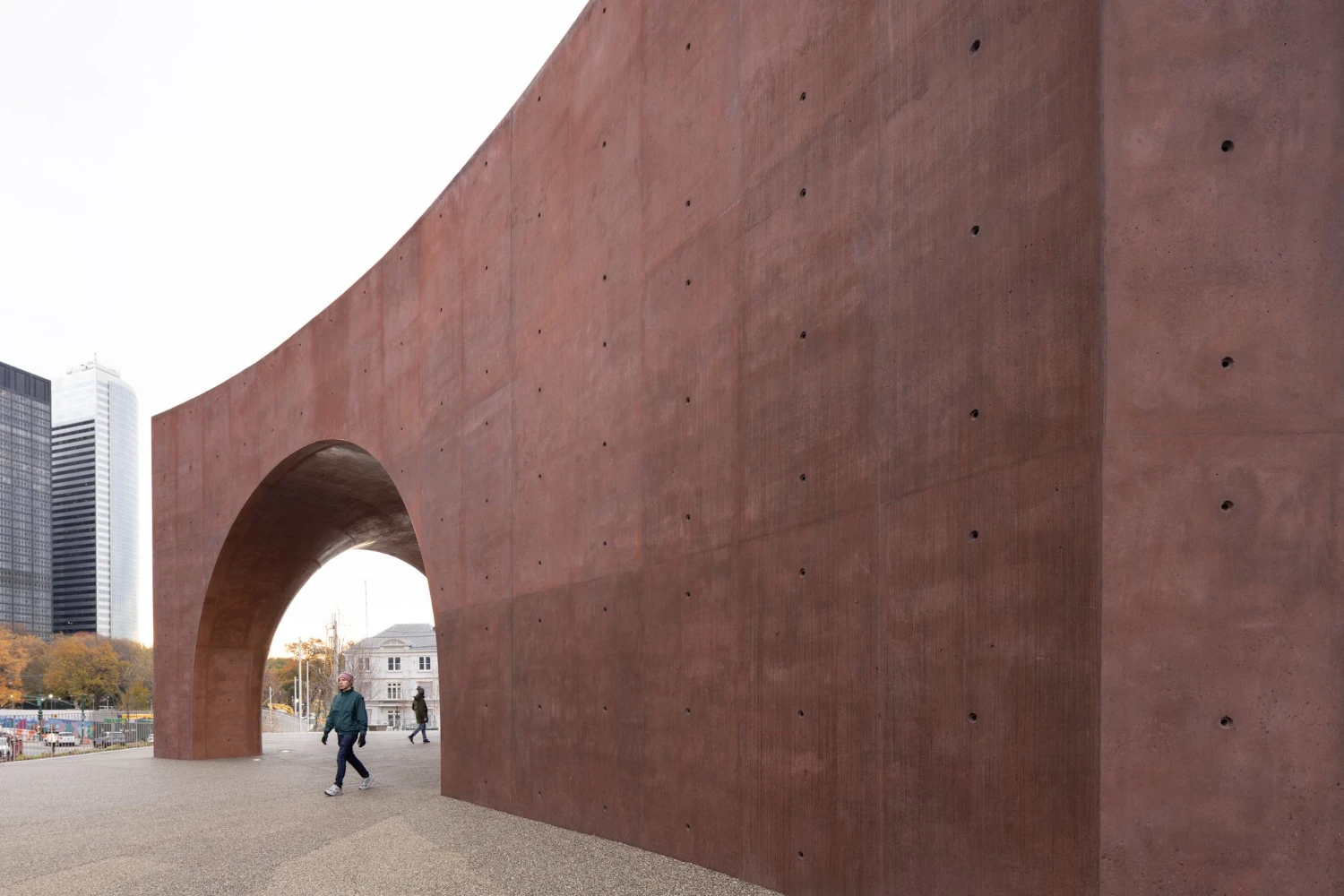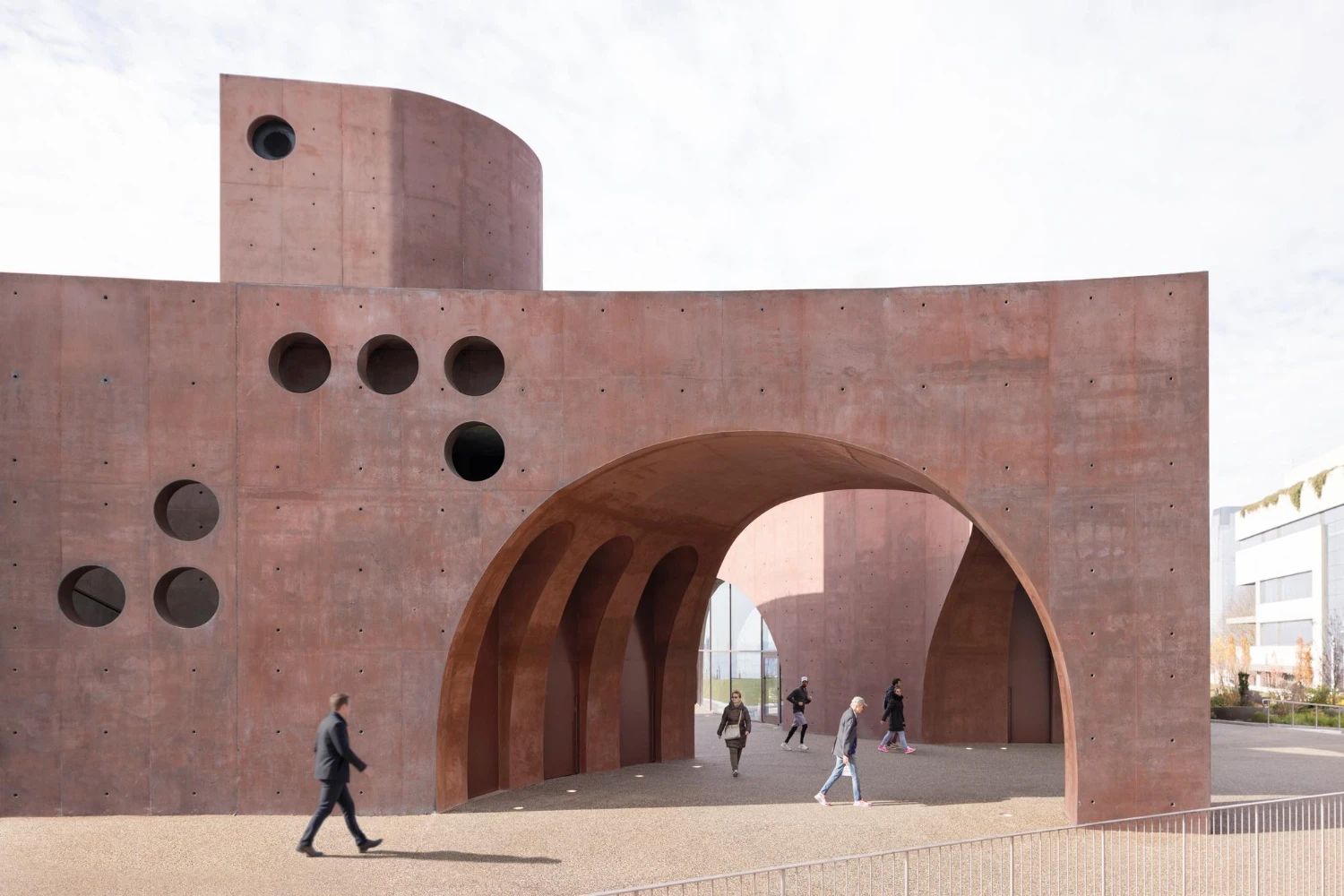
Thomas Phifer’s Wagner Park Pavilion in New York emerges from the ground with a quiet gravitational pull, its red-tinted concrete rising in broad, curving planes that feel less constructed than carved by coastal wind.
Approached from Battery Place, visitors ascend through two sloped gardens whose allées of trees rhythmically prepare the eye for the architecture’s compressed openings and monumental arcs. The pavilion carries the memory of New York Harbor’s historic fortifications, absorbing their mass and brick-toned warmth without quoting them directly.
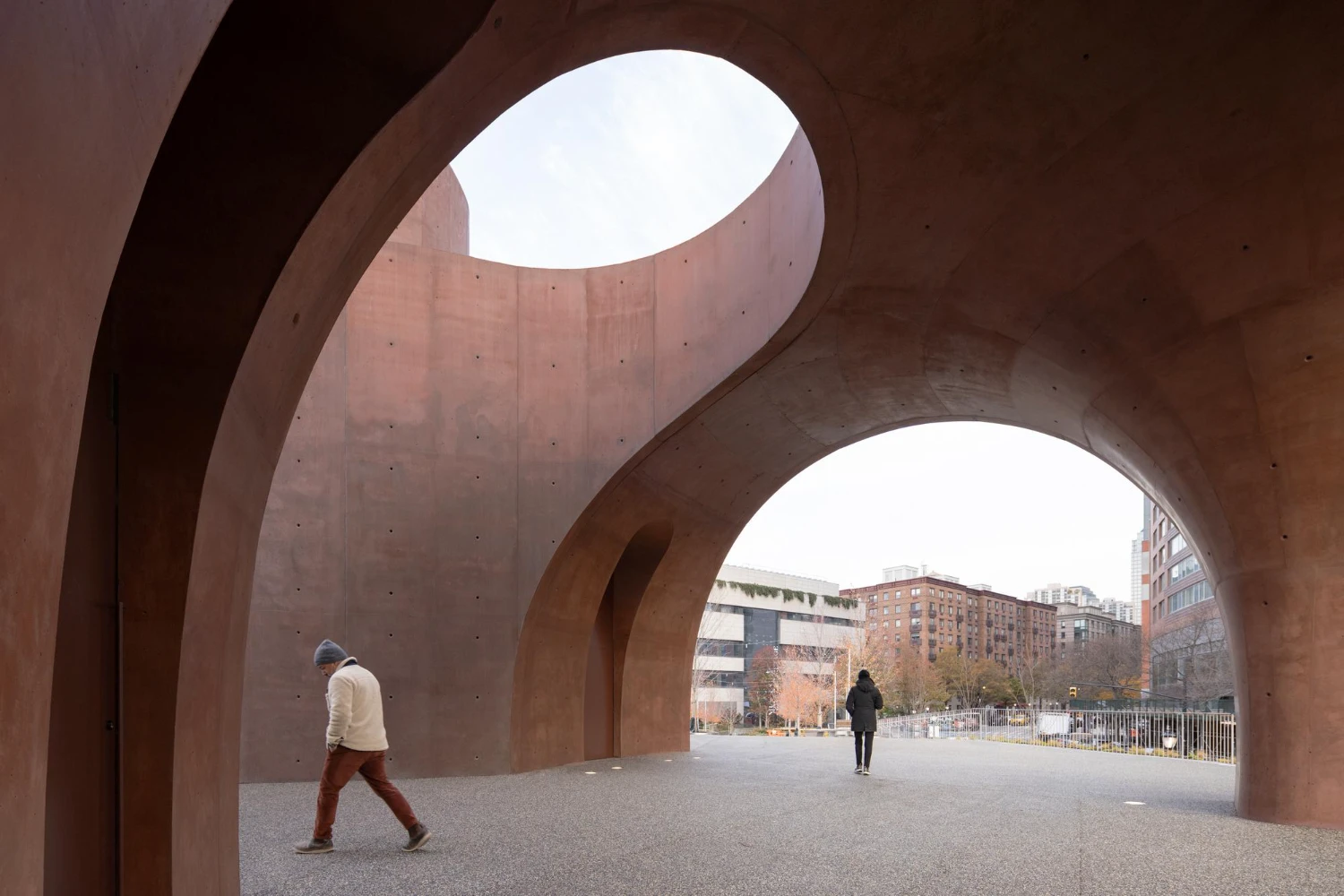
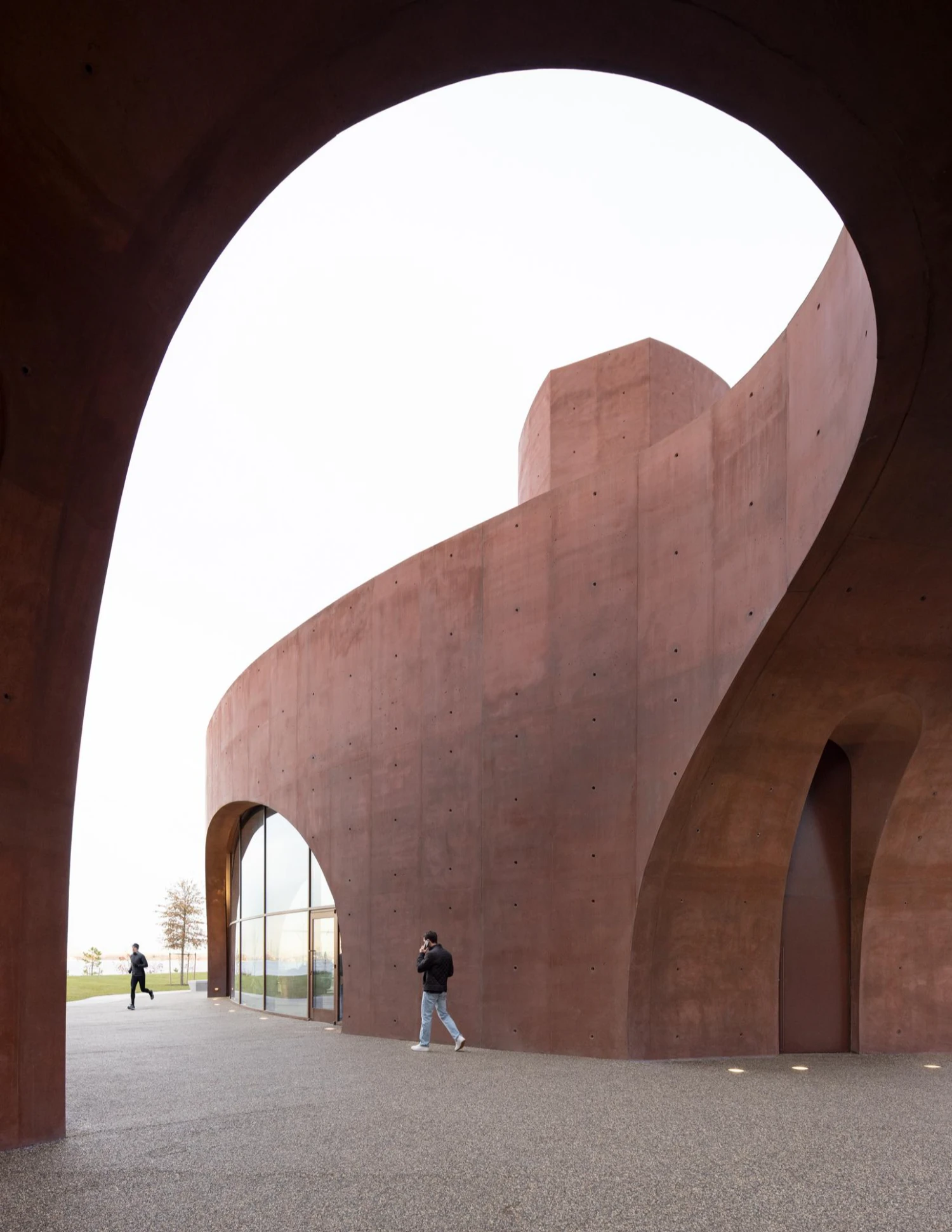
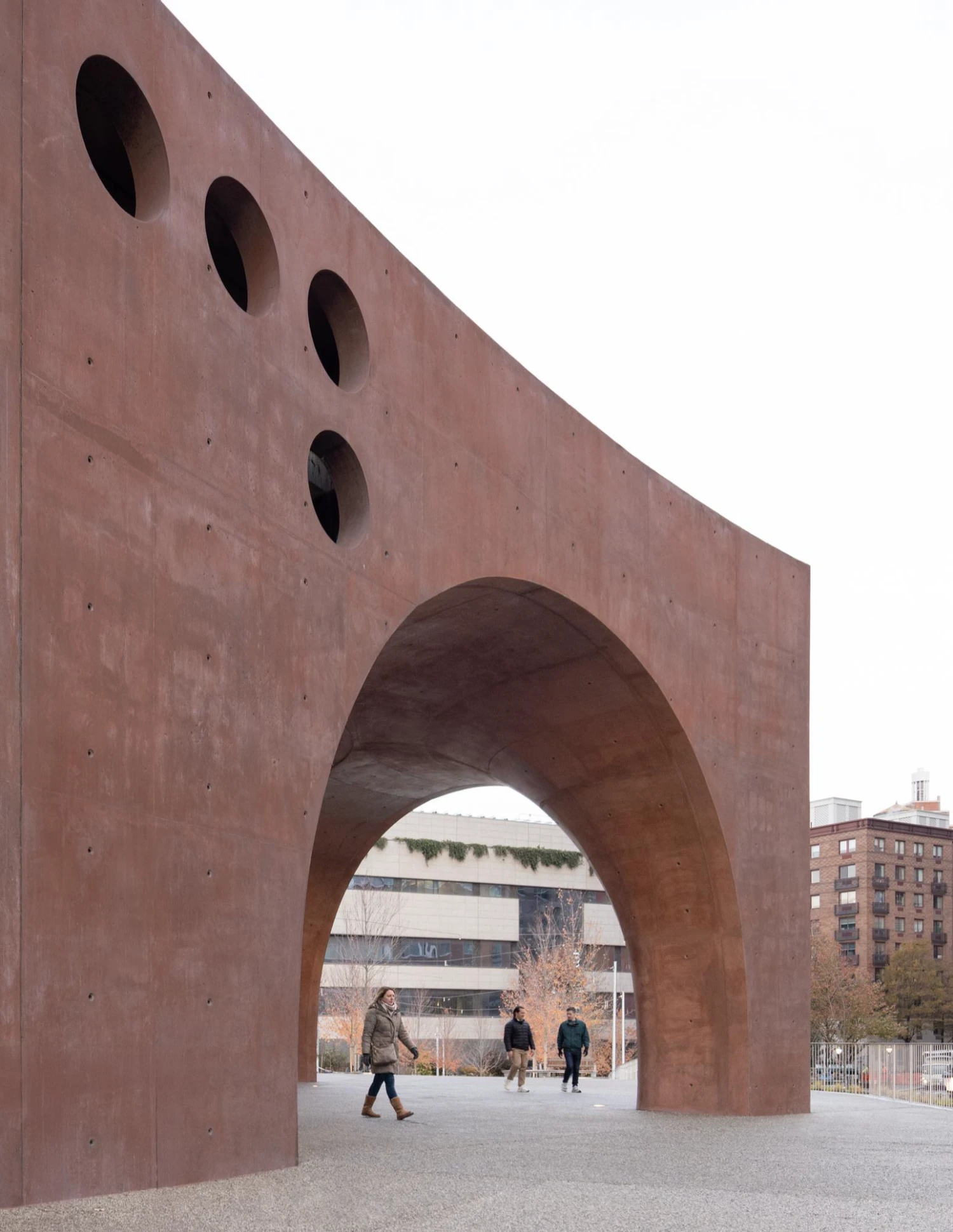
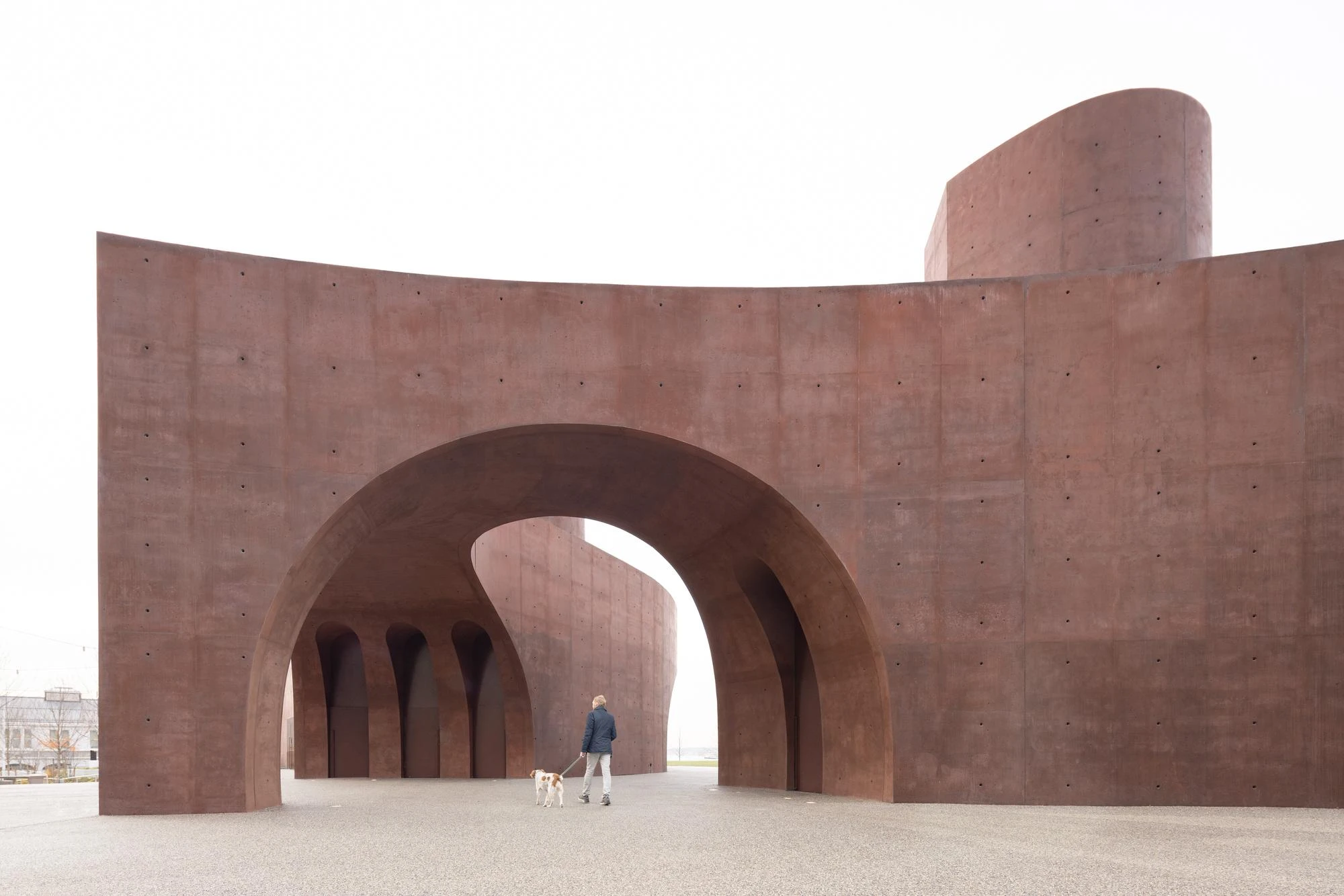
At its entry piazza, vast vaults gather the public beneath a canopy of concrete that behaves almost like earth inverted. The arches form a gateway not only to Robert F. Wagner Jr. Park but to a larger choreography of sightlines. Passing under the central vault, the city abruptly yields to open sky, harbor, and grass. The building behaves as a lens, calibrating views of the Statue of Liberty and Ellis Island with a clarity that feels both ceremonial and understated.
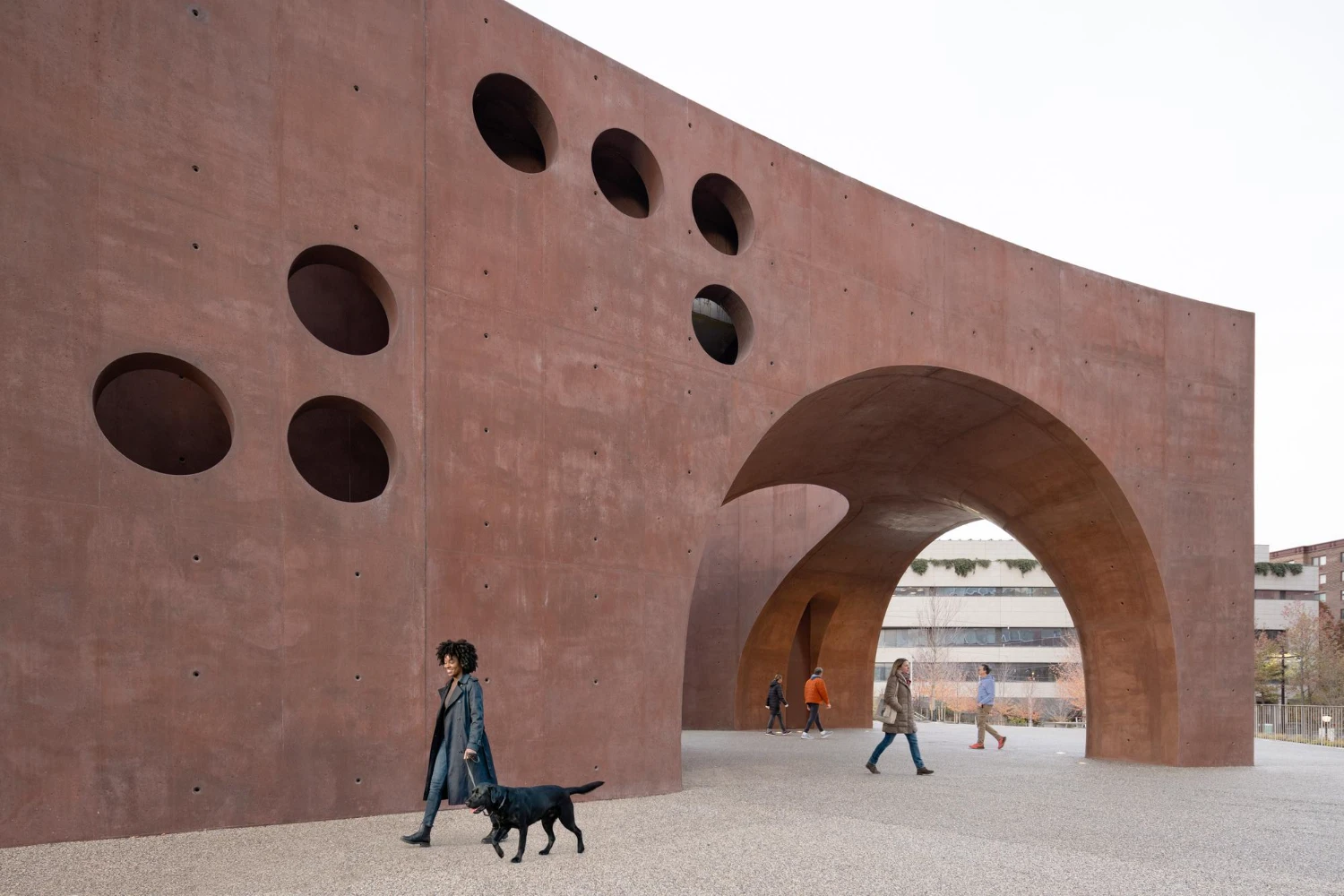
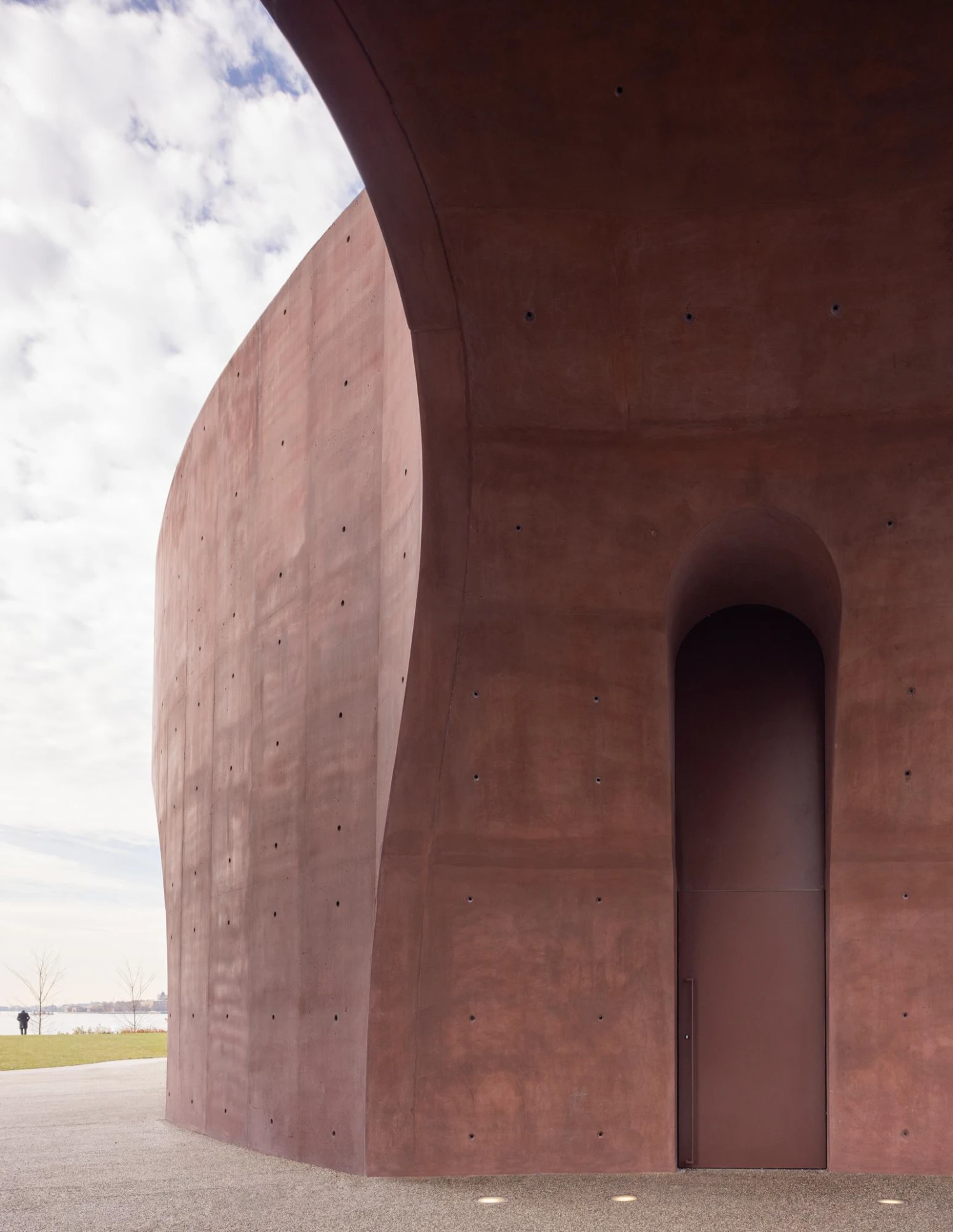
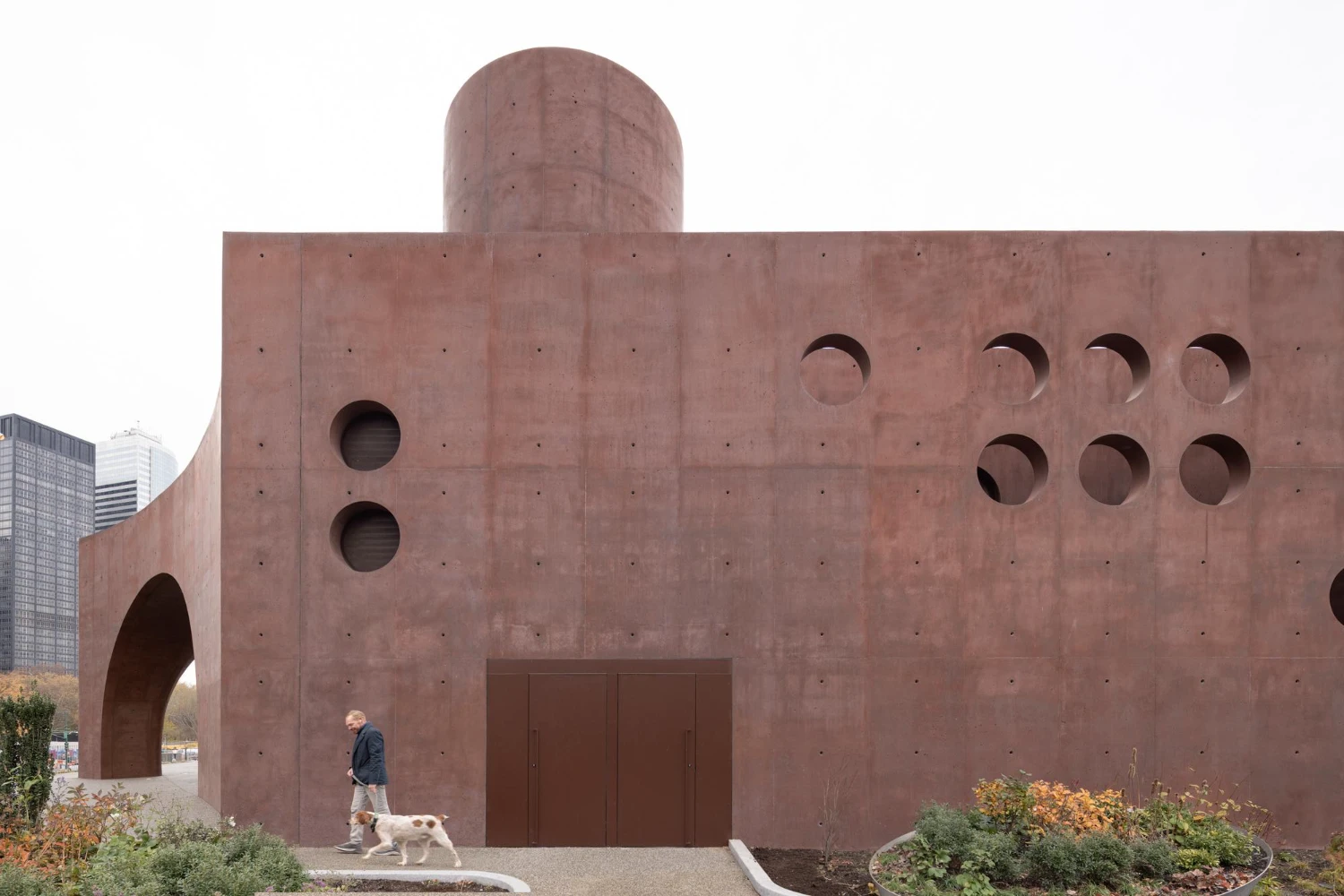
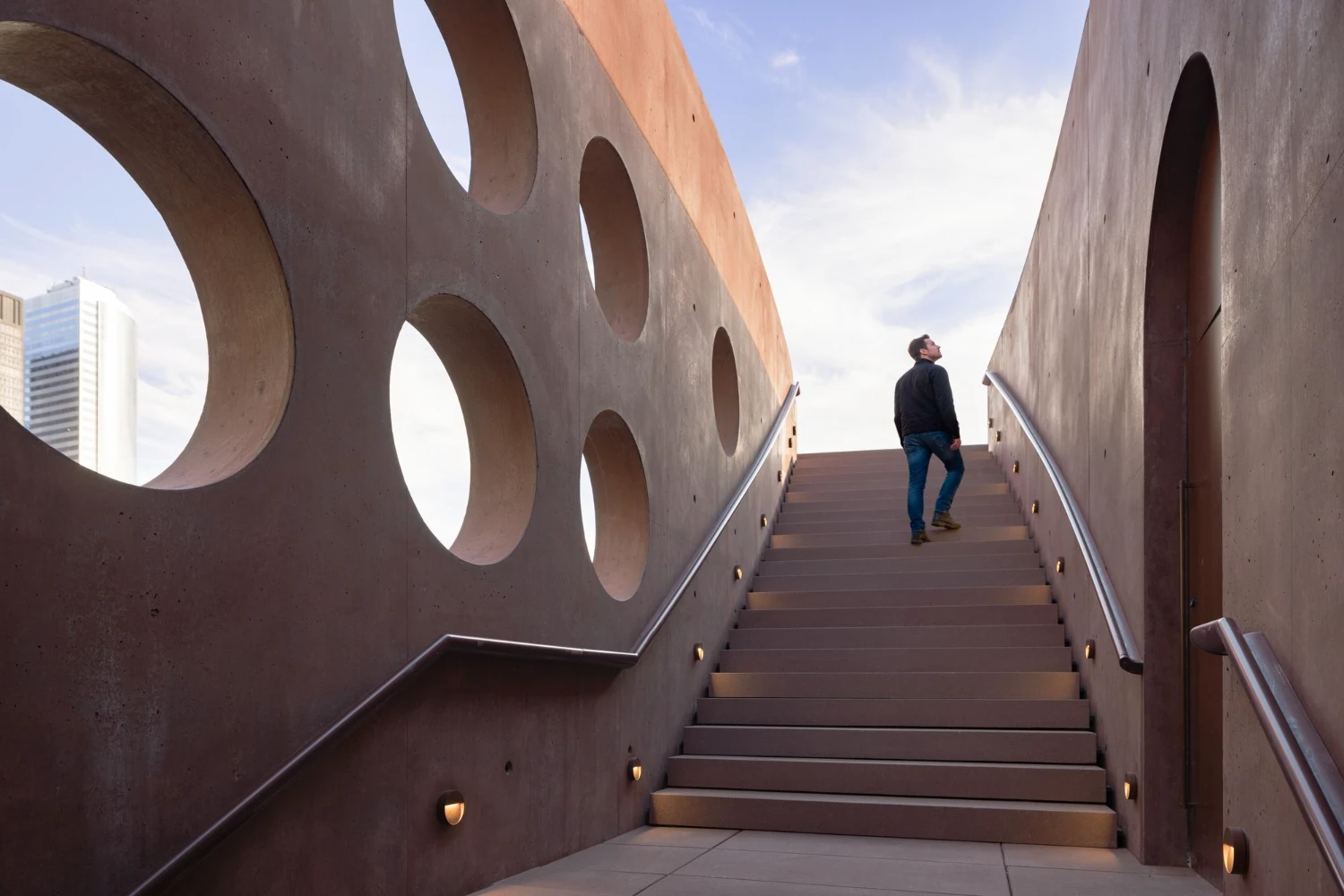
A second approach, from the waterside esplanade, reveals a different character: ramps and stairs that pull the visitor upward along softened edges and shifting perspectives. These circulatory routes reinforce the building’s role as a connective hinge between park, city, and harbor. Light slides across the curving walls, making the concrete appear surprisingly supple—an impression amplified by the oculi punctuating the façade, which read as moments of breathing space in an otherwise continuous surface.
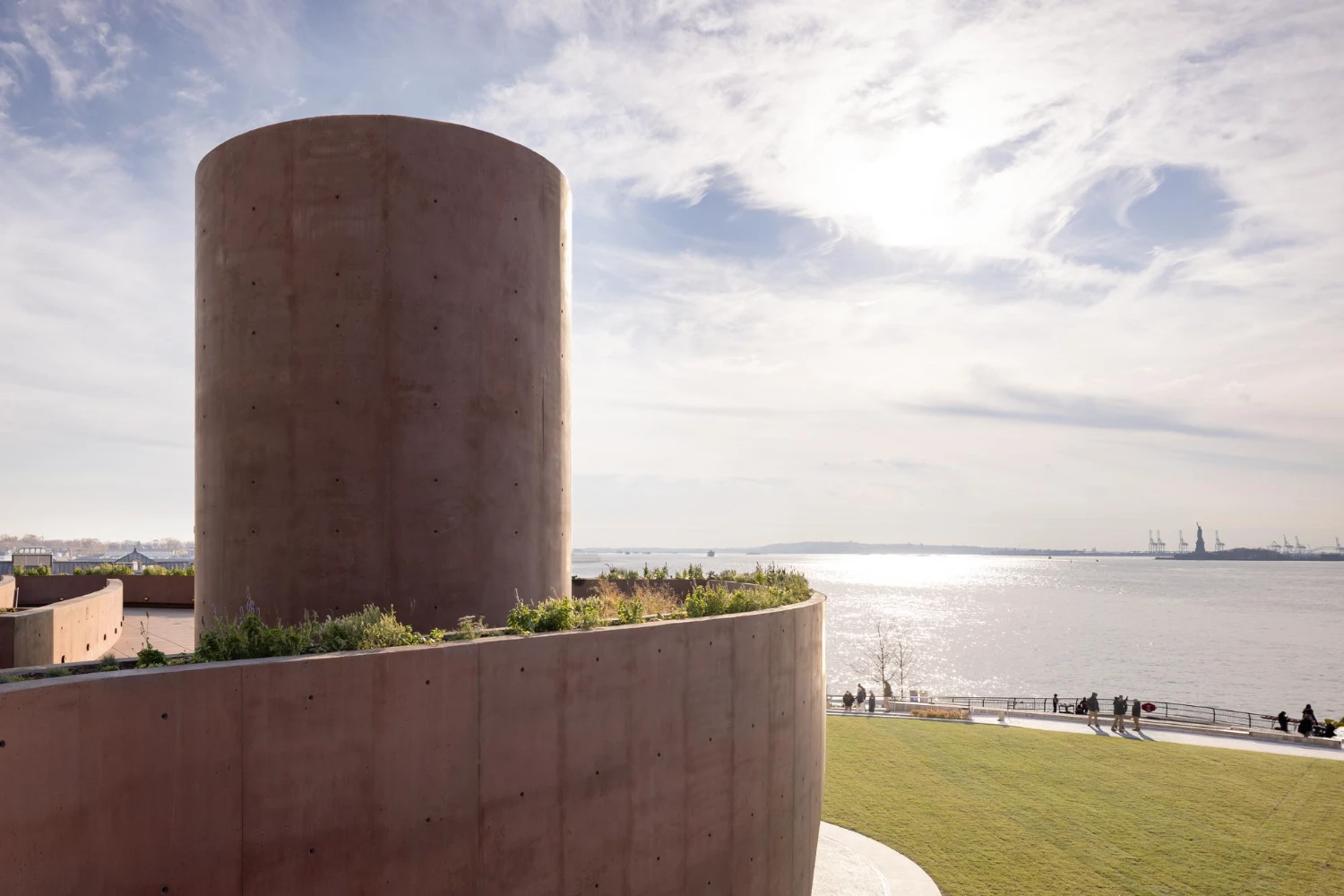
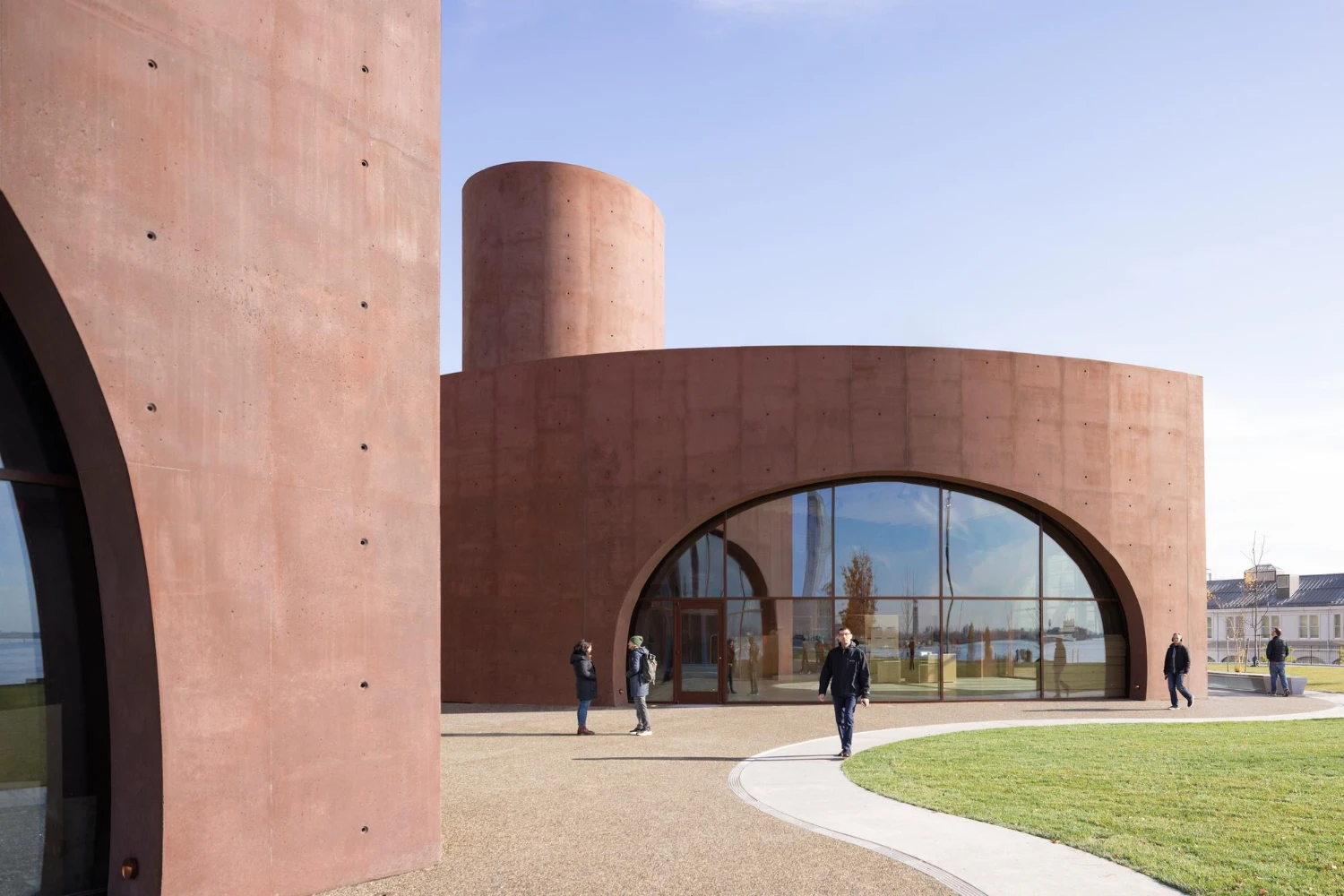
Programmatically, the pavilion is anchored by a restaurant and classroom, both opening outward to a lively piazza that spills into the surrounding gardens. This porous threshold blurs interior and exterior life, encouraging lingering and allowing the building’s monumental scale to coexist with a human intimacy. Above, an observation deck grants a 360-degree panorama: Staten Island drifting in the distance, downtown rising inland, the harbor’s shifting palette unfolding at eye level. Plantings that drape the roof edge dissolve the line between architecture and landscape, echoing nearby gardens and softening the pavilion’s silhouette.
What distinguishes the project is its integration of environmental ambition with spatial generosity. Its path toward zero carbon certification sits quietly within the architecture—no didactic flourishes, just a rigorously reduced footprint and careful material stewardship. The building’s massing suggests permanence, yet its ethos is one of restraint and responsibility, aligning with the long-term sustainability goals of Battery Park City.