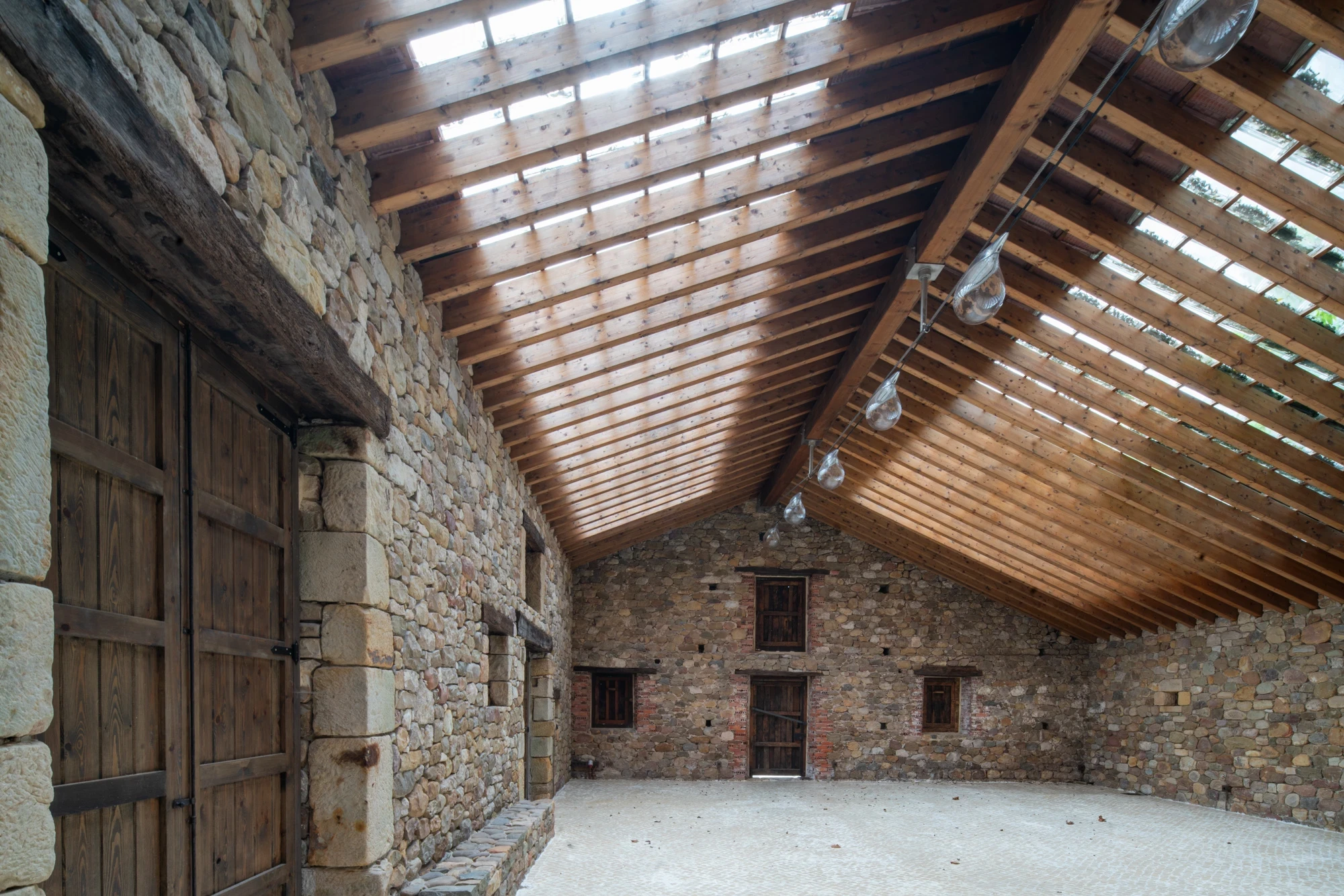
In Golbardo, Cantabria in Spain, Héctor Navarro, arkhitekton, Rodia Valladares and Ana María Flor transform a former stable into a flexible pavilion through a single constructive gesture: a roof of ceramic and glass tiles that turns the sky into shifting light.
The project explores a specific mode of architectural intervention based not on the incorporation of complex technology, but on the precise reinterpretation of traditional construction systems to generate new spatial, environmental, and programmatic conditions. The central operation, entitled Tejar cielo, consists of constructing an active roof plane from a single system, combining opaque ceramic tiles and glass tiles without altering the geometric or constructive logic of the whole.
The roof ceases to be a mere enclosing element and becomes a device capable of filtering natural light, registering the passage of time, and defining a changing atmosphere for the space it shelters. The intervention is carried out on a former stable and hayloft linked to a pre-existing dwelling, now conceived as an autonomous piece within the ensemble. The building is redefined as a pavilion for collective use, without a fixed program or permanent occupation, capable of hosting gatherings, celebrations, and a variety of activities.
This programmatic indeterminacy is key to the building's rehabilitation, as it allows the technical performance to be adjusted to a real and flexible use, avoiding processes of regularization or over-technification that would have substantially altered its constructive character. Natural ventilation, filtered light, and environmental variation become active components of the architectural experience.
Reading the building as a constructive palimpsest is one of the project's points of departure. The masonry walls, the different types of openings, and the superimposed structural solutions reveal a construction that has evolved progressively over time. Rather than concealing these traces, the intervention incorporates them as an essential part of the building's identity, understanding the existing architecture as a structure open to transformation, capable of accommodating new uses without losing the memory of its previous processes.
The roof concentrates the project's main constructive operation. A structural solution is proposed that fully frees the interior space, avoiding trusses and intermediate supports. A ridge beam integrating a stainless-steel tie working in tension allows a span of up to 15 meters to be bridged. From this beam spring the timber joists, which bear directly on the longitudinal load-bearing walls and on the ridge beam itself, configuring a structural system that is clear, legible, and consistent with the character of the existing building.
The incorporation of continuous surfaces of glass tiles within the same roofing system introduces variations of light and transparency that construct a vibrant, changing sky, reinforcing the intermediate condition of the space between interior and exterior. The limestone cobblestone pavement, treated as an exterior ground surface, links the building to the surrounding karst landscape and helps to blur the boundaries between enclosure and immediate context.