Thisispaper Community
Join today.
Enter your email address to receive the latest news on emerging art, design, lifestyle and tech from Thisispaper, delivered straight to your inbox.
Oops! Something went wrong while submitting the form.
Instant access to new channels
The top stories curated daily
Weekly roundups of what's important
Original features and deep dives
Exclusive community features
Madrid Guide
under the patronage of
Cafes by Design
under the patronage of
Luchy Bakery Cafe by MOME.ESTUDIO
Hitoshi Arato
May 25, 2026

In Madrid's Justicia district, MOME.ESTUDIO converts a linear bay plan into clay-plastered rooms where a curved terracotta counter and handmade brick floor hold bakery craft and spatial logic in one material register.

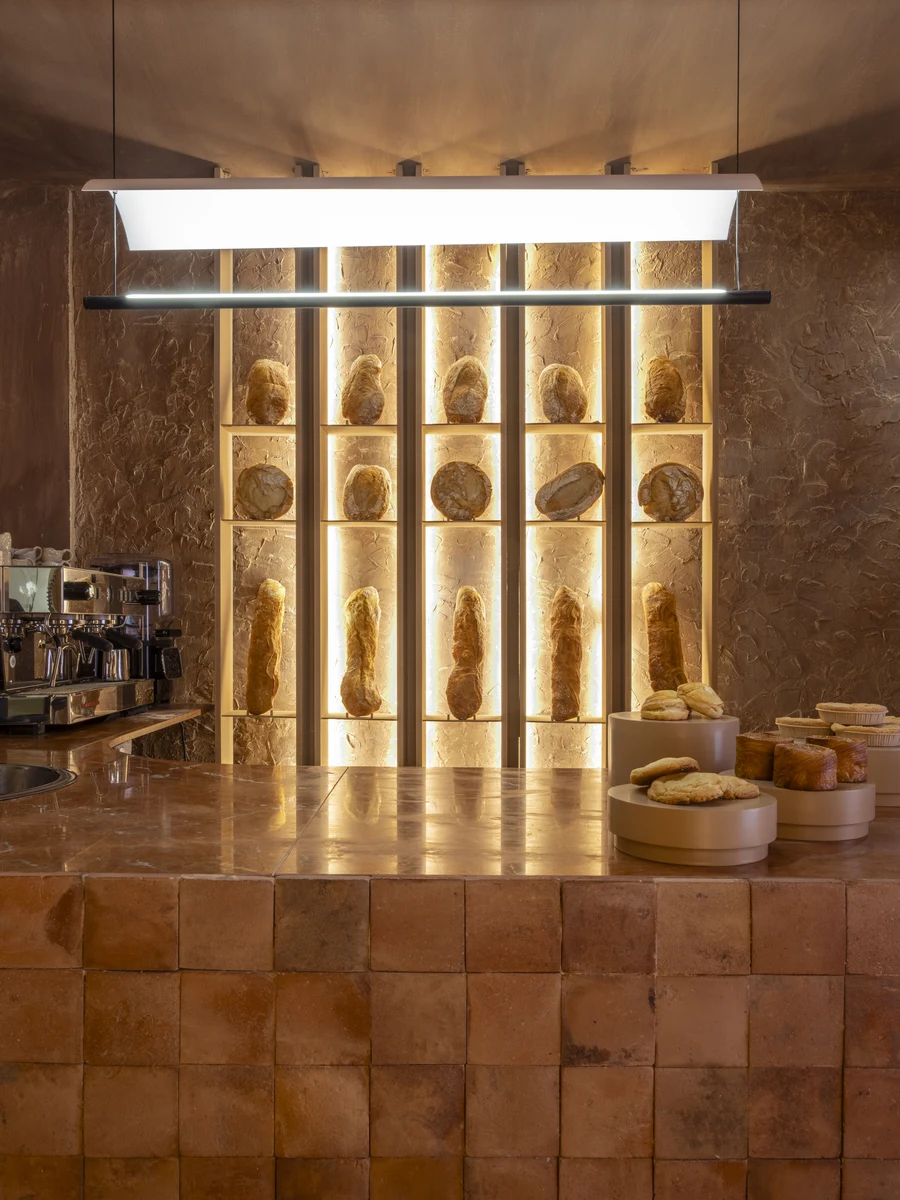
The curve is not a gesture — it is the load-bearing idea. MOME.ESTUDIO took the existing plan of the Luchy bakery on Calle Pelayo, a long sequence of original bays separated by structural passages, and used the curve as the device that resolves the duality of the brief: working bakery by morning, neighbourhood cafe by afternoon. The counter wrapping the service area is faced entirely in handmade terracotta tile, its radius tight enough to feel like furniture rather than a built element. Baguettes and sourdough loaves slot into a backlit shelf grid set into the clay-plastered wall behind, the amber glow pressing the bread's crust colour into the same palette as the room.

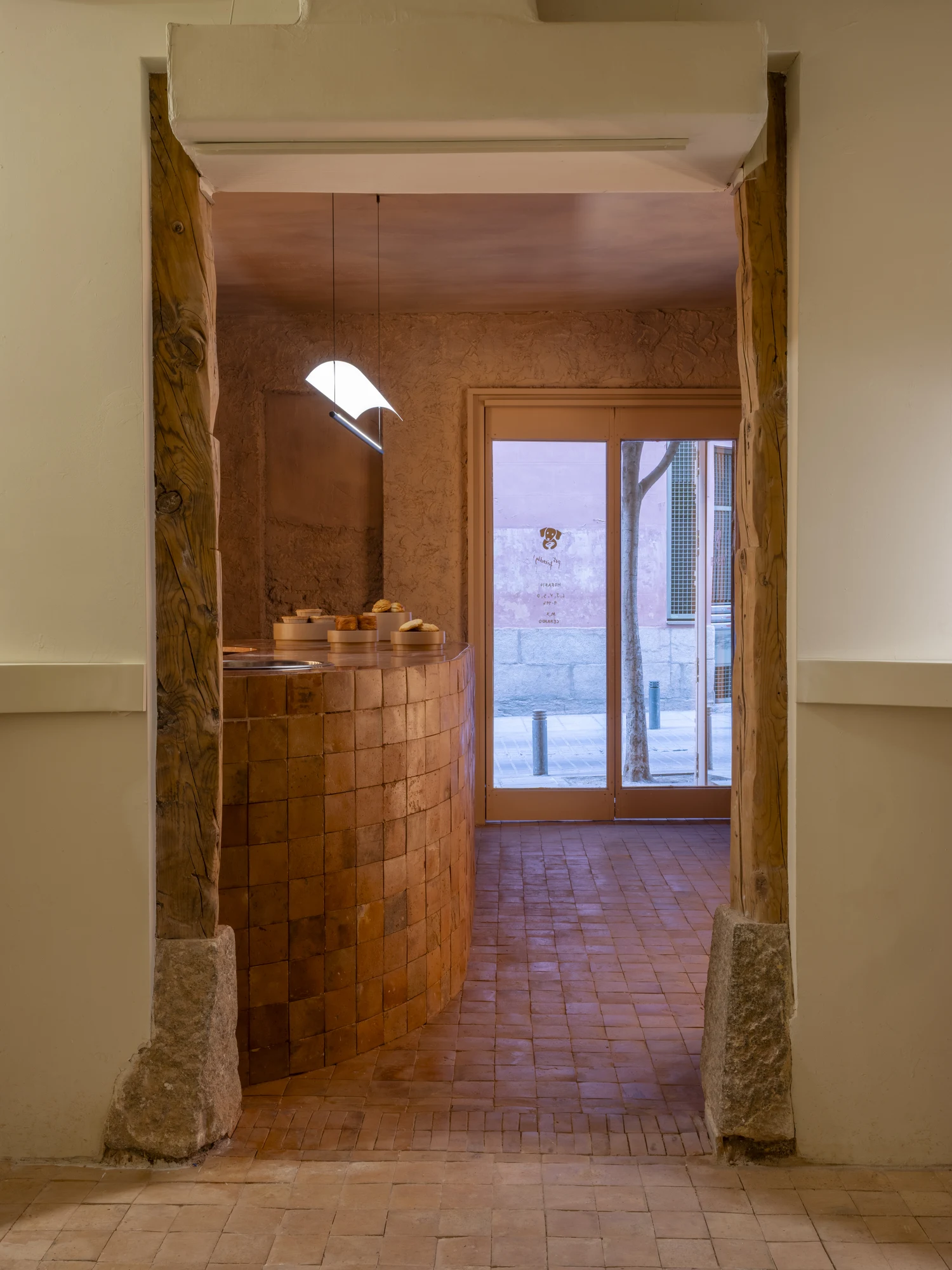
The floor is the continuity. Unfired terracotta brick pavers, laid in a running bond, run through every room without break at the thresholds. The material is porous enough to shift tonally in different light: the dim entrance corridor reads them as almost brown; nearer the street glazing they turn a dry orange. That tonal range gives the space its warmth without warm-coloured artificial lighting. The ceiling is original plaster, unfinished, left as found.

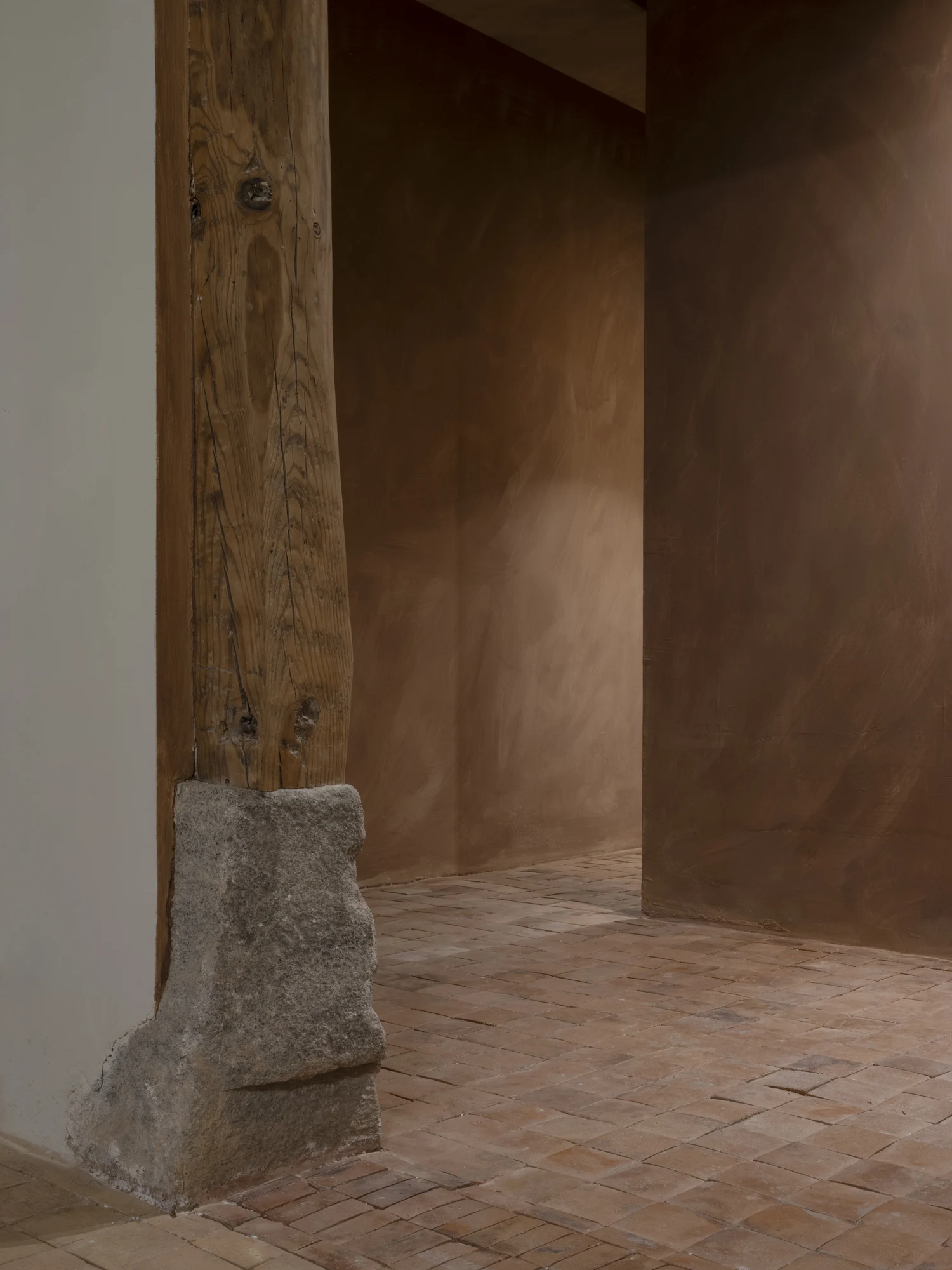
MOME.ESTUDIO brought two primary surface systems into contact: handcrafted clay on the horizontal plane and natural pigment coatings on the vertical. The wall plaster is a mid-ochre tone, applied with visible variation rather than a uniform coat. Exposed structural elements from the original building appear without concealment: a timber post set on a raw stone plinth at the junction between two bays, neither restored nor disguised. "Attention to detail and a focus on craftsmanship, values shared with the brand itself from bread-making to the ceramics that accompany it, are evident in every design decision," the studio notes of the project.

From the street, the bakery reads through a full-height timber-framed window: the curved counter in the middle ground, the backlit bread shelf behind it, the terracotta floor connecting foreground to depth. What the project proposes is that the material language of making — the mould marks in the tile, the variation in the pigment plaster, the raw stone at the post base can carry the same weight as the bread on the shelf. The craft is not decorative; it is structural to the argument. Plants placed at the bay thresholds introduce another layer without competing with the earth tones, reading as occupants rather than props. The sequence from street-facing room to rear corridor is one of progressive enclosure, confirming that this is a bakery designed to be moved through, not just entered.
Interested in Showcasing Your Work?

If you would like to feature your works on Thisispaper, please visit our Submission page and sign up to Thisispaper+ to submit your work. Once your submission is approved, your work will be showcased to our global audience of 2 million art, architecture, and design professionals and enthusiasts.
No items found.
We love less
but there is more.
Become a Thisispaper+ member today to unlock full access to our magazine, advanced tools, and support our work.
Get two months FREE
with annual subscription
We love less
but there is more.
Become a Thisispaper+ member today to unlock full access to our magazine, advanced tools, and support our work.
Get two months FREE
with annual subscription
No items found.
Hitoshi Arato
May 25, 2026

In Madrid's Justicia district, MOME.ESTUDIO converts a linear bay plan into clay-plastered rooms where a curved terracotta counter and handmade brick floor hold bakery craft and spatial logic in one material register.

The curve is not a gesture — it is the load-bearing idea. MOME.ESTUDIO took the existing plan of the Luchy bakery on Calle Pelayo, a long sequence of original bays separated by structural passages, and used the curve as the device that resolves the duality of the brief: working bakery by morning, neighbourhood cafe by afternoon. The counter wrapping the service area is faced entirely in handmade terracotta tile, its radius tight enough to feel like furniture rather than a built element. Baguettes and sourdough loaves slot into a backlit shelf grid set into the clay-plastered wall behind, the amber glow pressing the bread's crust colour into the same palette as the room.

The floor is the continuity. Unfired terracotta brick pavers, laid in a running bond, run through every room without break at the thresholds. The material is porous enough to shift tonally in different light: the dim entrance corridor reads them as almost brown; nearer the street glazing they turn a dry orange. That tonal range gives the space its warmth without warm-coloured artificial lighting. The ceiling is original plaster, unfinished, left as found.

MOME.ESTUDIO brought two primary surface systems into contact: handcrafted clay on the horizontal plane and natural pigment coatings on the vertical. The wall plaster is a mid-ochre tone, applied with visible variation rather than a uniform coat. Exposed structural elements from the original building appear without concealment: a timber post set on a raw stone plinth at the junction between two bays, neither restored nor disguised. "Attention to detail and a focus on craftsmanship, values shared with the brand itself from bread-making to the ceramics that accompany it, are evident in every design decision," the studio notes of the project.

From the street, the bakery reads through a full-height timber-framed window: the curved counter in the middle ground, the backlit bread shelf behind it, the terracotta floor connecting foreground to depth. What the project proposes is that the material language of making — the mould marks in the tile, the variation in the pigment plaster, the raw stone at the post base can carry the same weight as the bread on the shelf. The craft is not decorative; it is structural to the argument. Plants placed at the bay thresholds introduce another layer without competing with the earth tones, reading as occupants rather than props. The sequence from street-facing room to rear corridor is one of progressive enclosure, confirming that this is a bakery designed to be moved through, not just entered.

Interested in Showcasing Your Work?

If you would like to feature your works on Thisispaper, please visit our Submission page and subscribe to Thisispaper+. Once your submission is approved, your work will be showcased to our global audience of 2 million art, architecture, and design professionals and enthusiasts.
Thisispaper+
Madrid Guide
10+ Locations
Web Access
Link to Maps
Architecture in Madrid — sunlit courtyards, ceramic facades, and interiors of spare elegance. A city where modernism arrived late and stayed long, producing cultural institutions, apartment renovations, and restaurants designed with the same precision as museums.
Explore
Madrid Guide

Join Thisispaper+
Unlock access to 2500 stories, curated guides + editions, and share your work with a global network of architects, artists, writers and designers who are shaping the future.
Get two months FREE
with annual subscription
Travel Guides
Immerse yourself in timeless destinations, hidden gems, and creative spaces—curated by humans, not algorithms.
Explore All Guides +
Submission Module
Submit your project and gain the chance to showcase your work to our worldwide audience of over 2M architects, designers, artists, and curious minds.
Learn More+
Curated Editions
Dive deeper into carefully curated editions, designed to feed your curiosity and foster exploration.
Off-the-Grid
Jutaku
Sacral Journey
minimum
The New Chair
Explore All Editions +
Atlas
A new and interactive way to explore the most inspiring places around the world.
Interactive map
Linked to articles
300+ curated locations
Google + Apple directions
Smart filters
Subscribe to Explore+
Become a Thisispaper+ member today to unlock full access to our magazine, submit your project and support our work.
Join Thisispaper+Join Thisispaper+
€ 9 EUR
/month
Cancel anytime
Get two months FREE
with annual subscription