Thisispaper Community
Join today.
Enter your email address to receive the latest news on emerging art, design, lifestyle and tech from Thisispaper, delivered straight to your inbox.
Oops! Something went wrong while submitting the form.
Instant access to new channels
The top stories curated daily
Weekly roundups of what's important
Original features and deep dives
Exclusive community features
Concrete Stories
under the patronage of
Weekend Retreat
under the patronage of
Hut on Fichtelberg by AFF Architekten
Alexander Zaxarov
Mar 2, 2026

On the road between Rittersgrün and Oberwiesenthal, in the Ore Mountains of Saxony, Germany, AFF Architekten's Hutznhaisl appears like something wrestled from the landscape itself—a concrete sculpture at the edge where "the border between civilisation and nature is where trees begin to outnumber houses."

The project started with a deceptively large question about how far modern life has drifted from elemental experience. The architects observe that fire has essentially died out of our homes—"its unwitting last keepers were the smokers; all other sources had already been largely electrified." Water "comes from supermarkets in the form of an almost infinite variety of bottled mineral water, or flows from the wall like an afterthought." Darkness has been eliminated. We control light and heat with technological helpers the way we control everything else. The Hutznhaisl asks: what happens when all of that is gone?

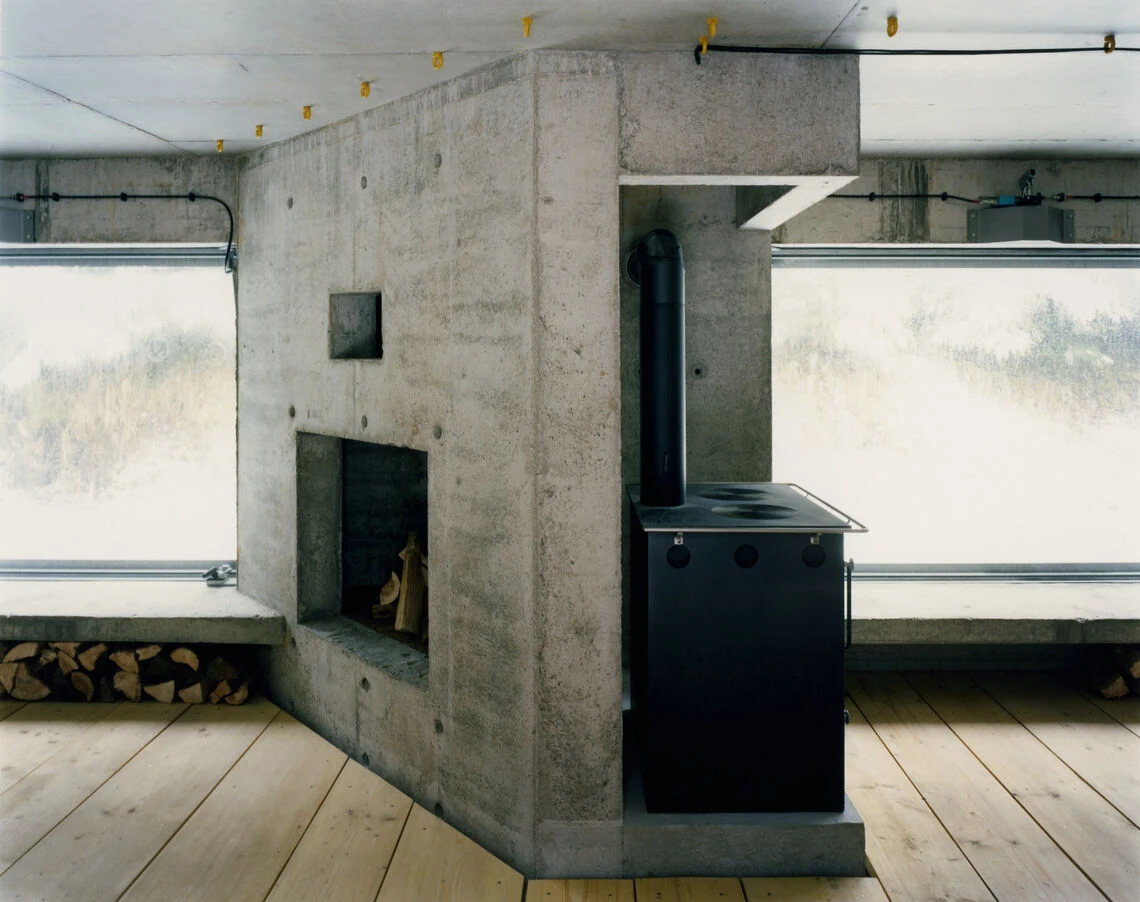
Here, on Fichtelberg Mountain, there are no mobile phone signals, no dishwashers, no televisions, no condensing heaters. The mountain hut accommodates six to eight people and offers food, and the quality of its details "is derived solely from tangible things." Walls and ceilings are formed in concrete. Wooden floorboards come from locally cut spruce. Fittings—switches, lights, chairs, wash basins—are recycled. Stoves are steel. Windows are generous. Everything about it is, as the architects put it, "unostentatious and sparse from a technical, functional and aesthetic point of view." And that is precisely the point.

The hut opens only to the forest, "like a bus stop opens only to the street, always in the direction of the intended destination." Far from snowboard slopes and leisure spas, the space distances itself from the dynamics of modern life. Any hiker can confirm what the architects seem to understand intuitively: "an impressive peak, fresh air and a tasty snack are all they need for an elemental experience, just like Hans in the Grimms' fairytale Hans in Luck, to whom freedom was more important than possessions and wealth."

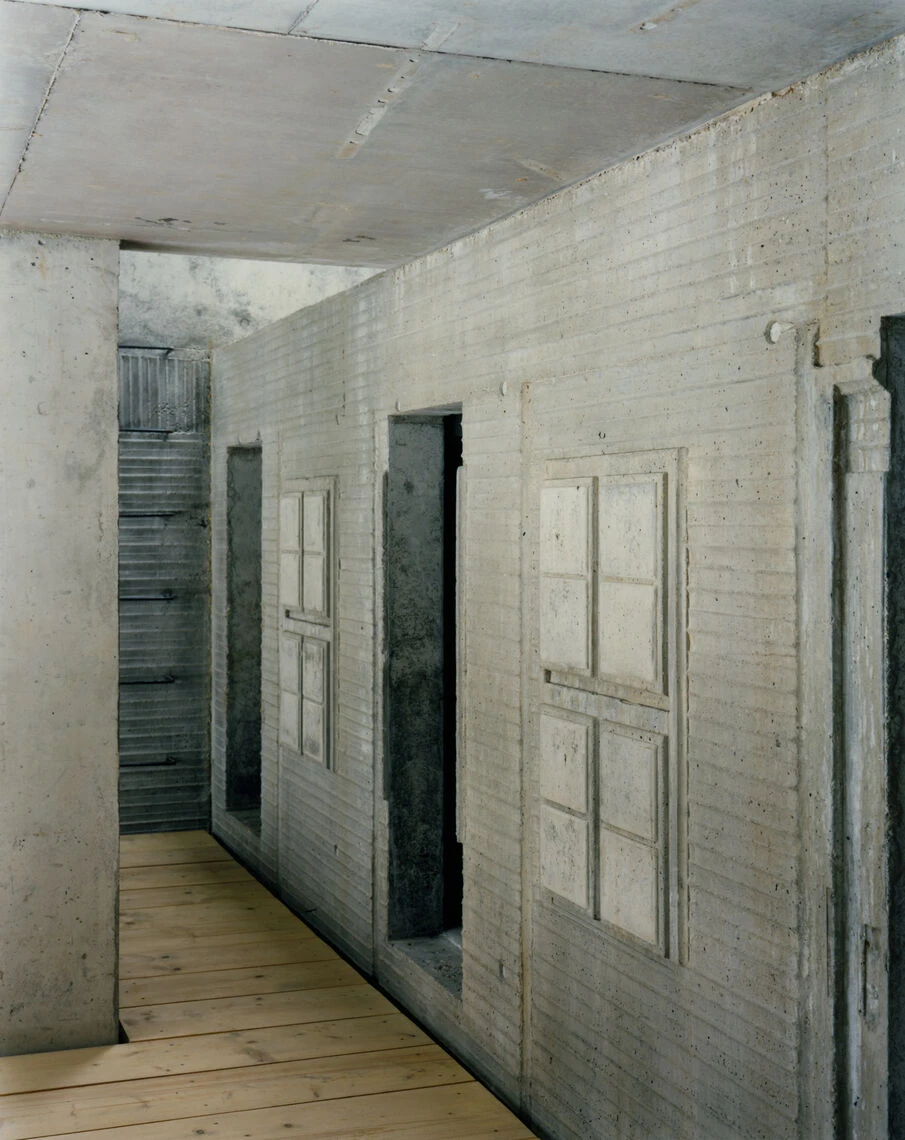
Inside, the Hutznhaisl preserves something of what came before. The original structure—a type bungalow built as a weekend home, later repurposed as locker rooms by the Dynamo sports club—was abandoned to its own fate, but its form survives as a relief-like imprint in the new concrete. "The act of decoding and discovering the relief-like markings of the form and surface of the former wooden hut," the architects write, "is reminiscent of a hunter following tracks in the forest." The old building offered its shape as a mould, and the new one carries that memory forward like a lantern slide projected into the present.

The hut's silhouette is neither nostalgically traditional nor striving to be avant-garde. It is, instead, "a courageous re-interpretation of the typology of a traditional hut"—one that does not pretend to be timeless but earns its place by being honest about what a shelter can be. It is the kind of architecture that has the quiet power to draw city people to a remote village "with more carved wooden Christmas decorations than residents." That says something about what people are hungry for, even if they cannot always name it.

Interested in Showcasing Your Work?

If you would like to feature your works on Thisispaper, please visit our Submission page and sign up to Thisispaper+ to submit your work. Once your submission is approved, your work will be showcased to our global audience of 2 million art, architecture, and design professionals and enthusiasts.
No items found.
We love less
but there is more.
Become a Thisispaper+ member today to unlock full access to our magazine, advanced tools, and support our work.
Get two months FREE
with annual subscription
We love less
but there is more.
Become a Thisispaper+ member today to unlock full access to our magazine, advanced tools, and support our work.
Get two months FREE
with annual subscription
No items found.
Alexander Zaxarov
Mar 2, 2026

On the road between Rittersgrün and Oberwiesenthal, in the Ore Mountains of Saxony, Germany, AFF Architekten's Hutznhaisl appears like something wrestled from the landscape itself—a concrete sculpture at the edge where "the border between civilisation and nature is where trees begin to outnumber houses."

The project started with a deceptively large question about how far modern life has drifted from elemental experience. The architects observe that fire has essentially died out of our homes—"its unwitting last keepers were the smokers; all other sources had already been largely electrified." Water "comes from supermarkets in the form of an almost infinite variety of bottled mineral water, or flows from the wall like an afterthought." Darkness has been eliminated. We control light and heat with technological helpers the way we control everything else. The Hutznhaisl asks: what happens when all of that is gone?

Here, on Fichtelberg Mountain, there are no mobile phone signals, no dishwashers, no televisions, no condensing heaters. The mountain hut accommodates six to eight people and offers food, and the quality of its details "is derived solely from tangible things." Walls and ceilings are formed in concrete. Wooden floorboards come from locally cut spruce. Fittings—switches, lights, chairs, wash basins—are recycled. Stoves are steel. Windows are generous. Everything about it is, as the architects put it, "unostentatious and sparse from a technical, functional and aesthetic point of view." And that is precisely the point.

The hut opens only to the forest, "like a bus stop opens only to the street, always in the direction of the intended destination." Far from snowboard slopes and leisure spas, the space distances itself from the dynamics of modern life. Any hiker can confirm what the architects seem to understand intuitively: "an impressive peak, fresh air and a tasty snack are all they need for an elemental experience, just like Hans in the Grimms' fairytale Hans in Luck, to whom freedom was more important than possessions and wealth."

Inside, the Hutznhaisl preserves something of what came before. The original structure—a type bungalow built as a weekend home, later repurposed as locker rooms by the Dynamo sports club—was abandoned to its own fate, but its form survives as a relief-like imprint in the new concrete. "The act of decoding and discovering the relief-like markings of the form and surface of the former wooden hut," the architects write, "is reminiscent of a hunter following tracks in the forest." The old building offered its shape as a mould, and the new one carries that memory forward like a lantern slide projected into the present.

The hut's silhouette is neither nostalgically traditional nor striving to be avant-garde. It is, instead, "a courageous re-interpretation of the typology of a traditional hut"—one that does not pretend to be timeless but earns its place by being honest about what a shelter can be. It is the kind of architecture that has the quiet power to draw city people to a remote village "with more carved wooden Christmas decorations than residents." That says something about what people are hungry for, even if they cannot always name it.

Interested in Showcasing Your Work?

If you would like to feature your works on Thisispaper, please visit our Submission page and subscribe to Thisispaper+. Once your submission is approved, your work will be showcased to our global audience of 2 million art, architecture, and design professionals and enthusiasts.
Thisispaper+
Concrete Stories
100+ Projects
Web Access
Link to Maps
Monolithic yet intricate, raw yet refined—Concrete Stories presents a global collection of architectural wonders shaped by the visionaries of our time. This is a tribute to the poetic and sculptural power of concrete, where material and form converge in striking, unforgettable statements.
Explore
Concrete Stories

Join Thisispaper+
Unlock access to 2500 stories, curated guides + editions, and share your work with a global network of architects, artists, writers and designers who are shaping the future.
Get two months FREE
with annual subscription
Travel Guides
Immerse yourself in timeless destinations, hidden gems, and creative spaces—curated by humans, not algorithms.
Explore All Guides +
Submission Module
Submit your project and gain the chance to showcase your work to our worldwide audience of over 2M architects, designers, artists, and curious minds.
Learn More+
Curated Editions
Dive deeper into carefully curated editions, designed to feed your curiosity and foster exploration.
Off-the-Grid
Jutaku
Sacral Journey
minimum
The New Chair
Explore All Editions +
Atlas
A new and interactive way to explore the most inspiring places around the world.
Interactive map
Linked to articles
300+ curated locations
Google + Apple directions
Smart filters
Subscribe to Explore+
Become a Thisispaper+ member today to unlock full access to our magazine, submit your project and support our work.
Join Thisispaper+Join Thisispaper+
€ 9 EUR
/month
Cancel anytime
Get two months FREE
with annual subscription