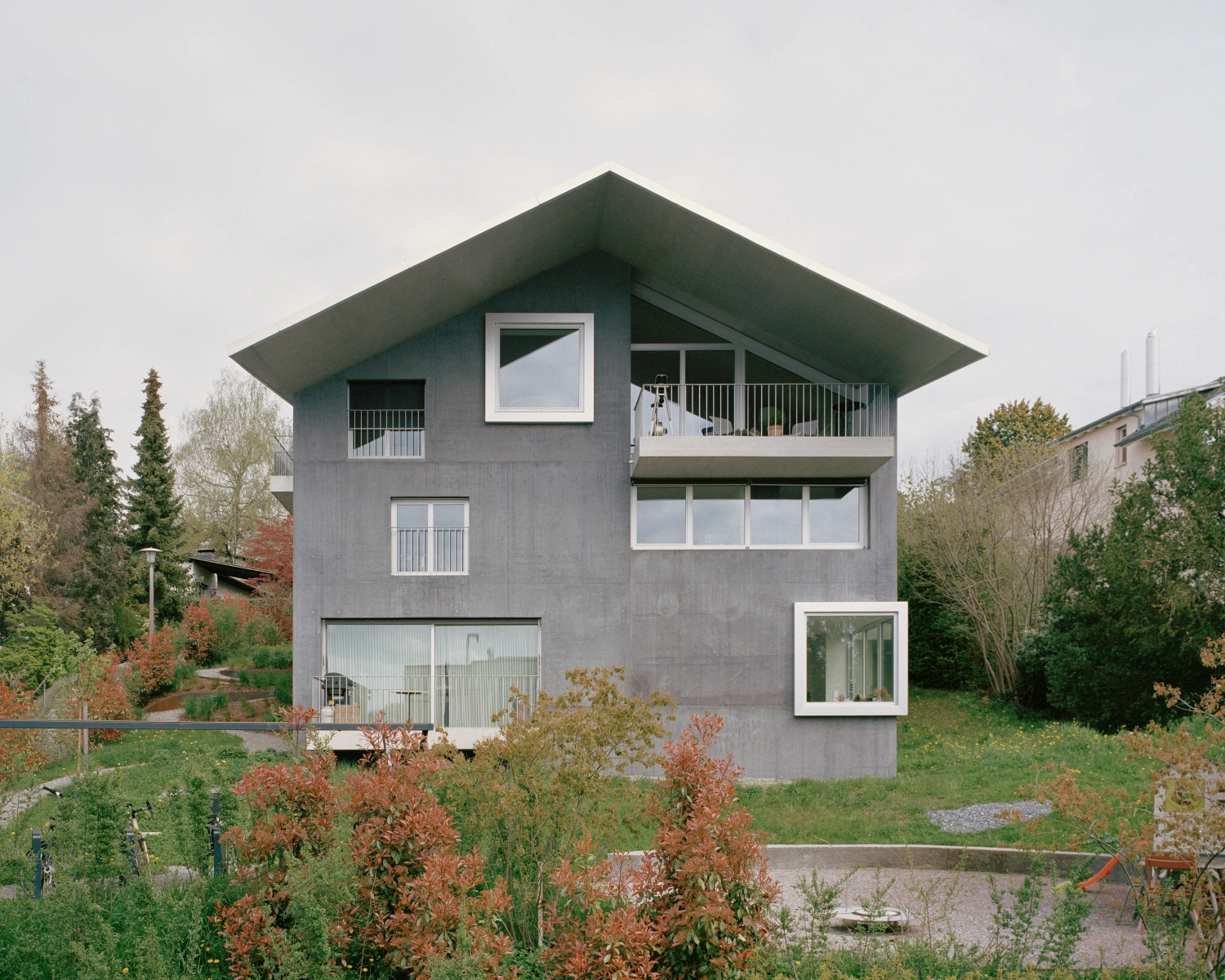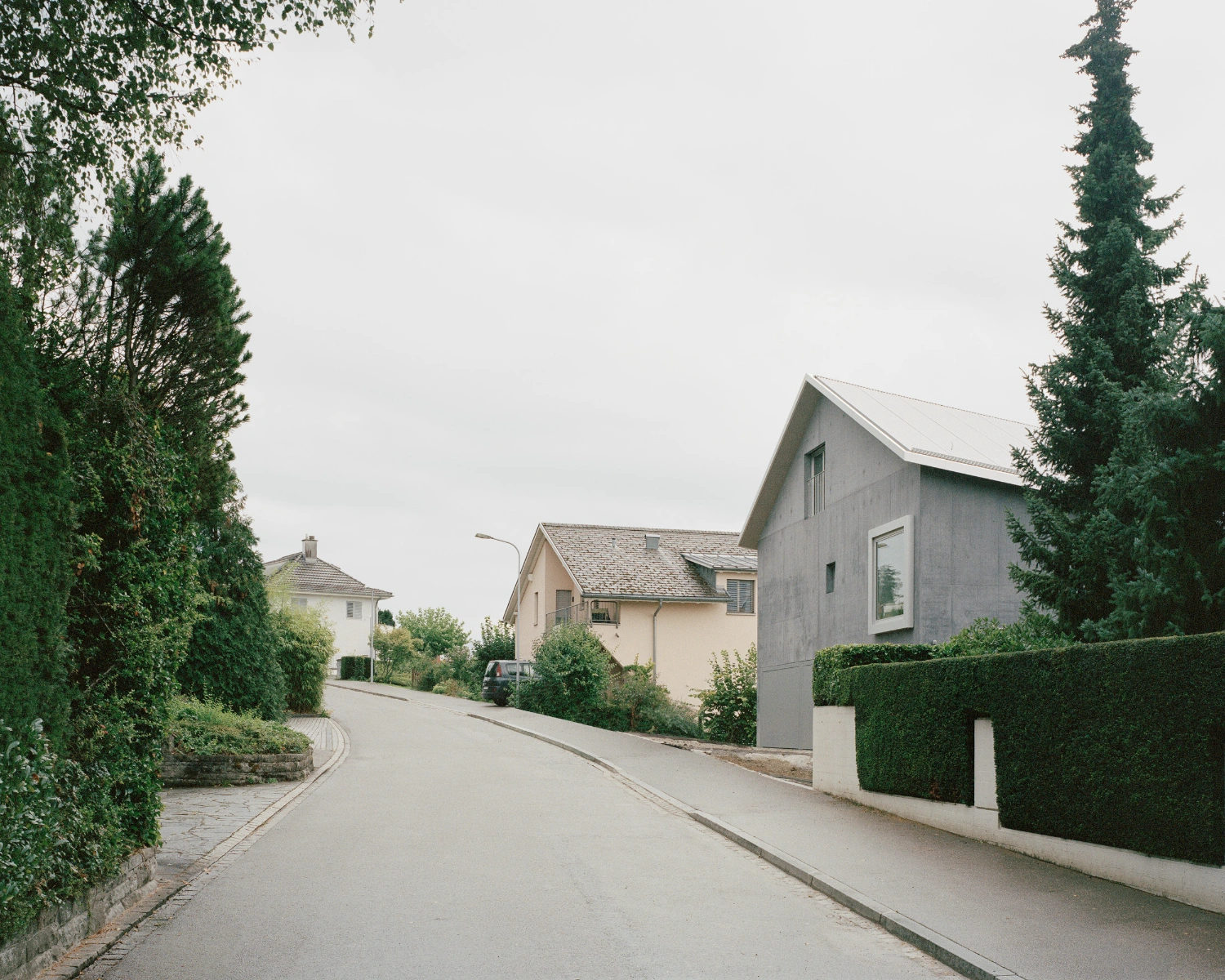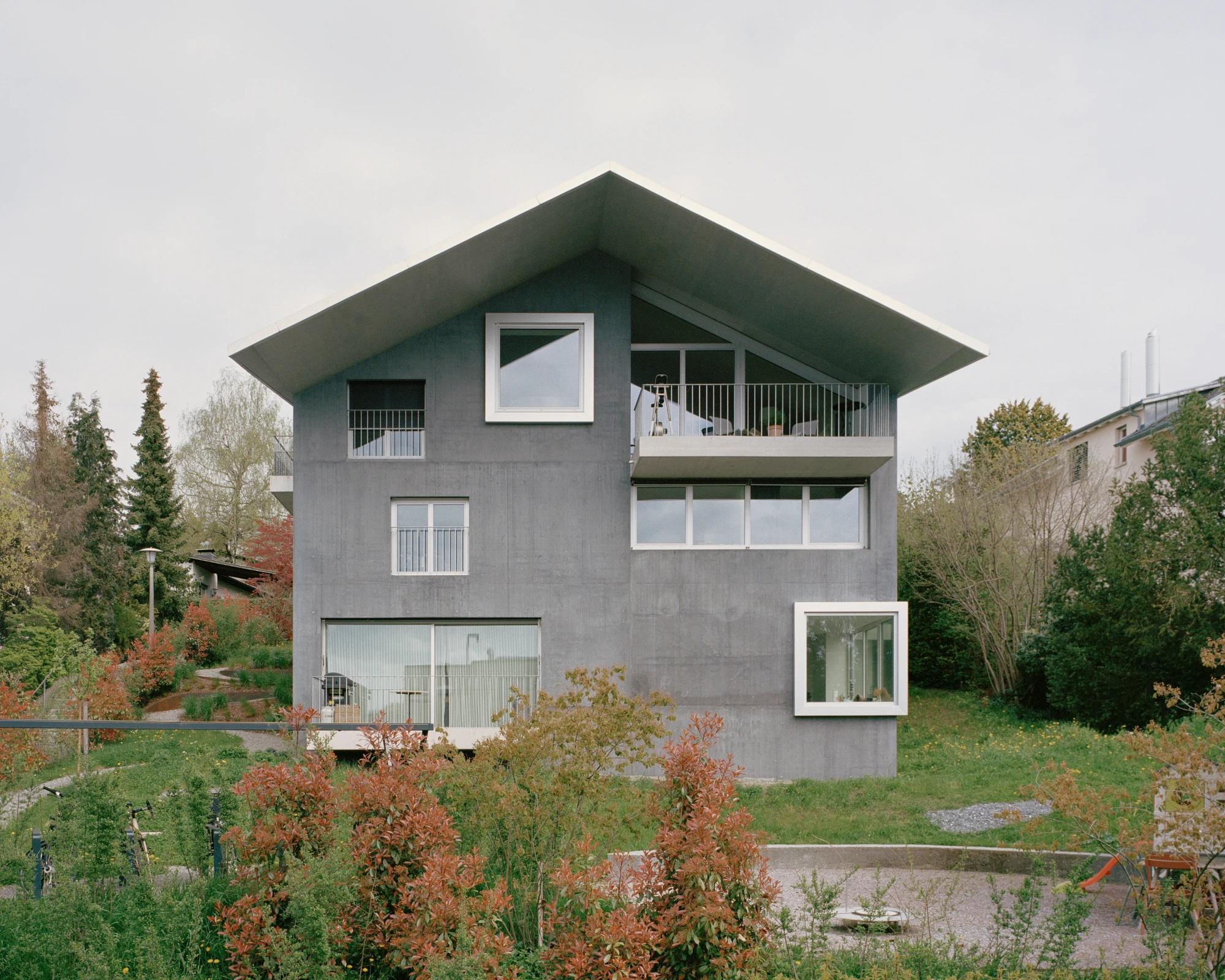
House on a Slope designed by Karamuk Kuo reads like a quiet provocation slipped into Zurich’s manicured suburban fabric.
What initially appears to be an oversized villa reveals itself, on closer approach, as a calibrated act of stealth density. The client’s refusal to default to the single-family typology long dominant in this affluent hillside neighborhood becomes the project’s conceptual engine: five heterogeneous dwelling types gathered under one sloping roofline, forming a micro-community disguised as architectural continuity.
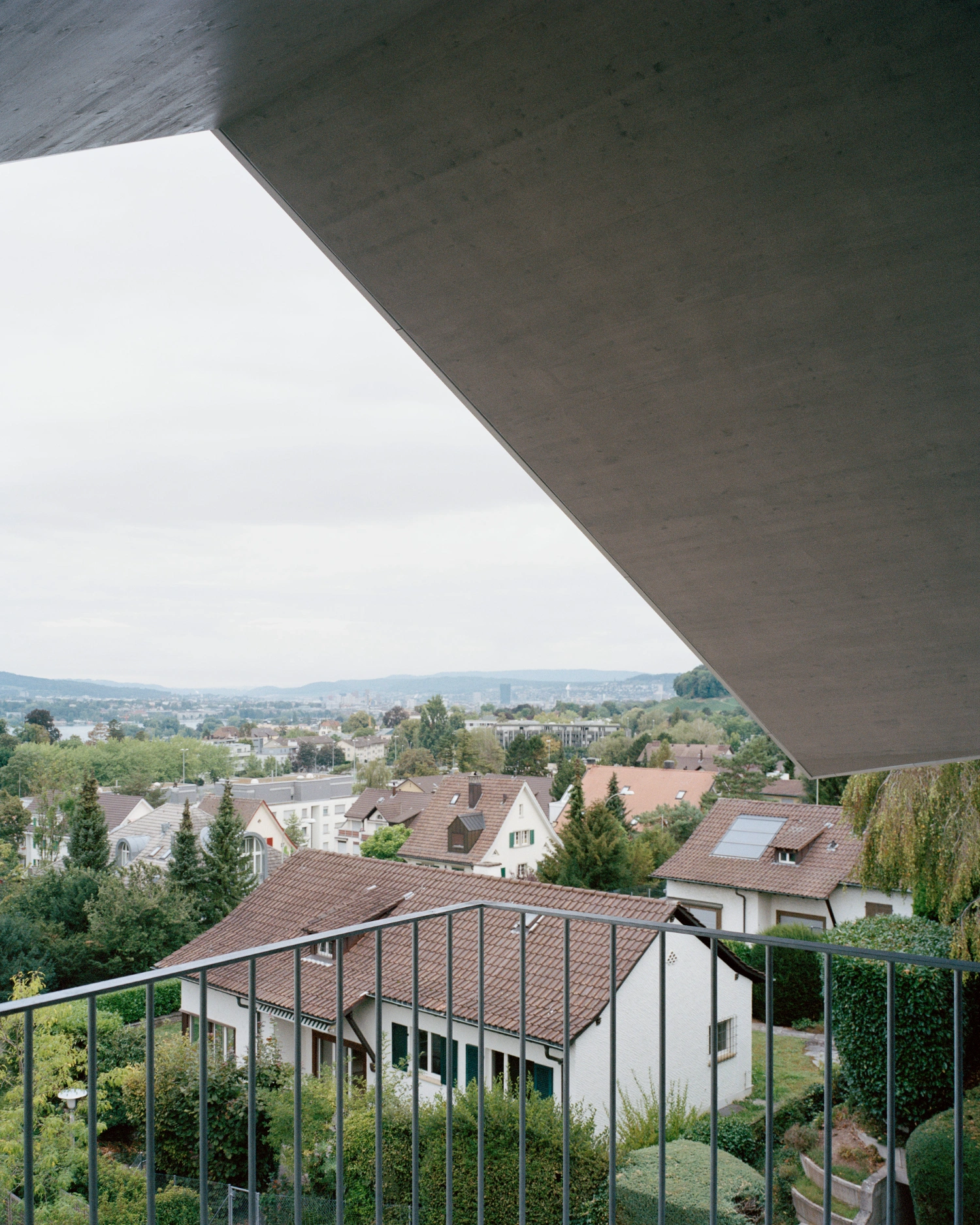
The gable roof, an almost polite nod to its context, becomes unexpectedly subversive once its ridge is seen tracing the natural incline of the site. This gesture—a “dumb replica” of zoning logic, as the architects call it—transforms regulatory constraint into volumetric opportunity. The deep southern eave, dramatically cantilevered, sharpens the building’s silhouette and creates a sheltered exterior threshold for the garden apartment, giving the whole ensemble a sense of tectonic tension, as if tugged forward by the terrain itself.
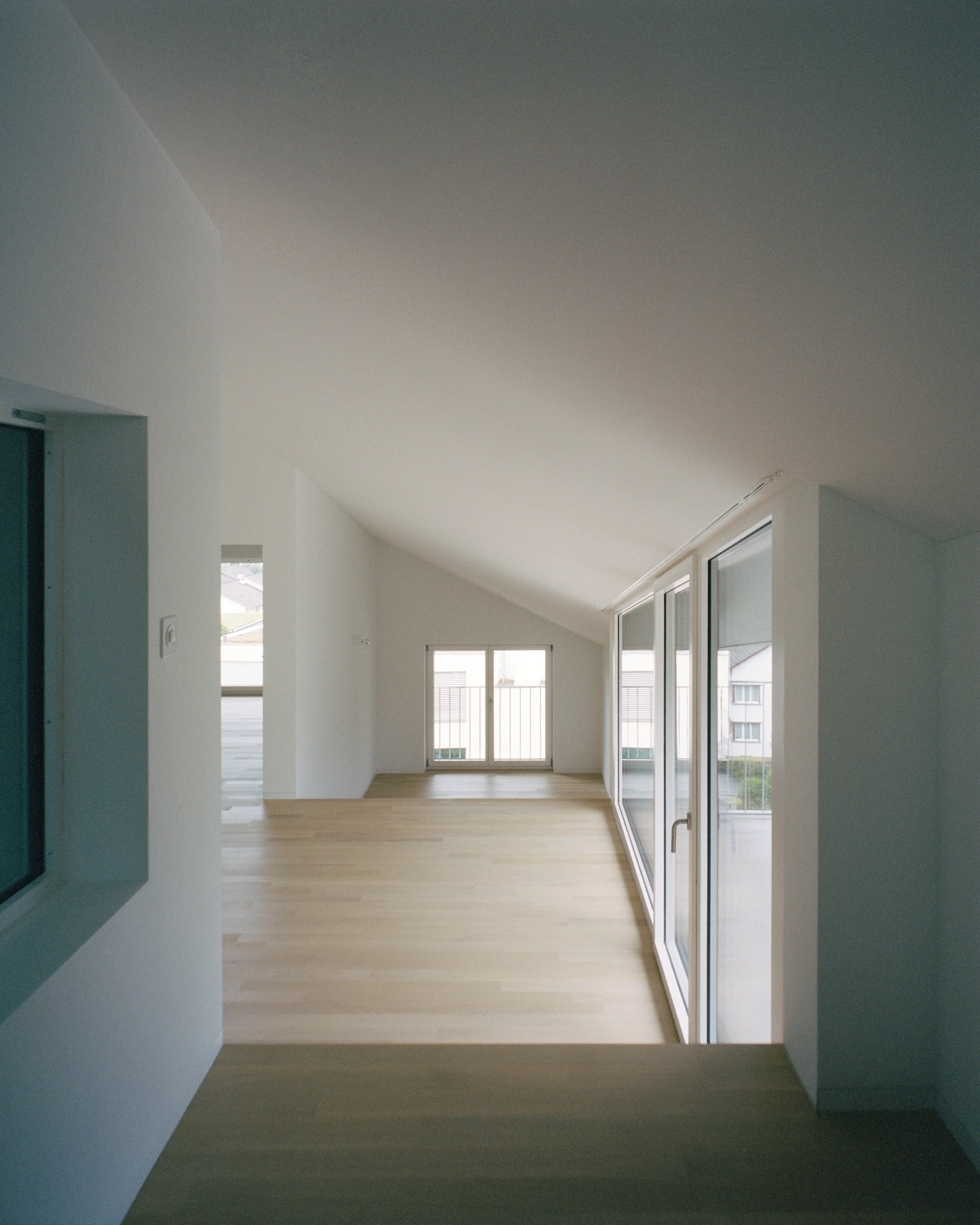
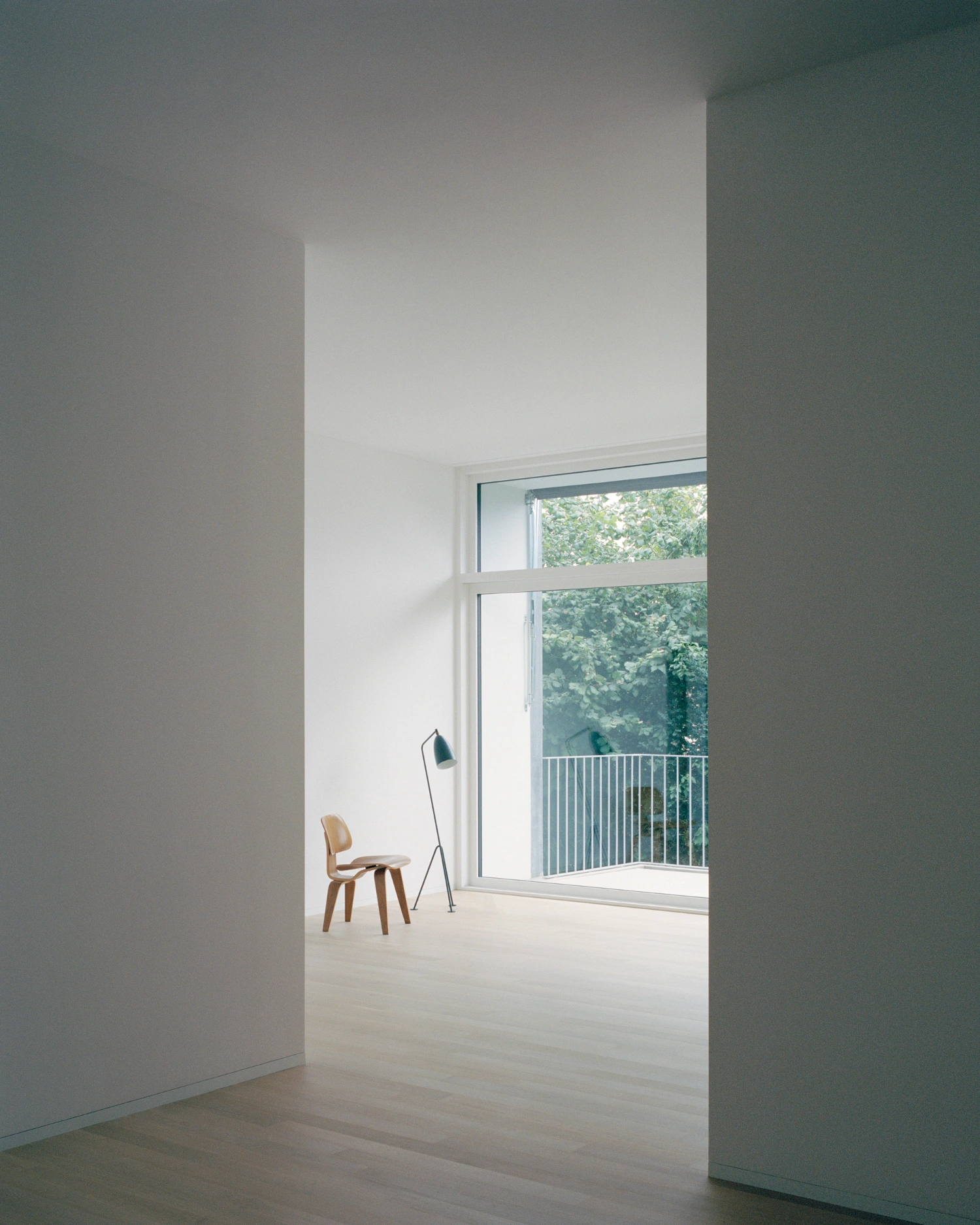
Inside, the architecture sheds the villa trope entirely. The section is choreographed as a series of split levels that echo the slope outside, generating moments of compression and release as one moves through the stacked apartments. This stepped interior geography not only differentiates each unit but also encourages a more intimate, almost topographic mode of inhabitation—rooms unfolding like landings on a carefully constructed path.
A diverse set of window types punctuates the exterior, each framing a distinct reading of the landscape while softening the perception of mass. These apertures operate as both instruments of privacy and mediators of scale, preventing the building from resolving into a single, monolithic volume. Instead, the façade becomes an assemblage of lived experiences, signaling the multigenerational community within without ever declaring it outright.
In a suburb where uniformity often masquerades as harmony, House on a Slope suggests another possibility: density that is discreet yet generous, and domesticity that embraces complexity rather than retreating from it.