


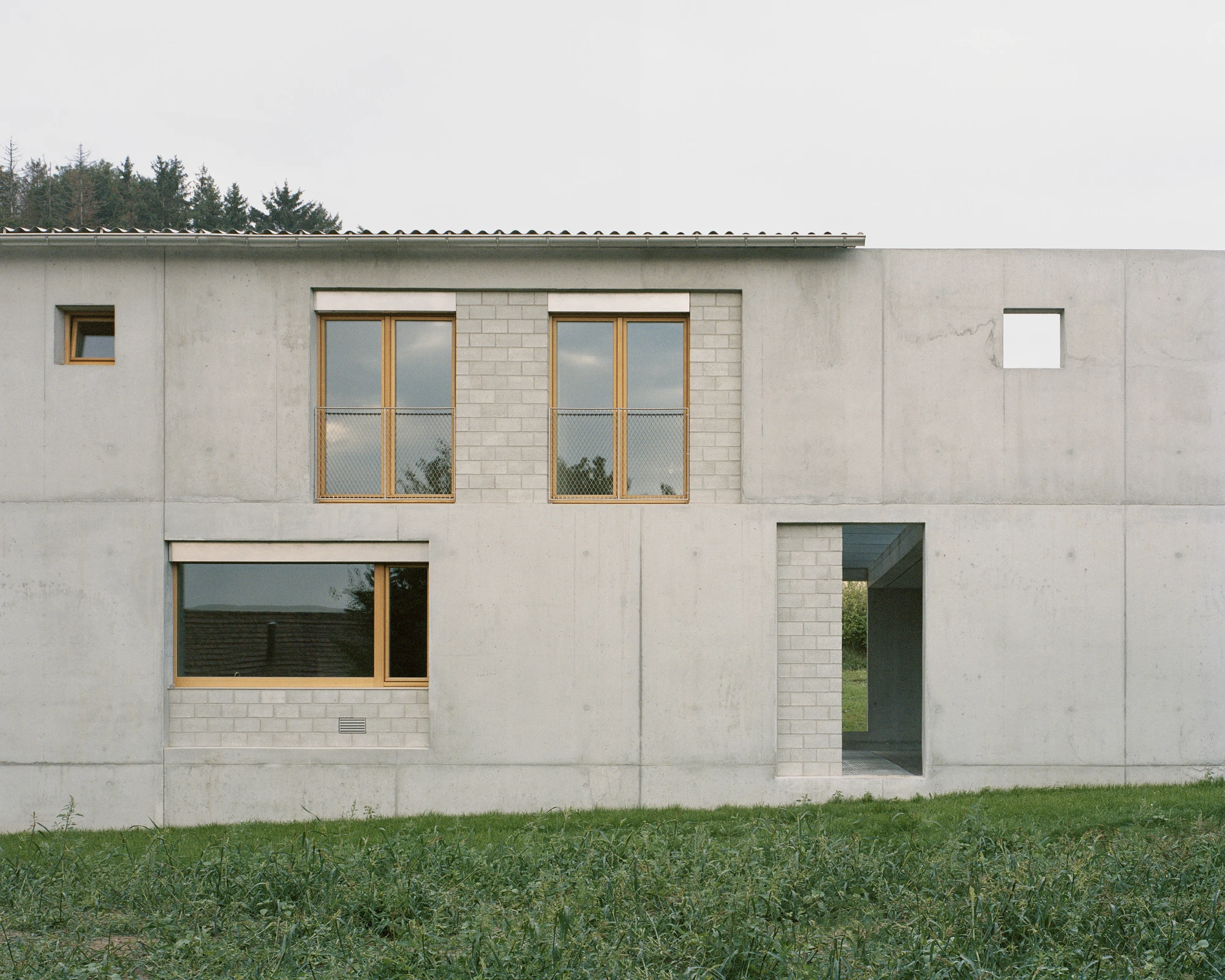
House in Vuissens by Deschenaux Architectes settles into the Swiss rural landscape with concrete pragmatism and modernist restraint, drawing the forest into a domestic conversation of rare intelligence.
The first thing you see is a concrete wall, and it tells you nothing. No window, no door, no indication of what lies behind it. This is deliberate. Deschenaux Architectes has designed a house in Vuissens — a secluded village in the canton of Fribourg that still feels genuinely rural — that requires you to walk around the wall, notice a strip of light behind the dark garage, and discover your own way in. It is architecture that withholds welcome just long enough to make the interior feel earned.
Once inside, the house unfolds along its length toward the forest. Two steps down from the entrance hall, you reach a kitchen integrated into the land’s natural slope. The main living room expands in both height and width, the full-width patio door pulling your attention toward trees through thick vertical glazing frames that echo the trunks beyond. This is not a picture window — it is a rhythm, a visual conversation between interior columns and forest verticals that makes the boundary between house and landscape feel genuinely uncertain.
The spatial journey culminates in a double-height loggia: private and open simultaneously, enclosed yet facing the forest’s mysterious depths. Upstairs, a central wall runs the full north-south axis, creating a wide corridor that connects two fundamentally different orientations. On one side, a concrete gable and a spacious balcony perfect for catching the evening warmth held by surrounding walls. On the other, a large opening through which the forest reasserts itself.
The design language borrows not from architectural magazines but from the rural surroundings: brick storage buildings, simple metal-roofed henhouses, the pragmatic logic of structures built to work rather than to impress. Concrete envelops both heated and outdoor spaces. Cement bricks define the insulated volume. Mineral insulation goes on in a single layer with no vapour barrier needed. The ground-floor slab serves as flooring, heating system, and structure simultaneously. Nothing is redundant.
There is a tendency in contemporary residential architecture toward the performative — the cantilevered gesture, the improbable material, the roof that announces itself. This house refuses all of it. The roof is off-centre because the load-bearing wall requires it. The kitchen counters are stainless steel because stainless steel works. The loggia’s roofing is translucent to bring more light into the living room below, not to create an effect. Every detail drawing, according to the architects, seeks constructive truth.
The house does not try to improve upon Vuissens. It joins the village with intelligence and material honesty, the way the best rural constructions always have — by solving problems directly, and leaving the drama to the forest.


