Thisispaper Community
Join today.
Enter your email address to receive the latest news on emerging art, design, lifestyle and tech from Thisispaper, delivered straight to your inbox.
Oops! Something went wrong while submitting the form.
Instant access to new channels
The top stories curated daily
Weekly roundups of what's important
Original features and deep dives
Exclusive community features
No items found.
Ferric Glass by Tino Seubert
Alexander Zaxarov
May 6, 2026

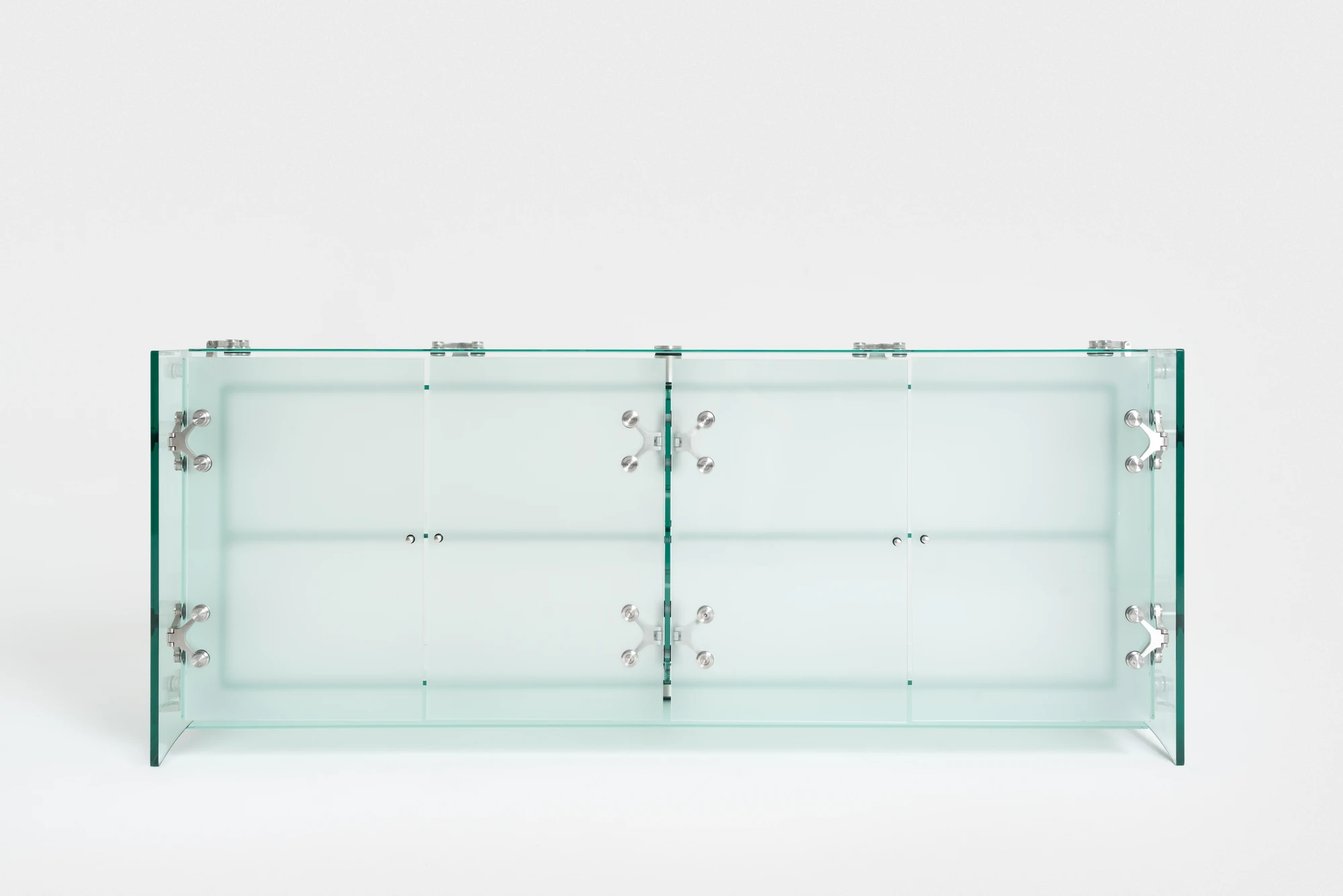
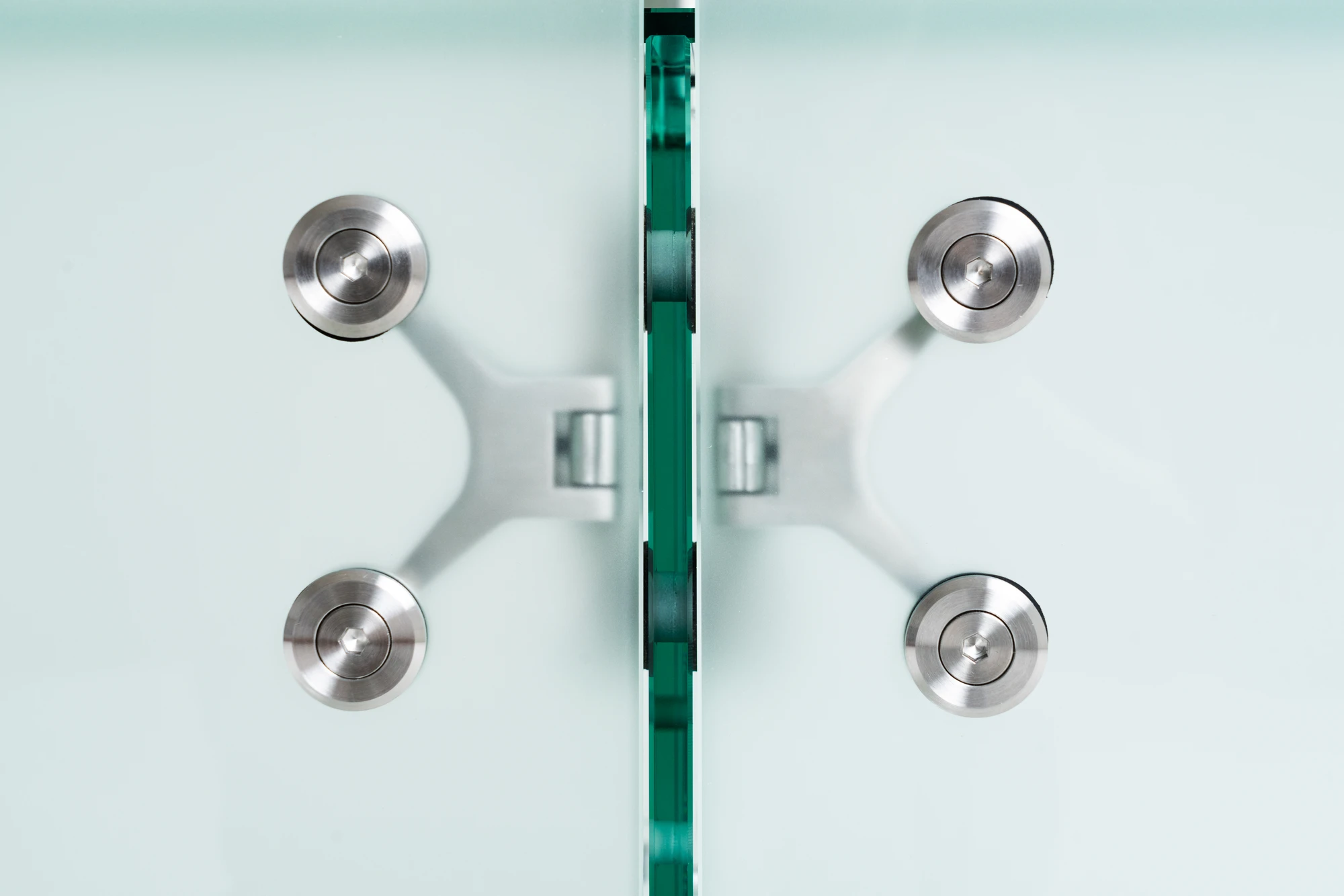
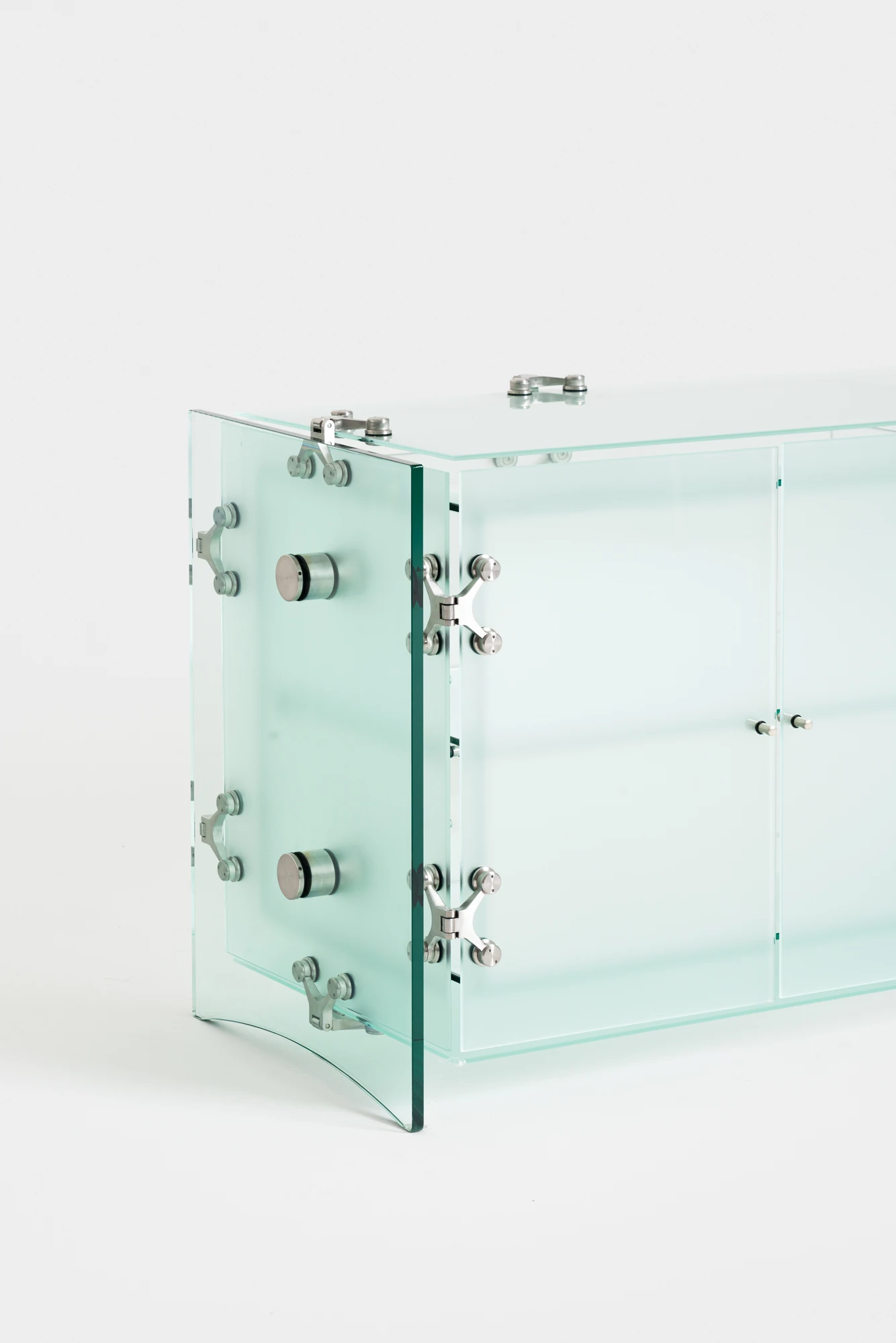
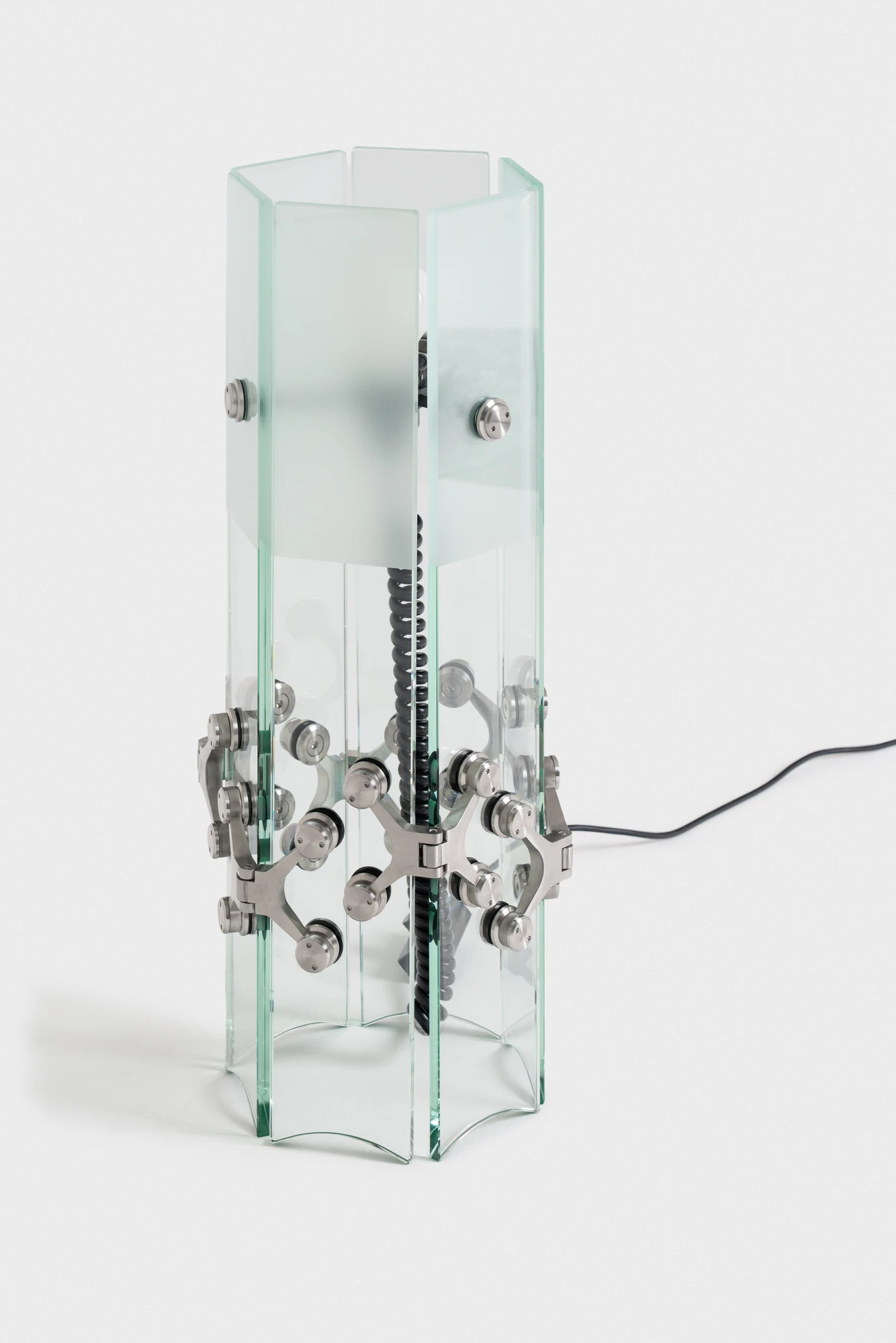
London-based designer Tino Seubert builds Ferric Glass around a single premise: toughened high-iron glass paired with stainless steel spider hinges from 1990s curtain-wall facades, repurposed at domestic scale.

The starting point was a commission, not a concept. A friend asked Tino Seubert to build a TV cabinet that could conceal the screen when not in use. Working with spider hinges, the kind deployed on glazed building facades, he built a piece of furniture that used them as both fixed and movable joints, placing them throughout the structure with what he describes as extravagance. That first object disclosed more than it resolved: the hinges and glass planes, Seubert realized, could function as a modular system generating three-dimensional form through CAD exploration. Ferric Glass followed from that moment.

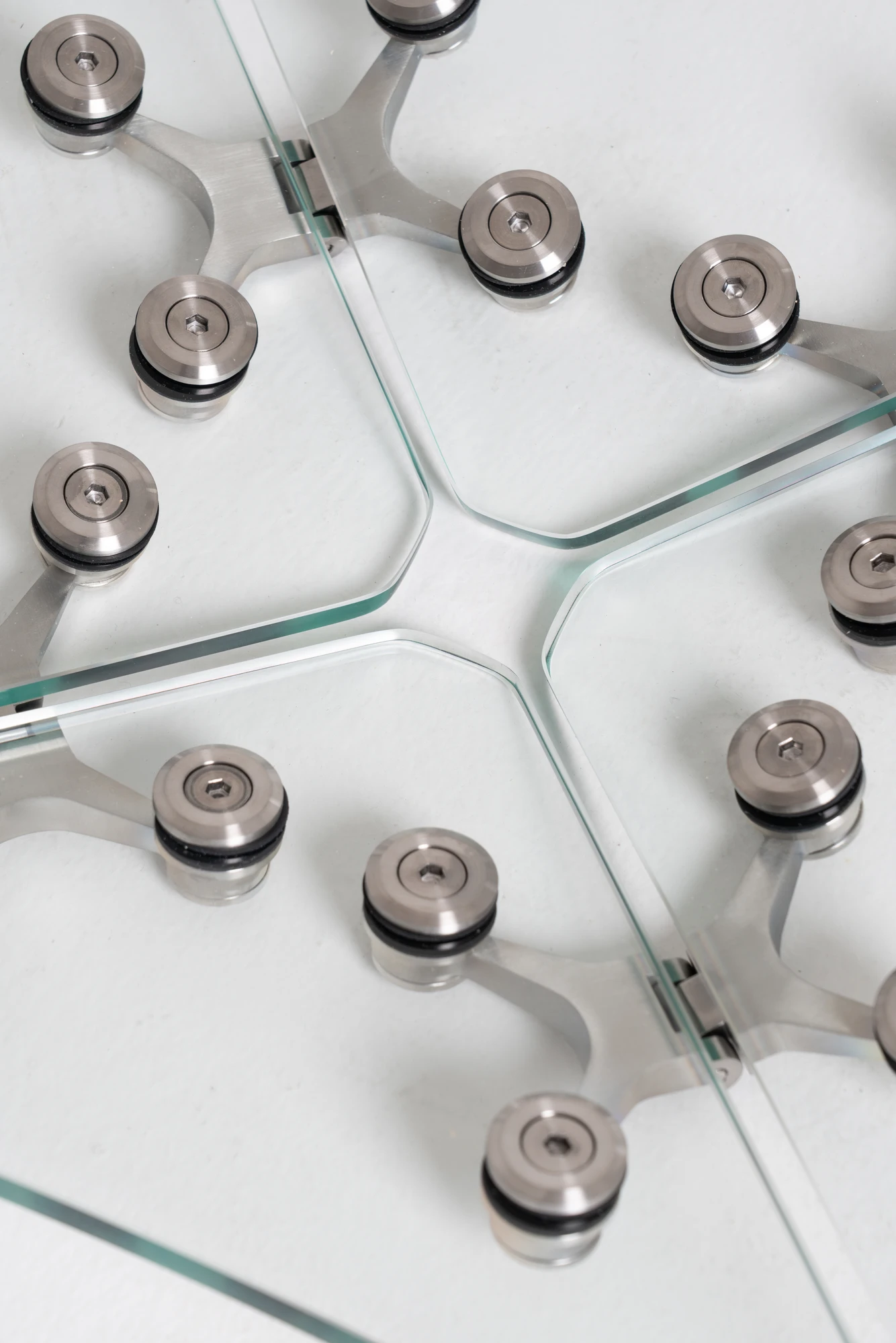
The glass that gives the collection its name is high-iron toughened glass, visually identifiable at its cut edges, which read deep forest green in cross-section. That tint comes from iron content in the batch, and the iron connects the glass to the hinges and to the hardware: one material element, three expressions. The production constraint is absolute. Toughened glass must have all holes drilled before tempering. Any error, a misplaced fixing, a misjudged tolerance, makes the entire sheet unusable. There is no repair. The piece is remade from the beginning.

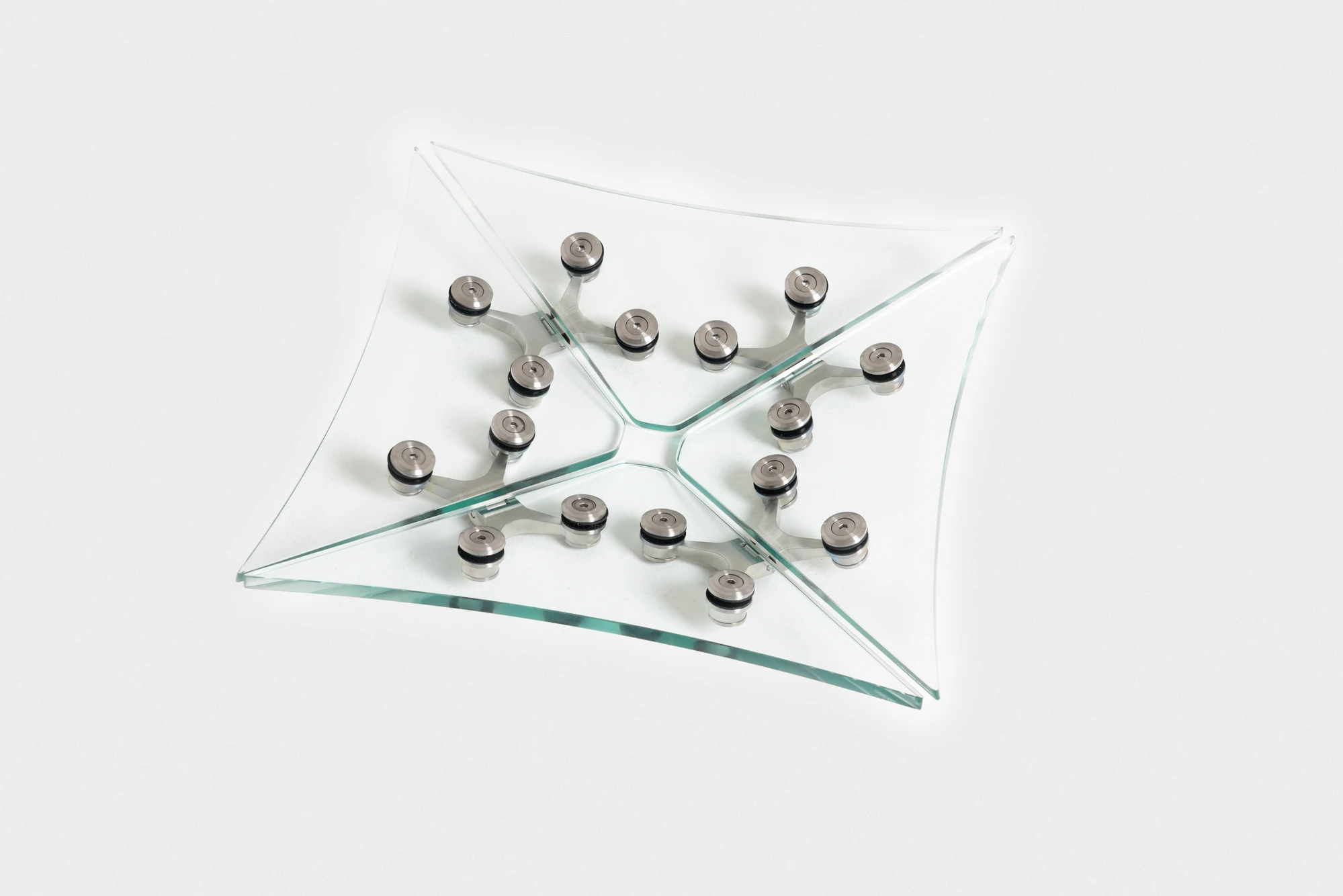
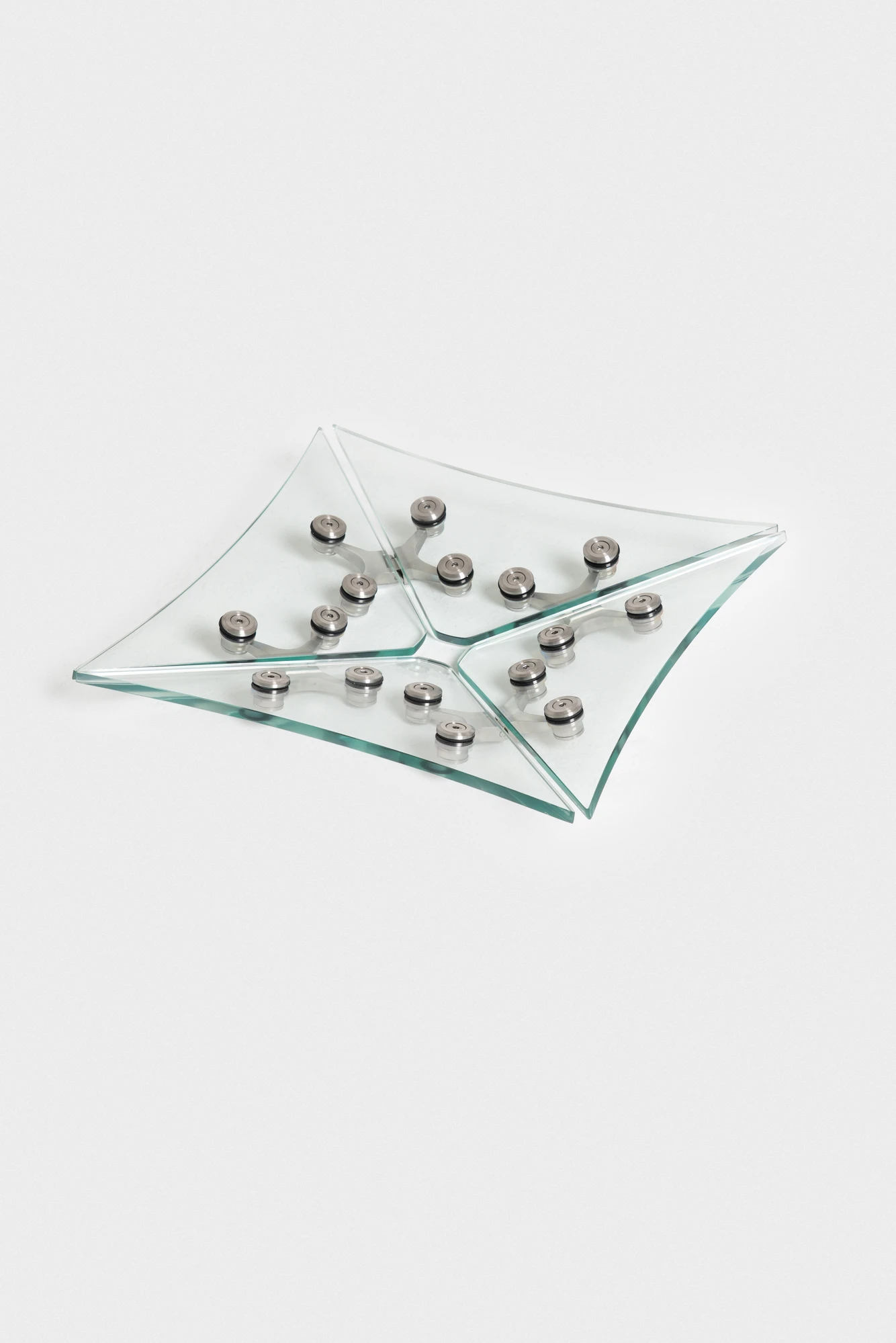
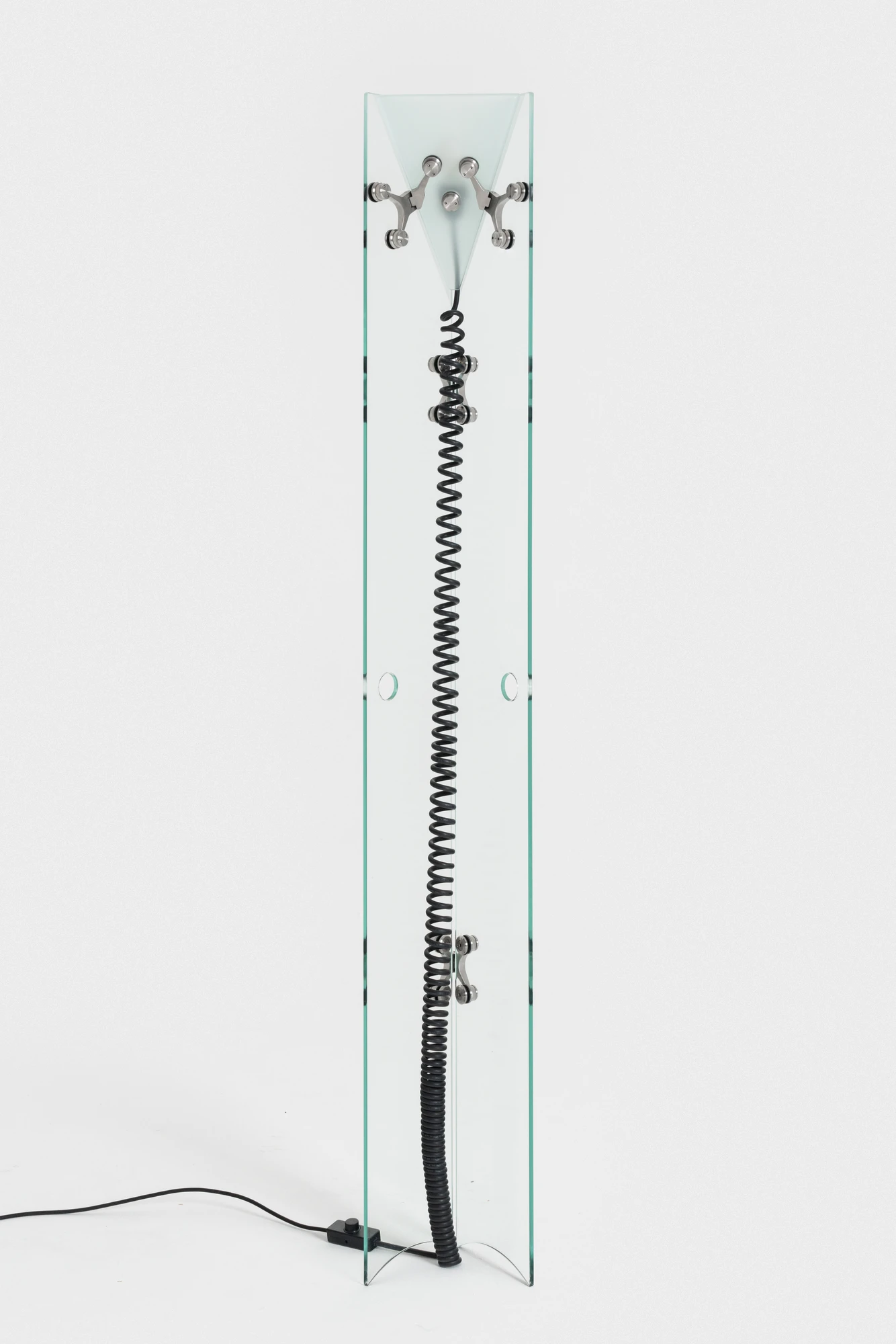
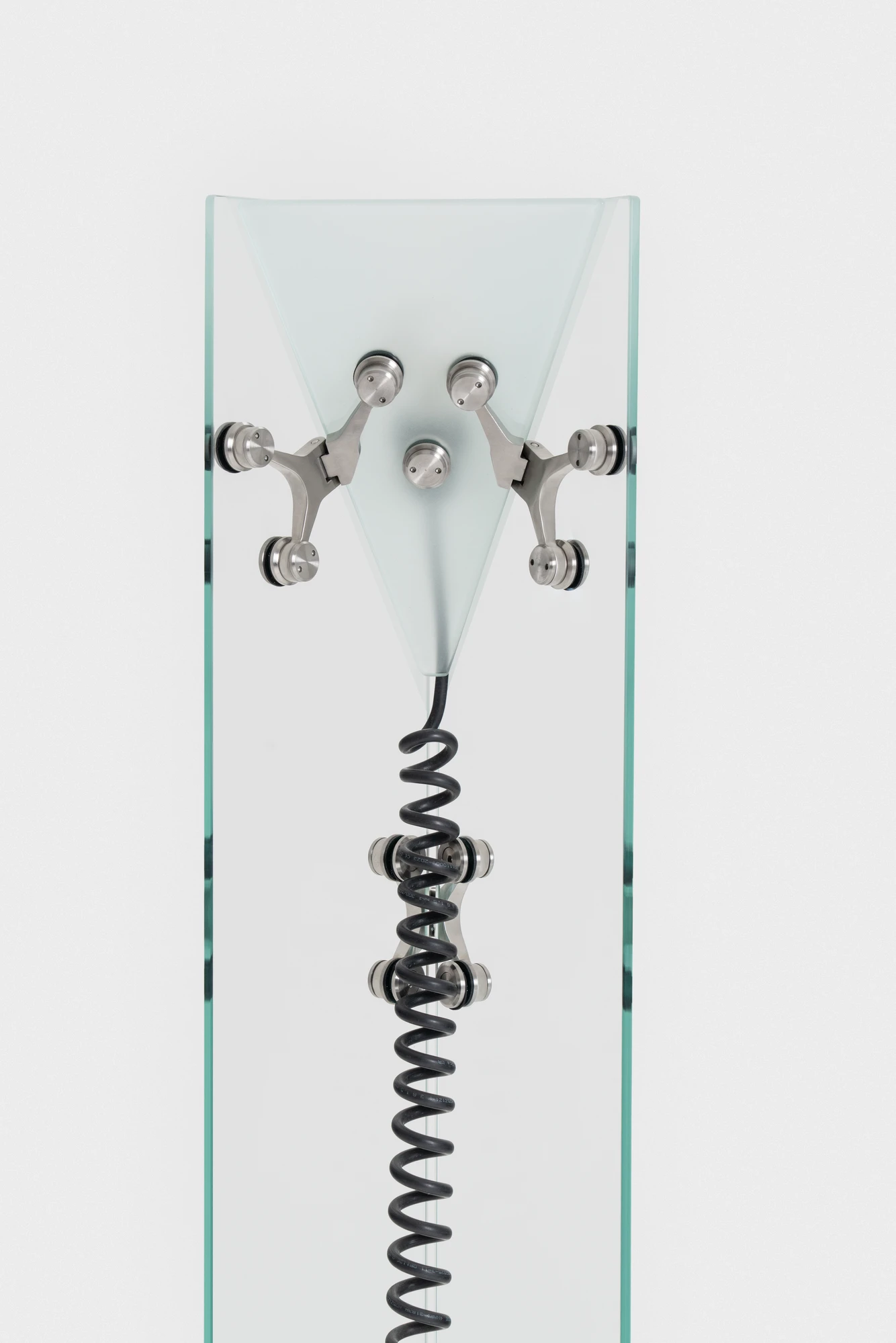
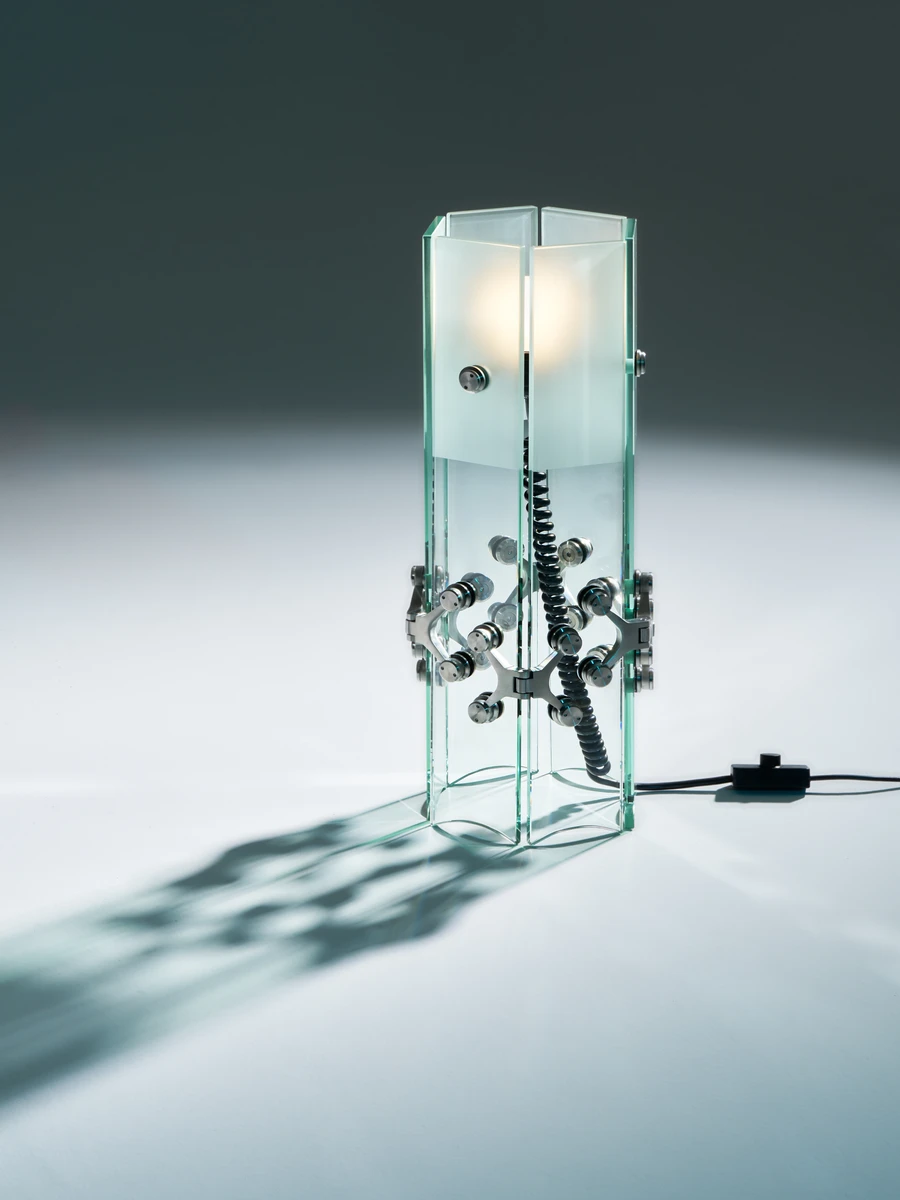
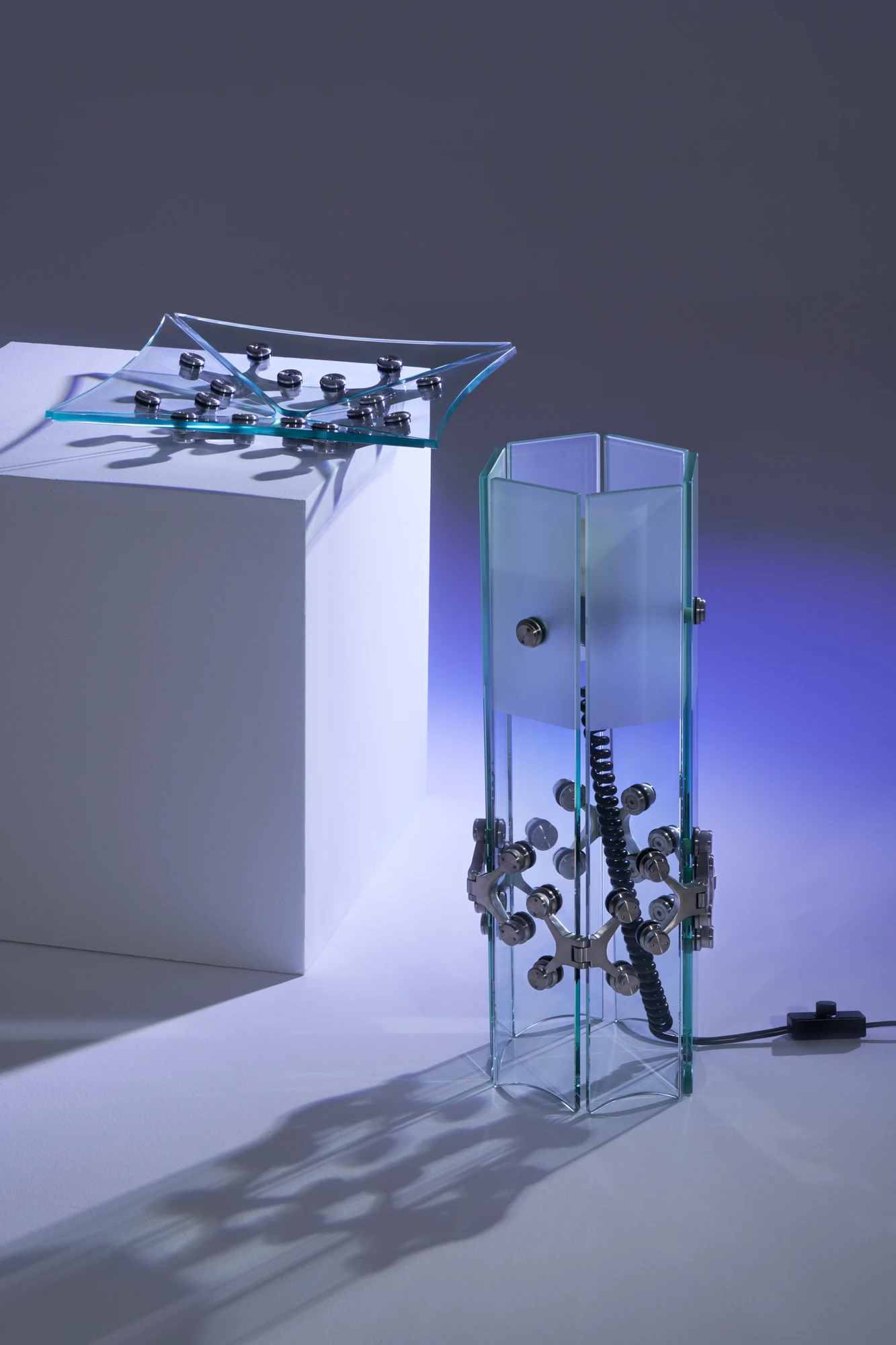
The table lamp in the photographs is a hexagonal assembly of high-iron panels joined with four-arm spider hinges and coil spring connectors. In the studio shot, an internal light source illuminates the frosted upper panels while the lower hardware throws a shadow pattern across a pale grey ground, a corona of radiating hinge-arm shapes projected outward. The bowl is four curved triangular panels meeting at a diamond point, each junction managed by the same hardware system.

Seubert has introduced other materials over the course of the collection. Travertine and onyx replaced glass in some bowls; smoked glass and gold-plated hinges extended the palette. These expansions tested the internal logic of the system against new material registers, and the most recent work returns to the original premise of industrial glass and stainless steel. The sideboard is the clearest version of that return: form and engineering inseparable, the design decisions and the structural decisions the same decision.

Seubert's earlier practice involved wicker and anodised aluminium furniture, shown at the Hepworth Wakefield in 2018. That work made similar arguments about the relationship between organic materials and industrial components. Ferric Glass tightens the proposition considerably: there is no organic material here, only degrees of industrial process, from the curtain-wall hinge to the pre-drilled toughened sheet.

Interested in Showcasing Your Work?

If you would like to feature your works on Thisispaper, please visit our Submission page and sign up to Thisispaper+ to submit your work. Once your submission is approved, your work will be showcased to our global audience of 2 million art, architecture, and design professionals and enthusiasts.
No items found.
We love less
but there is more.
Become a Thisispaper+ member today to unlock full access to our magazine, advanced tools, and support our work.
Get two months FREE
with annual subscription
We love less
but there is more.
Become a Thisispaper+ member today to unlock full access to our magazine, advanced tools, and support our work.
Get two months FREE
with annual subscription
No items found.
Alexander Zaxarov
May 6, 2026

London-based designer Tino Seubert builds Ferric Glass around a single premise: toughened high-iron glass paired with stainless steel spider hinges from 1990s curtain-wall facades, repurposed at domestic scale.

The starting point was a commission, not a concept. A friend asked Tino Seubert to build a TV cabinet that could conceal the screen when not in use. Working with spider hinges, the kind deployed on glazed building facades, he built a piece of furniture that used them as both fixed and movable joints, placing them throughout the structure with what he describes as extravagance. That first object disclosed more than it resolved: the hinges and glass planes, Seubert realized, could function as a modular system generating three-dimensional form through CAD exploration. Ferric Glass followed from that moment.

The glass that gives the collection its name is high-iron toughened glass, visually identifiable at its cut edges, which read deep forest green in cross-section. That tint comes from iron content in the batch, and the iron connects the glass to the hinges and to the hardware: one material element, three expressions. The production constraint is absolute. Toughened glass must have all holes drilled before tempering. Any error, a misplaced fixing, a misjudged tolerance, makes the entire sheet unusable. There is no repair. The piece is remade from the beginning.

The table lamp in the photographs is a hexagonal assembly of high-iron panels joined with four-arm spider hinges and coil spring connectors. In the studio shot, an internal light source illuminates the frosted upper panels while the lower hardware throws a shadow pattern across a pale grey ground, a corona of radiating hinge-arm shapes projected outward. The bowl is four curved triangular panels meeting at a diamond point, each junction managed by the same hardware system.

Seubert has introduced other materials over the course of the collection. Travertine and onyx replaced glass in some bowls; smoked glass and gold-plated hinges extended the palette. These expansions tested the internal logic of the system against new material registers, and the most recent work returns to the original premise of industrial glass and stainless steel. The sideboard is the clearest version of that return: form and engineering inseparable, the design decisions and the structural decisions the same decision.

Seubert's earlier practice involved wicker and anodised aluminium furniture, shown at the Hepworth Wakefield in 2018. That work made similar arguments about the relationship between organic materials and industrial components. Ferric Glass tightens the proposition considerably: there is no organic material here, only degrees of industrial process, from the curtain-wall hinge to the pre-drilled toughened sheet.
Interested in Showcasing Your Work?

If you would like to feature your works on Thisispaper, please visit our Submission page and subscribe to Thisispaper+. Once your submission is approved, your work will be showcased to our global audience of 2 million art, architecture, and design professionals and enthusiasts.
No items found.

Join Thisispaper+
Unlock access to 2500 stories, curated guides + editions, and share your work with a global network of architects, artists, writers and designers who are shaping the future.
Get two months FREE
with annual subscription
Travel Guides
Immerse yourself in timeless destinations, hidden gems, and creative spaces—curated by humans, not algorithms.
Explore All Guides +
Submission Module
Submit your project and gain the chance to showcase your work to our worldwide audience of over 2M architects, designers, artists, and curious minds.
Learn More+
Curated Editions
Dive deeper into carefully curated editions, designed to feed your curiosity and foster exploration.
Off-the-Grid
Jutaku
Sacral Journey
minimum
The New Chair
Explore All Editions +
Atlas
A new and interactive way to explore the most inspiring places around the world.
Interactive map
Linked to articles
300+ curated locations
Google + Apple directions
Smart filters
Subscribe to Explore+
Become a Thisispaper+ member today to unlock full access to our magazine, submit your project and support our work.
Join Thisispaper+Join Thisispaper+
€ 9 EUR
/month
Cancel anytime
Get two months FREE
with annual subscription