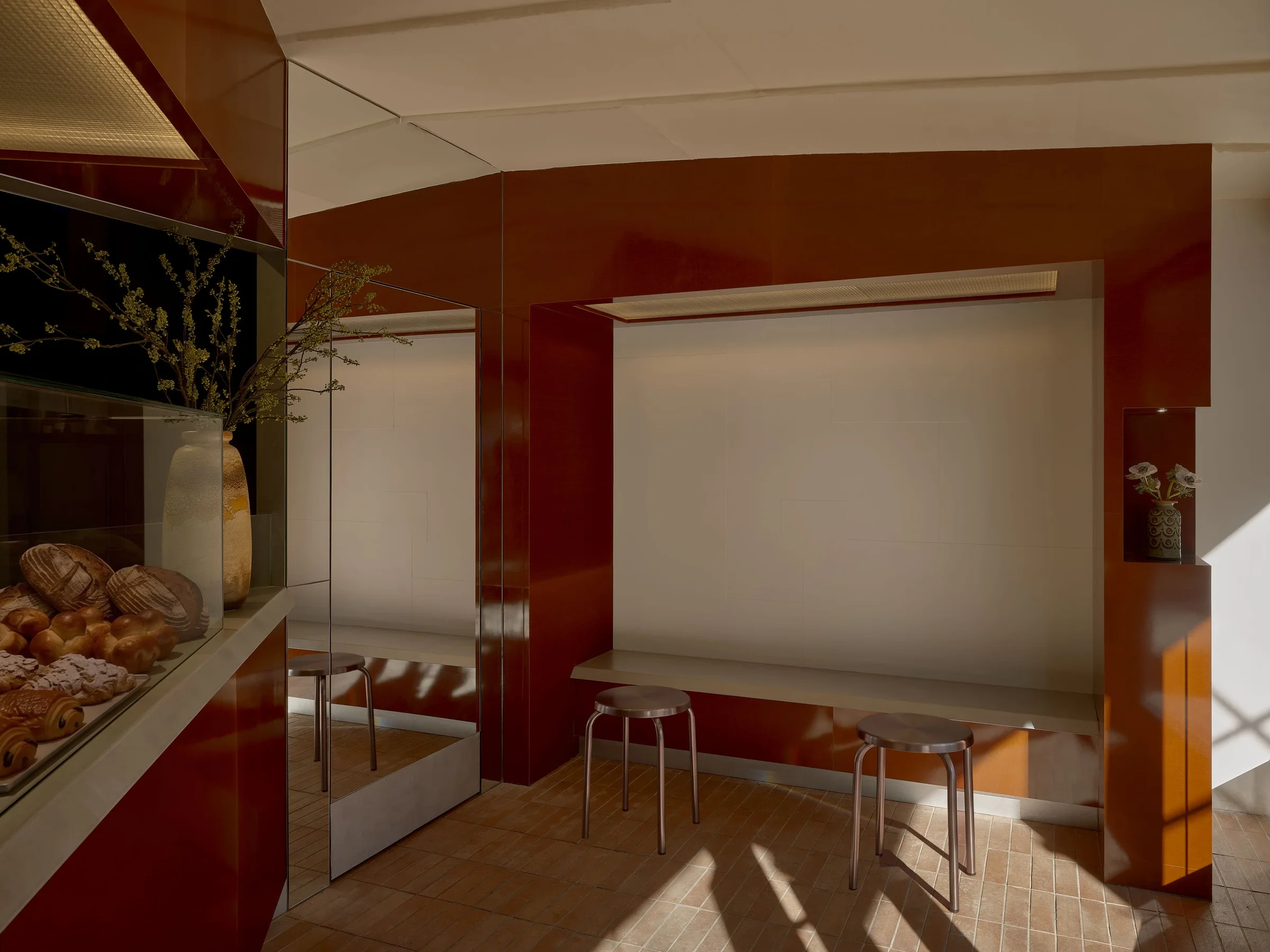
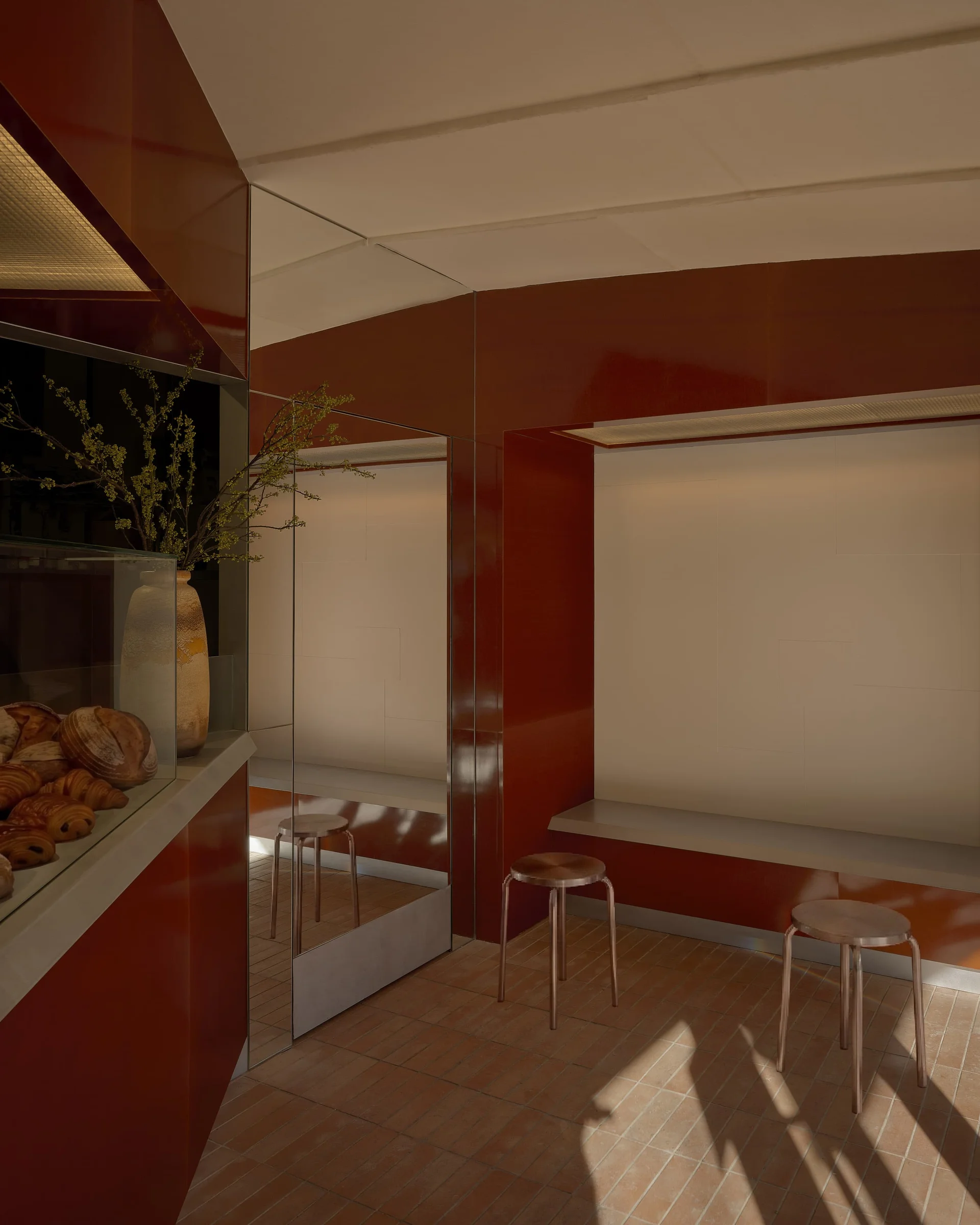
On a corner in Brooklyn Heights in New York, New Body designs Diljān Afghan Bakery, a narrow storefront where red garolite, brushed aluminum and Japanese handmade paper are gathered around the culture of Afghan bread.
Diljān opened this year on a quiet Brooklyn Heights street, the third project New Body has completed for the same client. The studio, led by Henry Lucien Barrett and Charles Dorrance-King and recently named to Architect's Newspaper's Twenty to Watch, has used the repeat brief to sharpen a house language. Here it reads at its most compressed, and most specific to the material it shows off, which is bread.
The footprint is small and cut on a diagonal. One line runs across the plan, peeling the public room away from the production space behind it. Mirrored surfaces on the dividing walls pull the street window deeper into the interior, while the depth of the garolite does the opposite, thickening the walls with a colour you want to touch. Front and back of house share air and light but never quite resolve into a single room.
The palette is borrowed from places outside hospitality. Counters and bench tops are brushed and waxed aluminum, set against overlapping white-painted steel panels. The millwork is faced in red garolite, a fibreglass laminate usually found in semiconductor tooling, here reading as a deep, warm red with a surface halfway between stone and resin. Floors are laid in terracotta brick in a tight running bond. Stools are raw stainless steel, stacked lightly against the walls.
Overhead, the ceiling is sheeted in Japanese handmade paper. The deckle edge has been folded down and left exposed, so the ragged boundary of each sheet becomes a repeated ornament instead of a flaw hidden behind trim. Elsewhere, standard egg-crate office ceiling tiles are reframed as diffused light panels, glowing gently above the benches. The utilitarian grid reads as intentional once it is surrounded by aluminum and red laminate and paper.
The bread sits in the middle of all this as the one warm biological thing in a room of cool, manufactured surfaces. A tall ceramic vessel of forsythia on the main counter, a small niche carved into a garolite wall holding anemones in a patterned Italian jar, a steel pastry rack half-visible through the glass vitrine. New Body lets a few handled objects do the work of softening a room that is otherwise almost entirely industrial.
The New Yorker covered Diljān in December as part of a piece on the city's current bread moment, and had previously written about Blue Hour, another project by the same owners. The stories tend to be about the loaves. The practice behind them, quietly worked out over three commissions, has not been published until now.