At management in New York, Belarusian artist Jura Shust presents Außerkörperliche Erfahrung: Wandering Spirit—a meditation on animism, technology, and ecological memory through discarded Christmas trees sealed in resin.
A wandering spirit leaves the vessel of an animistic being, drawn toward a new materialism. Through ritual, it gradually forgets its origin. It spins through a Christmas-tree plantation, repeating loops of growth and extraction, and slips into a parallel world. This is the cosmology of Jura Shust's exhibition at management—part sculpture, part moving image, part speculative theology—in which the boundary between the organic and the synthetic, the living and the archived, the spirit and the system begins to dissolve.
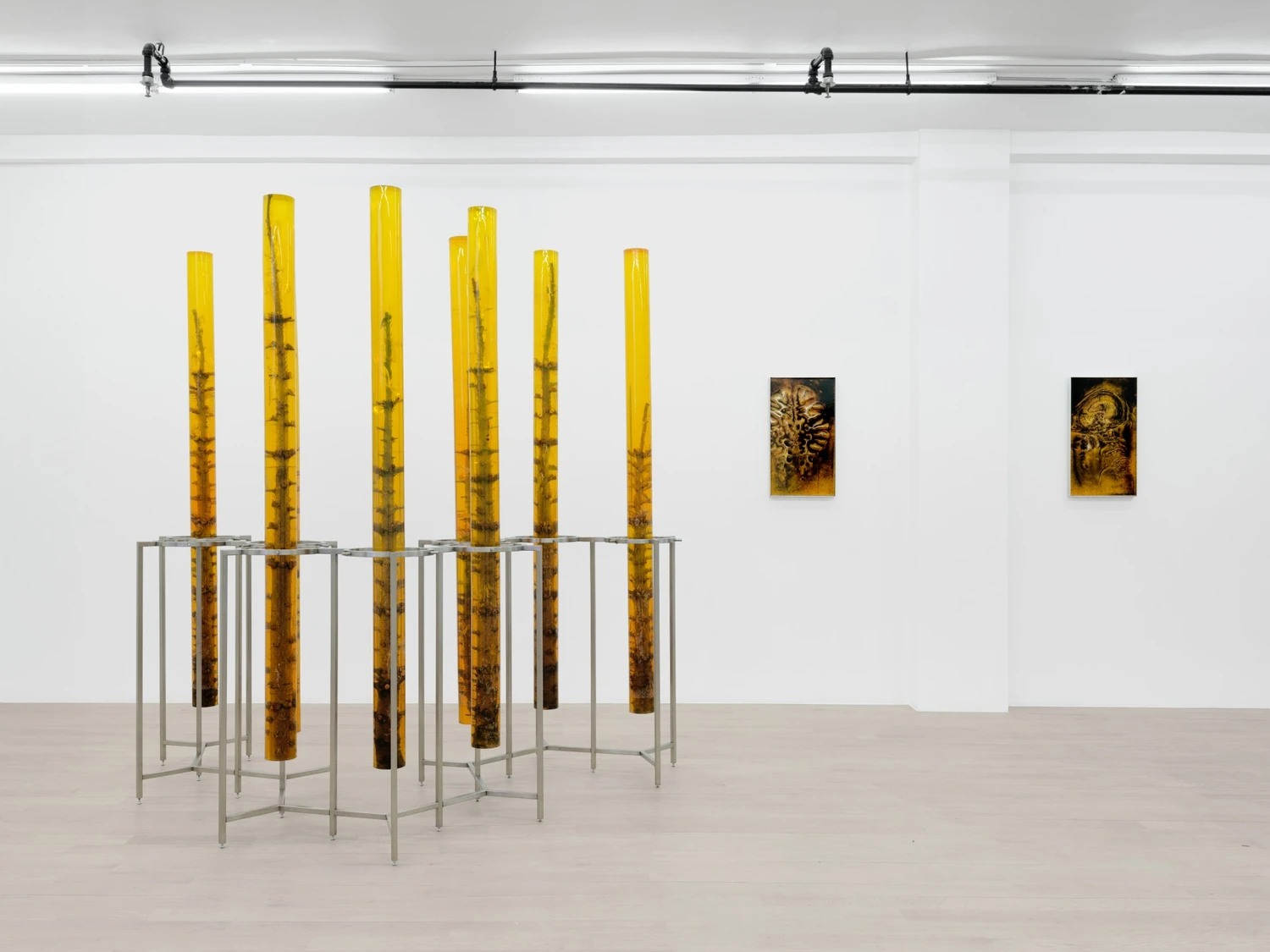
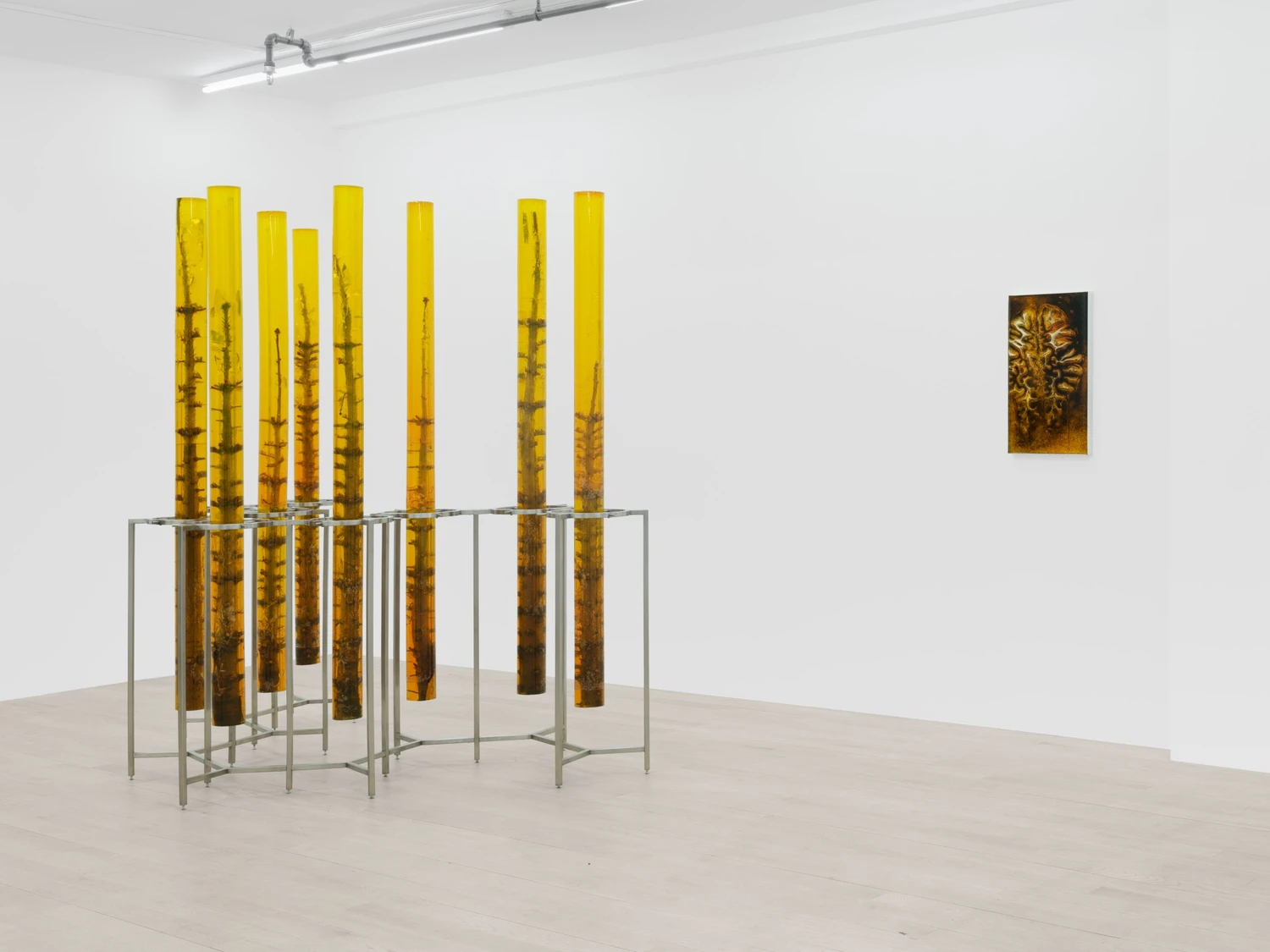
The central sculptural work, Leaving an Annual Growth at the Top: Succession (2024), comprises eight discarded Christmas trees whose branches are cut and whose trunks are encapsulated in synthetic amber. The gesture oscillates between care and exploitation, preservation and capture. After the festival, desecrated trees are collected from the streets; their branches are cut—"a gesture that once carried meaning, now repeated as an automated action." The cuts encrypt a message in a language that has been forgotten. Drawing on ancient Slavic tree-worship practices, the work references funerary cults and the concept of the sacred grove—a space that indigenous cultures of Northern and Eastern Europe perceived as a temple, a site of connection to a broader cosmology beyond human time.
The core video, eponymously titled Außerkörperliche Erfahrung, depicts this disembodied spirit as a digital consciousness. Neither human nor entirely artificial, the neural entity performs a ritual migration, transplanted from a Christmas tree farm to a cemetery in Berlin's Neukölln. What once belonged to animistic cosmologies now circulates through technological systems, carrying agency without a body. The cemetery becomes a database. The root system of the spruce spreads horizontally, close to the surface, and in a gust of wind, it is often the first to fall.
In a parallel register, the wall-based diptych Untitled (2024) presents digital consciousness as a hybrid of root system and neural network. Generated by prompting a large language model to define its own anatomy, the work is machine-sculpted from spruce wood, activated with black soil, and sealed in synthetic resin. A new series, Breath-filled glass crown (2025), extends this technique—here the LLM is trained to generate the architecture of a human mind through MRI images of the artist's brain, translating neurological activity into speculative structures.
The exhibition, toward a condition in which technology no longer functions as a tool but emerges as an autonomous agent integrated with natural systems. Shust draws on principles of ancient animism to ask a question that feels increasingly urgent: what happens when distinctions between the organic and the synthetic, the living and the archived, the spirit and the system are no longer useful?