Thisispaper Community
Join today.
Enter your email address to receive the latest news on emerging art, design, lifestyle and tech from Thisispaper, delivered straight to your inbox.
Oops! Something went wrong while submitting the form.
Instant access to new channels
The top stories curated daily
Weekly roundups of what's important
Original features and deep dives
Exclusive community features
No items found.
40 Portraits 2003–2008 by Gisèle Vienne
Alexander Zaxarov
Mar 5, 2026

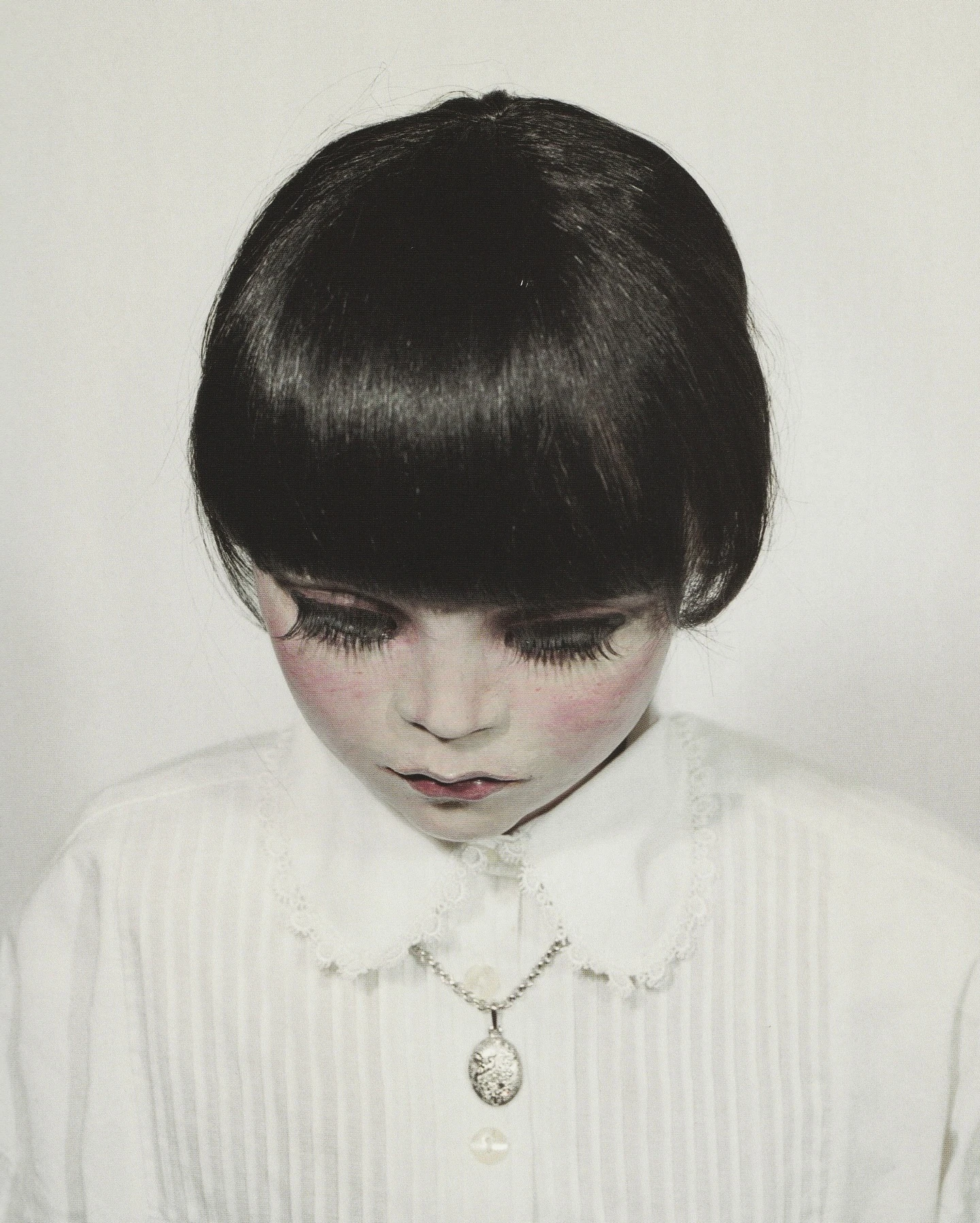
The faces in Gisèle Vienne's 40 Portraits (2003–2008) are not alive, and they know it. Pallor, glazed eyes, motionless mouths—sometimes bloodstained, sometimes tear-streaked—these are the silent faces of dolls the artist has been fabricating by hand since 2003, photographed here with the gravity usually reserved for human subjects.

Vienne is a visual artist, choreographer, stage director, and photographer whose theatrical works tour internationally, often in collaboration with the writer Dennis Cooper. Much of her work circles adolescents—teenagers in rupture, "martyrized by others as much as by themselves," as one text puts it—impenetrable figures who are nonetheless unprotected. Rather than using only live performers, she began building dolls and mannequins to populate her stage pieces. They are not inert props. They are presences—beings that, in this photographic series, step out of the theatre and stand before the camera as ambiguous, posing figures, somewhere between childhood and adulthood, between the living and the inanimate.

What you see are sad Lolitas, sometimes caked in heavy makeup, who shift across the series into androgynous beings and then into something closer to death. They "come to life in a teenage attitude, voices muffled—all clues hinting at a culture of violence, repressed yet haunting our myths of innocence and purity bathed in white." The philosopher Elsa Dorlin, writing about Vienne's dolls, puts it viscerally: "the color of anguish grabs us by the throat, twists our guts." You feel it. The whiteness of these faces is not purity. It is the color of something endured.

The trap of 40 Portraits is its complicity. You look at these dolls and you become a voyeur—but the voyeurism "becomes a trap for a direct confrontation with the scabrous object of our imagination." The dolls ask what they can tell us about ourselves. "What tales are told? Tales of defilement, of injury, dolls disfigured by indifference, desire, and salacious laughter." The exhibition, which accompanied Short Theatre 2022 throughout its entire duration, insists that you not look away.

In these forty handmade faces—each slightly different, each carrying its own particular damage—Vienne has built something rare: a body of art that addresses domination, suffering, and public shame while remaining hauntingly, unsettlingly beautiful. The boundary between the living and the inanimate collapses, and what remains is the unmistakable universe of an artist who has spent two decades making objects that refuse to be merely objects.

Interested in Showcasing Your Work?

If you would like to feature your works on Thisispaper, please visit our Submission page and sign up to Thisispaper+ to submit your work. Once your submission is approved, your work will be showcased to our global audience of 2 million art, architecture, and design professionals and enthusiasts.
No items found.
We love less
but there is more.
Become a Thisispaper+ member today to unlock full access to our magazine, advanced tools, and support our work.
Get two months FREE
with annual subscription
We love less
but there is more.
Become a Thisispaper+ member today to unlock full access to our magazine, advanced tools, and support our work.
Get two months FREE
with annual subscription
No items found.
Alexander Zaxarov
Mar 5, 2026

The faces in Gisèle Vienne's 40 Portraits (2003–2008) are not alive, and they know it. Pallor, glazed eyes, motionless mouths—sometimes bloodstained, sometimes tear-streaked—these are the silent faces of dolls the artist has been fabricating by hand since 2003, photographed here with the gravity usually reserved for human subjects.

Vienne is a visual artist, choreographer, stage director, and photographer whose theatrical works tour internationally, often in collaboration with the writer Dennis Cooper. Much of her work circles adolescents—teenagers in rupture, "martyrized by others as much as by themselves," as one text puts it—impenetrable figures who are nonetheless unprotected. Rather than using only live performers, she began building dolls and mannequins to populate her stage pieces. They are not inert props. They are presences—beings that, in this photographic series, step out of the theatre and stand before the camera as ambiguous, posing figures, somewhere between childhood and adulthood, between the living and the inanimate.

What you see are sad Lolitas, sometimes caked in heavy makeup, who shift across the series into androgynous beings and then into something closer to death. They "come to life in a teenage attitude, voices muffled—all clues hinting at a culture of violence, repressed yet haunting our myths of innocence and purity bathed in white." The philosopher Elsa Dorlin, writing about Vienne's dolls, puts it viscerally: "the color of anguish grabs us by the throat, twists our guts." You feel it. The whiteness of these faces is not purity. It is the color of something endured.

The trap of 40 Portraits is its complicity. You look at these dolls and you become a voyeur—but the voyeurism "becomes a trap for a direct confrontation with the scabrous object of our imagination." The dolls ask what they can tell us about ourselves. "What tales are told? Tales of defilement, of injury, dolls disfigured by indifference, desire, and salacious laughter." The exhibition, which accompanied Short Theatre 2022 throughout its entire duration, insists that you not look away.

In these forty handmade faces—each slightly different, each carrying its own particular damage—Vienne has built something rare: a body of art that addresses domination, suffering, and public shame while remaining hauntingly, unsettlingly beautiful. The boundary between the living and the inanimate collapses, and what remains is the unmistakable universe of an artist who has spent two decades making objects that refuse to be merely objects.

Interested in Showcasing Your Work?

If you would like to feature your works on Thisispaper, please visit our Submission page and subscribe to Thisispaper+. Once your submission is approved, your work will be showcased to our global audience of 2 million art, architecture, and design professionals and enthusiasts.
No items found.

Join Thisispaper+
Unlock access to 2500 stories, curated guides + editions, and share your work with a global network of architects, artists, writers and designers who are shaping the future.
Get two months FREE
with annual subscription
Travel Guides
Immerse yourself in timeless destinations, hidden gems, and creative spaces—curated by humans, not algorithms.
Explore All Guides +
Submission Module
Submit your project and gain the chance to showcase your work to our worldwide audience of over 2M architects, designers, artists, and curious minds.
Learn More+
Curated Editions
Dive deeper into carefully curated editions, designed to feed your curiosity and foster exploration.
Off-the-Grid
Jutaku
Sacral Journey
minimum
The New Chair
Explore All Editions +
Atlas
A new and interactive way to explore the most inspiring places around the world.
Interactive map
Linked to articles
300+ curated locations
Google + Apple directions
Smart filters
Subscribe to Explore+
Become a Thisispaper+ member today to unlock full access to our magazine, submit your project and support our work.
Join Thisispaper+Join Thisispaper+
€ 9 EUR
/month
Cancel anytime
Get two months FREE
with annual subscription